

Back To The Social Welfarist Called “Baba Kekere” Alhaji Lateef Jakende
GODKNOWS IGALI
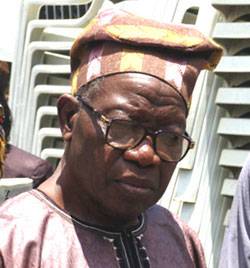
Few Nigerian statesmen have in the country’s history received the amount of adulation and accolades as ace journalist, Alhaji Lateef Jakande, who governed Lagos State, the country economic nerve centre from 1979 to 1983. Often known simply by his initials LKJ, this former Nigerian Minister of Works, unlike many other politicians whose life works are only eulogized posthumously, has become the veritable centre point of good governance and quintessence of public service. In his honour, the Nigerian Guild of Editors (NGE) commenced the maiden Annual Lecture Series on August 7, 2023.
HOW LIFE STARTED
3. In his media work, he became greatly fascinated by the larger than life profile and politics of Chief Obafemi Awolowo, who founded the Action Group, a political party in 1951. By 1953, Jakande joined the “Nigerian Tribune Newspaper”, which was established in 1949 by Chief Awolowo and became the visible mouth piece of the sage’s political structure and ideology. Gradually, he rose to become the Editor-in-Chief of this major national newspaper in 1956. It later became a life-long career of nearly 22 years of dutiful service to his mentor, Chief Awolowo during his high and low tides in politics. What upped his journalistic image was the fact that The Tribune newspaper under LKJ’s stewardship became popular for its very objective and fearless reportage. Despite the fact that for much of the time his political principal was in the opposition, he earned for the paper and for himself respect on the quality of his editorials. Till date, against the backdrop of the foundation which he laid, The Tribune is not only Nigeria’s oldest private newspaper in existence but has fledged on as the leading newsprint of preference in some sections of Nigeria.
4. During his brief exit from the Tribune, he established a printing outfit, which came up with a new product “The Lagos News”. He also served at a time as the first President of Newspaper Proprietors Association of Nigeria (NPAN) and the Guild of Editors. LKJ was also credited a one of the brains behind the strengthening of Nigerian Union of Journalist (NUJ) and the establishment of Nigerian Institute of Journalism (NIJ) at Ogba in Ikeja, Lagos State.
FROM THE PEN TO AGBADA
STERLING PERFORMANCE AND IMPACT
7. With respect to tertiary education, he went on to establish, Lagos State College of Education and the Lagos State University (LASU) in 1983. With a population of about 34,000 students today, LASU has grown to be amongst the main universities in Nigeria. Aside from that, LASU has become a leading centre for research and innovation and was at several times amongst the ten best in Nigeria’s two hundred universities.
8. In the area of Mass Housing, Jakande built about 30,000 units of houses around the state within a span of four years. He also flagged off the construction of the Onikan Stadium, now one of the country’s main recreational landmarks. In his own constituency, that is the world of mass media, Governor Jakande started both the Lagos State Radio and Lagos Television in 1980 and both media outfits are still making very remarkable impact in electronic broadcasting in Nigeria.
9. Another area of great impact, which he created was in public transportation. He opened up the entire state, especially Lagos metropolis, to affordable transport connectivity. This included marine transport services, taking advantage of the state’s riverine environment. Foreseeing the imminent population explosion in Lagos, which had maintained a steady growth rate of about 6.3% and heading into a megacity status, he started a “metro line” mass transport project. Although the city was the nation’s capital at the time, he did not wait for Federal authorities, but went ahead to embark on this massive project. Sadly, since his exit for office, 40 years ago, the metro line was largely abandoned and the city continues to groan under the burden of great transport congestions.
THE SPECTACULAR NATIONAL FOOTPRINT
11. He was not successful in his second foray into politics during the return of Nigeria to democratic rule in 1999, perhaps due to his erstwhile close relationship with Abacha. However, he later became a senior member of All Nigerian Peoples Party (ANPP). As the political processes kept evolving, he helped to form and became first Chairman of the Action Party of Nigeria (APN) in 2006. The political party did not however, make much impact in the political arena despite its contributions in politics and governance in the Second Republic.
CONCLUSION
13. At a critical time in the country’s political evolution when the worth and value of true heroism remains evasive like a mirage, the life of such an outstanding character will no doubt be missed. However, the story of his life’s journey and the impact of his works, which we all see around, will continue to inspire succeeding generations of Nigerians to surpass his achievements.
– Godknows Igali, PhD is a former Ambassador and retired Federal Permanent Secretary. Currently Alternate Chairman, Committee of Pro-Chancellors of Nigerian Universities, First Vice President, Academy of International Affairs of Nigeria. (Igalibuea@yahoo.com)
Related posts