

Of Yusuf Tuggar And Nigeria’s Assertive Return To Global Relevance
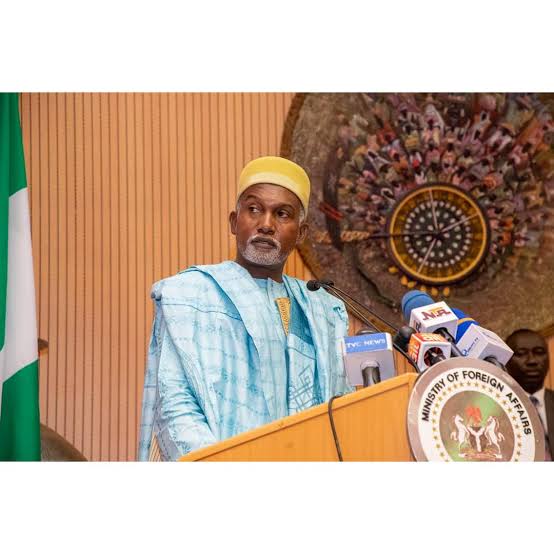
For Yusuf Tuggar, the Minister of Foreign Affairs, every day presents an opportunity to redefine Nigeria’s place in the global order; and for him, it is a task that begins with clarity of purpose and relentless commitment.
Interestingly, Tuggar, who is tasked with managing one of the most demanding portfolios in government, has approached his role with focus, energy, and a deep understanding of the responsibilities it entails.
His appointment was definitely not accidental. When President Bola Tinubu needed a capable hand to steer Nigeria’s foreign policy, Tuggar’s name featured prominently owing largely to his solid professional pedigree and a reputation for strategic thinking.
Indeed, his emergence as the Foreign Affairs Minister reflected a deliberate choice aimed at repositioning Nigeria diplomatically.
Since he assumed office, Tuggar has worked steadily to recalibrate Nigeria’s international image, countering longstanding negative narratives with deliberate engagement and assertive diplomacy.
Like a skilled surgeon in an operating theatre, he has applied precision, tact, and discipline in navigating sensitive bilateral and multilateral relations.
No doubt, at a time when Nigeria is grappling with multiple diplomatic pressures, including international concerns over alleged Christian persecution, Tuggar’s leadership is being tested in real time.
However, amid criticism and scrutiny, he has remained composed; he views opposition as part of the burden of leadership rather than a deterrent.
Specifically, his assertiveness came to the fore when he openly rejected suggestions by the American government to deport Venezuelan gang members to Nigeria.
To say he was unequivocal is to put it mildly. He insisted that Nigeria would not serve as a dumping ground for criminals from other countries.
Aside this, he has also drawn global attention over his reactions to the restrictive U.S. visa policies, describing them as unfair and inconsistent with the principles of mutual respect.
He has instead advocated for balanced partnerships and equitable trade relations, and rejected arrangements tilted toward one-sided advantage.
Observers of the global diplomacy have confirmed that Tuggar’s influence extends beyond his official title, as he embodies a blend of courage and foresight that has helped Nigeria reassert itself in key international conversations.
Under his watch, Nigeria has now become more visible and vocal in global fora, thereby reclaiming relevance and diplomatic confidence.
Unlike some others, his approach is marked by substance rather than spectacle. Through well-articulated presentations at elite international gatherings, firm lobbying efforts, and thoughtful interviews with reputable global media outlets, Tuggar has consistently projected Nigeria as a serious and responsible actor on the world stage.
He has also demonstrated that he loathes unnecessary praise; he rather loves to see the results of his efforts speak for him.
In his view, respect is earned only through competence and delivery rather than theatrics.
Though the outgoing year has been marked by intense diplomatic challenges, Tuggar’s work has not gone unnoticed. In 2025, he received the BusinessDay Excellence in Public Service Award, recognizing outstanding performance among public officials.
Earlier, Street Journal Magazine, an Ireland-based publication, named him the Best Minister in the current administration.
Indeed, in the current political dispensation, Tuggar stands out as one of the few appointees whose career reflects consistency, strategic timing, and bold decision-making, qualities that continue to shape Nigeria’s evolving diplomatic posture.
Related posts