


What The BudgIT Q3 2025 Fiscal Transparency Ranking Says About Anambra Under Soludo
OBINNA JOSEPH
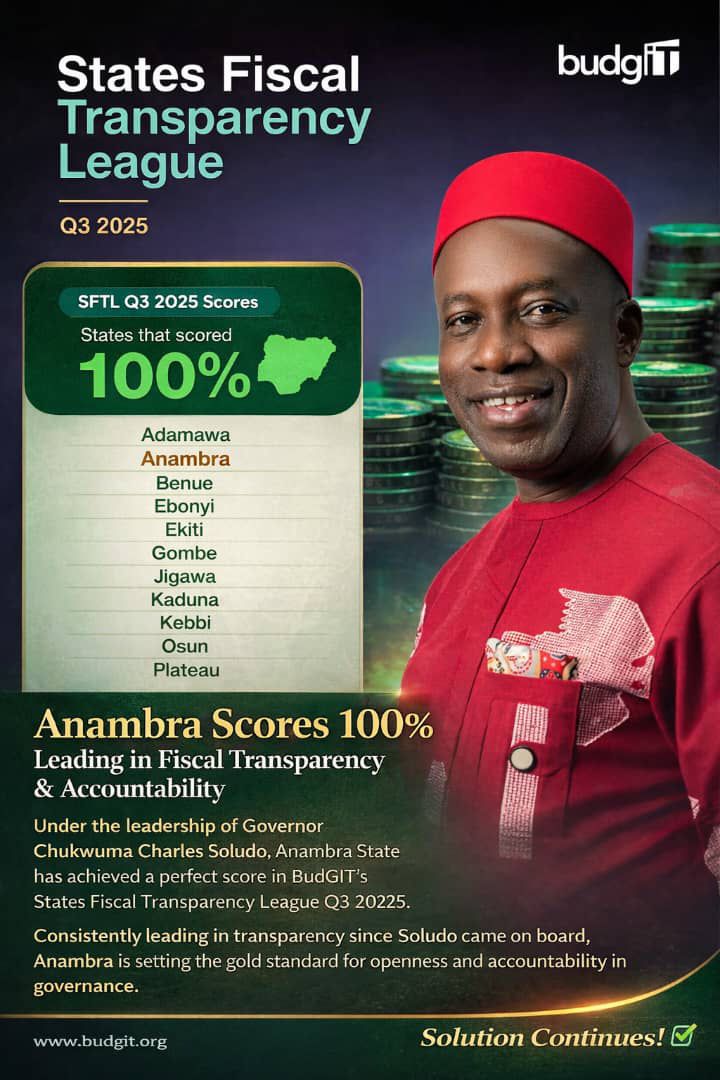
The release of the 2025 Q3 States Fiscal Transparency League Table by BudgIT Nigeria is more than a scorecard. It is now a pattern, it is a credibility test—one that measures how honestly governments open their books to the people they govern.
In that test, Anambra State scored 100%.
Not once, Not by accident.
But consistently—since the coming on board of Oluatuegwu.
In Q3 2025, only eleven states (2 from South East) across the federation attained a perfect score, based on the availability, timeliness, and completeness of key fiscal documents; the functionality of e-procurement portals; and the accessibility of state fiscal data repositories. Anambra stood firmly among this elite group. That outcome tells a deeper story about leadership, philosophy, and governance culture.
Transparency, in truth, is not a public-relations choice; it is a governing principle. Fiscal openness is one of the hardest reforms to sustain because it strips power of discretion, secrecy, and arbitrariness. Governments that embrace it do so not for applause, but because they understand that trust is the strongest currency of governance.
Under Soludo, Anambra’s public finance system reflects a deliberate mindset. Budgets are no longer hidden documents; they are public contracts. Procurement is not opaque; it is trackable and competitive. Fiscal data is not restricted; it is accessible. This did not happen by chance. It flows naturally from the governing instinct of a professor of international repute and an economist of the highest grade—one who understands that markets, institutions, and societies function best where information is open, rules are predictable, and systems outlive personalities.
What does this say about Soludo’s leadership?
First, it confirms competence. You do not run a transparent fiscal system by rhetoric. You do so with systems, rules, and discipline.
Second, it establishes legitimacy. When a government consistently opens its financial records, it sends a clear signal: we have nothing to hide.
Third, it builds investor and citizen confidence. Investors look for predictable rules; citizens look for accountable leadership. Transparency satisfies both.
Fourth, it affirms the wisdom of Anambra’s choice. Electing a professor of economics was not symbolism; it was a strategic decision—to place the state’s finances and future in the hands of someone trained to think structurally, not impulsively.
Anambra’s sustained leadership in this league since Soludo took office is proof that intellectual depth can translate into administrative excellence, and imagination become reality.
Beyond rankings, fiscal transparency matters because it directly affects how efficiently public funds are spent, how corruption is prevented rather than merely punished, how development projects are tracked and completed, and how citizens trust government decisions. ..
A transparent government spends less time on excuses and more time delivering outcomes. This is what Odinigbo is doing.
It is also instructive that BudgIT’s report highlights persistent gaps in other states—especially in budget implementation reporting and procurement transparency. These gaps weaken accountability. Anambra’s performance shows that such gaps are not inevitable; they are a choice.
Yet transparency achieves its full value only when citizens engage responsibly with it. Ndi Anambra—particularly civil and public servants—also have roles to play: demanding accountability through facts, not rumors; protecting procurement and budget processes from political sabotage; and sustaining a culture of civic maturity.
When citizens read, question, monitor, and respect public finance processes, transparency becomes a living system, not just a policy statement.
Finally, the BudgIT Q3 2025 Fiscal Transparency ranking says something profound about Anambra. The state did not merely vote for a governor; it voted for a governing philosophy—one where openness replaces opacity, systems matter more than slogans, and leadership is grounded in knowledge rather than emotional manipulation and noise.
Anambra can be proud—not only of the ranking, but of the choice it made. The evidence is now written clearly, quarter after quarter, in the public record.
Solution continues
with Honesty and verifiable report card filled with Evidence and Great LEGACIES.
Obinna Joseph
(Obinna Orumba)
Related posts