


Critical Review: Eze Aro’s Historic Address At UC Berkeley, USA
ERNIE ONWUMERE
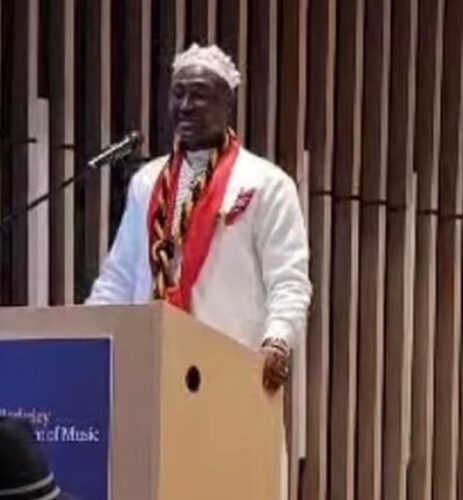
“Reclaiming African Civilizational Voices: The Arochukwu Renaissance and the Future of Indigenous Knowledge in a Global Information Age.”
Executive Summary.
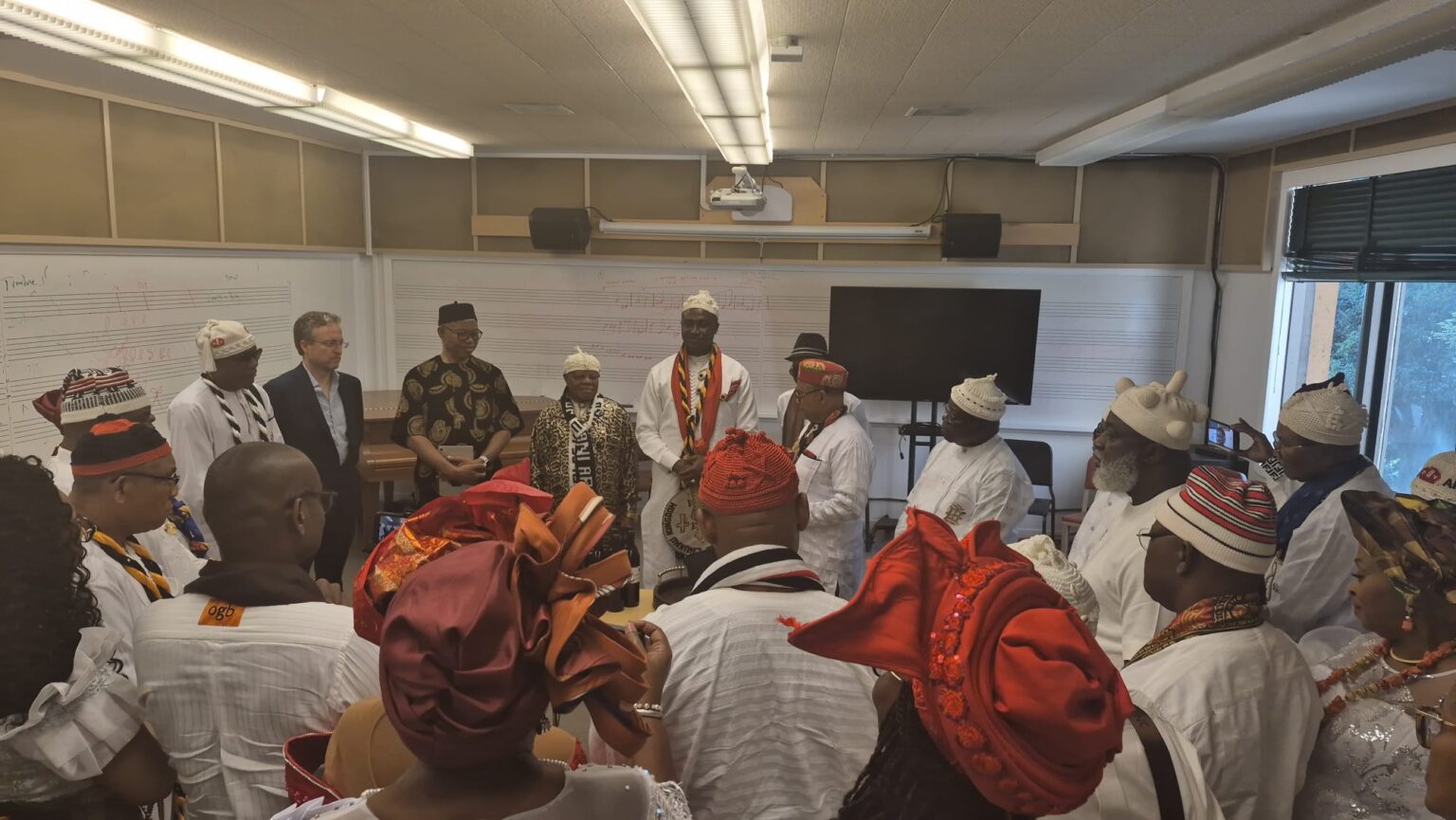
Earlier this year, His Eminence, Dr. Eberechukwu Oji, Eze Aro of the Ancient Kingdom of Arochukwu, delivered a landmark lecture at the University of California, Berkeley titled ‘Reclaiming African Civilizational Voices: The Arochukwu Renaissance and the Future of Indigenous Knowledge in a Global Information Age.’ The lecture was not some ceremonial diplomacy dressed in academic language; it was, indeed, a policy paper delivered in royal regalia, articulating a civilizational roadmap for how African indigenous institutions can engage modernity without self-erasure. In essence, the address positions the Aro Kingdom not as a museum piece but as a living archive of governance, jurisprudence, and epistemology with urgent contemporary relevance.
I. Cultural Preservation and Historical Reclamation:
From Object to Subject
Content Analysis
The Eze Aro opens with an epistemological provocation: “Who produces knowledge? Whose histories survive?” This frames the entire lecture as an intervention in the politics of knowledge production.
The address systematically dismantles the colonial historiographical conceit that portrayed African societies as “static, fragmented, primitive, or ahistorical.”
The characterisation of Arochukwu as a “civilizational archive” is particularly potent. It reclaims the kingdom from ethnographic curiosity to world-historical significance. The lecture documents:
– The Aro Confederacy (c. 17th century) as an indigenous model of regional integration predating modern federalism.
– The Ibini Ukpabi oracle not as superstition but as a “powerful institution of moral arbitration, conflict mediation, ritual diplomacy, and intercommunal legitimacy”
– The Ekpe Society as a transregional governance network extending into Cuba as the Abakuá Society, demonstrating civilizational continuity across the Black Atlantic.
Critical Assessment
Strengths:
The address achieves what decolonial scholars have long advocated, as it shifts Africa from the object to the subject of history. The call for a Center for Arochukwu History and Cultural Renaissance is concrete and actionable, spanning oral history preservation, digital archiving, language documentation, and museum partnerships.
Tensions: The lecture’s candour about Aro role in the trans-Atlantic slave trade (“the same networks that facilitated migration, diplomacy, commerce, and cultural exchange also became entangled in the tragic machinery of the trans-Atlantic slave trade”) is intellectually courageous. However, this moral complexity is somewhat underdeveloped. The address gestures towards “historical honesty without simplification” but does not fully articulate what healing accountability would look like.
Implied Issues
1. Epistemic Justice:
The address raises the question of who controls the digitisation of African knowledge. The Eze Aro warns that “entire civilizations risk digital invisibility” as AI systems are trained overwhelmingly on Western archives. This implies a need for data sovereignty frameworks and indigenous digital rights.
2. Museum Repatriation:
The call for “museum partnerships” implies, but does not explicitly demand, the repatriation of Aro cultural artifacts held in Western institutions.
3. Language Endangerment:
The reference to “thousands of African languages remain poorly digitized” points to a crisis of linguistic extinction that the proposed Center must address through computational linguistics and NLP development for low-resource languages.
II. Traditional Institutions and Nation Building: The Governance Paradigm
Content Analysis
The address presents the Eze Aro institution as one of West Africa’s oldest continuous hereditary offices, emphasizing its unique synthesis of monarchy and republican consultation. The governance model described involves:
– Councils of elders and titled men
– Lineage heads and spiritual custodians
– Age-grade institutions and communal consensus mechanisms
The 73-year reign of Eze Kanu Oji (1914-1987) is deployed as evidence of institutional resilience across colonialism, independence, civil war, and postcolonial transition.
Critical Assessment
Strengths:
The lecture makes a sophisticated theoretical contribution by distinguishing between legal authority (the modern state’s claim) and relational legitimacy (the indigenous system’s foundation). This is a genuinely important intervention in governance studies. The Aro model demonstrates that “societies can sustain political order through cultural trust, shared norms, symbolic authority, and negotiated consensus.”
Limitations:
The address idealises the consultative nature of the Eze Aro institution without examining its exclusionary dimensions. Who was excluded from these councils? How did gender, class, and slave status structure participation? The lecture’s silence on women’s roles in Aro governance is a notable omission for an address delivered in 2026.Given that Queen Mgbokwo Udo Omini once sat as Eze Aro.
Contemporary Relevance:
The argument that “sustainable development in Nigeria must integrate indigenous leadership structures with democratic institutions” is timely. Nigeria’s postcolonial state has struggled with legitimacy crises precisely because statutory governance often operates without relational embeddedness. The Eze Aro’s claim that traditional rulers are “custodians of peace, mediators in conflict, and partners in grassroots development” aligns with empirical evidence
that customary institutions often provide more effective dispute resolution than overstretched formal courts.
Implied Issues
1. Constitutional Recognition: The address implies, but does not explicitly demand, formal constitutional status for traditional institutions in Nigeria’s federal structure. This is a live political issue, as the 1999 Constitution grants only advisory roles to traditional rulers.
2. Succession: The hereditary principle of the Eze Aro institution : The address does not address how hereditary succession can be reconciled in the 21st century.
3. Federalism: The Aro Confederacy is presented as a precolonial federal model. This implies that Nigeria’s contemporary federal crises might find resolution in indigenous political philosophies of distributed authority rather than Westminster institutional transplantation.
III. Education, Research and Diaspora Collaboration:
The Berkeley Connection
Content Analysis
The address strategically leverages UC Berkeley’s institutional prestige while asserting Aro intellectual autonomy. The Eze Aro establishes a genealogy of Aro-Berkeley connections:
– Professor Humphrey Nwosu (Berkeley alumnus, 1976), architect of Nigeria’s Option A4 electoral system
– Professor G. Ugo Nwokeji, Berkeley historian whose scholarship on the Bight of Biafra and Atlantic commerce has “significantly expanded global understanding of Aro civilization”
– Dr. Ochi Achinivu, exemplar of Aro contributions to public administration and fiscal governance
The proposed collaboration framework includes digital preservation, oral history projects, archival partnerships, faculty exchange, and comparative governance research.
Critical Assessment
Strengths:
The address avoids the trap of academic dependency. It does not ask Berkeley to “save” Aro history; it proposes intellectual partnership between equals. The emphasis on “interdisciplinary scholarship connecting African systems to global intellectual debates” correctly frames the relationship as bidirectional knowledge flow.
Strategic Sophistication:
By highlighting Aro scholars already embedded in Berkeley’s intellectual ecosystem, the Eze Aro demonstrates that the kingdom is not seeking charity but consolidating existing intellectual capital. This is a brilliant diplomatic positioning.
Tensions: The address does not address the political economy of academic partnership. Who will fund the proposed Center? Will Aro archives retain intellectual property rights over digitised materials? Will Berkeley students and faculty engage in extractive research practices, or will the partnership be genuinely co-designed?
Implied Issues
1. Brain Drain Reversal:
The address challenges the Igbo diaspora to “invest in scholarship and cultural exchange.” This implies a need for diaspora philanthropy models that fund African institutions directly rather than channeling resources through Western intermediaries.
2. Curriculum Decolonisation:
The call for collaboration implies that Berkeley, and by extension Western academia, must revise curricula to foreground African epistemologies. This is a radical demand dressed in diplomatic language.
3. Intellectual Property:
The digitisation of oral traditions and sacred knowledge raises urgent questions about who owns indigenous knowledge once it enters digital archives. The address does not articulate safeguards against corporate or academic appropriation.
IV. Ethics, Truth, and Community Values:
Indigenous Deliberative Democracy
Content Analysis
The address draws on Izu Aro (open council and truth-telling) to link indigenous deliberative practices to global conversations on accountability and ethical leadership. The Ibini Ukpabi oracle is re-theorised as an institution of “moral arbitration,” while the Ekpe Society is presented as a multi-functional governance institution regulating commerce, social order, judicial authority, and intercommunal relations.
The most philosophically dense passage in the lecture contrasts modern and indigenous legitimacy:
“Modern states often emphasize legal authority. Indigenous systems often emphasized relational legitimacy.”
Critical Assessment.
Strengths: This is the lectures most original contribution to political philosophy. By framing the Ekpe Society as simultaneously “judicial institution, diplomatic corps, regulatory authority, communication network, and cultural preservation system, the Eze Aro demonstrates that African institutions were never “primitive” but hyper-complex adaptive systems.
The reference to Koreduga (Malian truth-telling) alongside Aro practices suggests an emerging pan-African philosophy of deliberative ethics that could inform global conversations on transparency and accountability.
Limitations:
The address does not fully develop the tension between sacred authority and secular democracy. The Ibini Ukpabi oracle’s power derived from spiritual legitimacy; yet, modern governance requires rational-legal authority. How these modalities can be integrated remains under-theorised.
Implied Issues
1. Restorative Justice: The address’s honesty about Aro kingdom slave trade role opens space for, but does not articulate, a healing justice framework. What would Aro-led reparative action look like?
2. Environmental Ethics: The reference to “sacred relationship with nature” implies an indigenous ecological philosophy that could inform climate governance. This is underdeveloped in the lecture.
3. Human Rights Interface: The address does not address how indigenous jurisprudence (e.g., Ekpe’s regulatory functions) interfaces with international human rights frameworks, particularly regarding gender equality and due process.
V. Additional Implied Issues: Gaps and Silences.
A critical, dispassionate reading of the Eze Aros lecture reveals several productive silences in the address:
1. Gender and Social Organisation.
The lecture’s governance narrative is strikingly androcentric (male-focused). Women appear nowhere in the description of councils, diplomacy, or commerce. Given that Igbo societies had complex gendered institutions (including Umuada, daughter groups with significant political influence), this omission is historically challenged and politically sensitive for a 21st-century address, and it needs to be addressed in any future similar lecture.
2. Youth and Generational Transition.
The address emphasizes elder authority and ancestral continuity but does not articulate a youth engagement strategy. The “Arochukwu Renaissance” cannot be sustained without generational knowledge transfer mechanisms that appeal to digitally native young people.
3. Economic Sovereignty.
While the lecture celebrates Aro commercial networks, it does not propose contemporary economic strategies. How can the kingdom leverage its cultural capital for sustainable development? Cultural tourism? Intellectual property licensing? These questions need answers and accommodation in future lectures.
4. The Nigerian State
The address is notably silent on the contemporary Nigerian political crisis. It speaks of “postcolonial transitions” in the past tense, but the postcolonial condition has stabilised.
Given Nigeria’s ongoing security crises, constitutional instability, and economic struggle, the lecture’s optimism about integrating traditional and democratic institutions may appear politically simplistic.
VI. Global Resonance and Impact Assessment

Immediate Reception
The address has been disseminated through Nigerian diaspora media (Global Patriot News published the full text), suggesting significant uptake within Igbo diaspora networks. However, online search reveals limited mainstream academic or international media coverage, indicating that the lecture’s global resonance remains primarily within African studies and diaspora communities rather than broader public discourse. Still, the lecture possesses appreciable universal relevance for academia and modern kingdoms.
Scholarly Significance
The address makes four distinct contributions to global intellectual history:
1. It demonstrates that traditional African rulers, like the Eze Aro, can engage in high-theory academic discourse without code-switching into Western epistemological frameworks. The lecture is uncompromisingly indigenous in its conceptual vocabulary, yet global in its theoretical postulations and arguments.
2. It bridges the divide between oral tradition and digital modernity, proposing that the former can be preserved through the latter without corruption.
3. It reclaims the “secret society” (Ekpe) from colonial demonisation to sophisticated governance institution, contributing to the global literature on indigenous institutional design.
4. It models a new form of royal diplomacy, one that uses academic platforms not for ceremonial visibility but for policy articulation and institutional fundraising.
Limitations of Impact
The royal lectures impact is constrained by:
– Elite audience: Berkeley’s ivory tower limits grassroots accessibility
– Language: The lecture is in English, not accessible to non-English-speaking Aro communities
– Implementation gap: The proposed Center remains aspirational without secured funding or institutional partnerships
– Political context: Without engagement with the Nigerian state’s current crises, the lecture risks appearing disconnected from the material realities of Arochukwu’s citizens
VII. Conclusion
The Eze Aro’s Berkeley address is a masterpiece of decolonial diplomacy.
It succeeds in:
– Reclaiming Arochukwu’s world-historical significance
– Proposing concrete institutional mechanisms (the Center) for cultural preservation
– Theorising indigenous governance as relevant to modern political challenges
– Demanding intellectual partnership rather than academic charity
However, the lectures silences, on gender, youth, economic strategy, and the contemporary Nigerian crisis, limit its policy coherence. The lecture is strongest as an epistemological intervention and retains potential as a development blueprint.
The central tension remains: Can tradition speak to modernity without losing its soul? The Eze Aro answers affirmatively, but the mechanics of that conversation, the institutional protocols, funding models, power-sharing arrangements, and accountability mechanisms, remain to be negotiated.
The address opens the door; walking through it requires more than royal eloquence. It requires coalition-building across diaspora networks, academic institutions, digital technologists, and, crucially, the women and youth of Arochukwu Kingdom itself.
The Berkeley lecture will be remembered not for what it accomplished, but for what it dared to propose: that an African king, in full regalia, could stand before one of the world’s great universities and declare that his civilisation was not a subject of study, but a partner in the production of human knowledge. That declaration, in itself, is a commendable civilisational act.
Related posts