

Lagos Drowns In Waste As LAWMA Crisis Deepens: Heaps Take Over Streets, Residents Fear Disease
CYRIACUS IZUEKWE
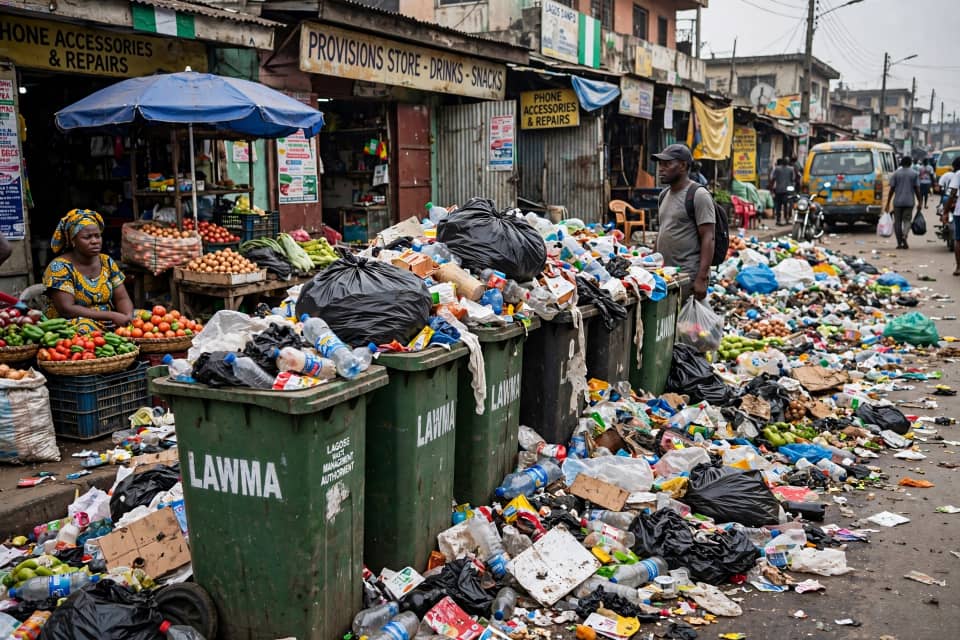
Lagos, once celebrated as Africa’s model megacity for waste management, is gradually returning to the era of filth.
From Ejigbo to Ikotun, from Oshodi to Okota, from Iyana-Ipaja to Trade Fair Complex, the story is the same: heaps of refuse now compete with pedestrians for space. The smell is choking, flies hover in millions, and traders are lamenting low patronage because customers avoid their shops.
The crisis came to public knowledge last week when reports emerged that Governor Babajide Sanwo-Olu had ordered the Managing Director of the Lagos Waste Management Authority, LAWMA, to resign following public outcry over refuse accumulation across the metropolis.
Sources within Alausa told http://P.M.EXPRESS that the Governor was displeased with the slow response of the agency to the mounting refuse and the negative image it was creating for the State, which prides itself as a smart city.
But what really went wrong?
Investigations by http://P.M.EXPRESS revealed that the problem is multi-faceted and has been building for months.
Private Sector Participants (PSP) operators, who are responsible for door-to-door waste collection in over 80 percent of Lagos, have withdrawn their services in many areas, citing unpaid bills, high cost of diesel, and lack of access to dumpsites.
A PSP operator at Ejigbo who spoke on condition of anonymity said: “Diesel is now over N1,400 per litre. One trip to Olusosun dumpsite consumes over 80 litres. LAWMA is owing us for 7 months. How do we survive? Our trucks break down daily on the deplorable road to the landfill.”
Another operator at Oshodi said many of their trucks have been impounded by task force officials for minor traffic offences, further reducing their fleet.
Residents are the worst hit. At Jakande Gate, Oke-Afa, in Oshodi-Isolo Local Government, the main road has been narrowed to one lane because refuse has taken over half the road. At Ikotun market, market women said customers now avoid their stalls because of the unbearable stench.
“We have written letters to LAWMA, to our councillor, to the LCDA chairman. No response. Rats and cockroaches have invaded our homes,” Mrs. Funke Adebayo, a resident of Abaranje Road, Ikotun, told http://P.M.EXPRESS.
Health experts have warned that the waste crisis, if not urgently addressed, could trigger cholera, typhoid, dysentery and malaria outbreak, especially as Lagos enters another cycle of flooding.
Dr. Bayo Oluwole, a public health physician based in Surulere, said: “Decomposing waste is a breeding ground for pathogens. When it rains, the waste washes into gutters and contaminates water sources. We should expect disease outbreak if this continues.”
LAWMA, in a statement issued over the weekend, appealed for calm and assured Lagosians that it is working to restore normalcy and has deployed more trucks to clear black spots. But for many residents, the assurance is not enough. They want action, not grammar.
As Lagos targets 40 percent food self-sufficiency by 2028, experts argue that waste-to-wealth should be prioritized. Lagos generates over 13,000 tonnes of waste daily, yet less than 40 percent is properly collected and recycled.
The question Lagosians are asking is: Where did we get it wrong again? And how soon will the megacity breathe fresh air again?
Related posts