


Lagos Rent Crisis: How Landlords Are Converting Shops To Self-contained Apartments Over Demand Suge By Tenants
Posted on October 26, 2026
CYRIACUS IZUEKWE
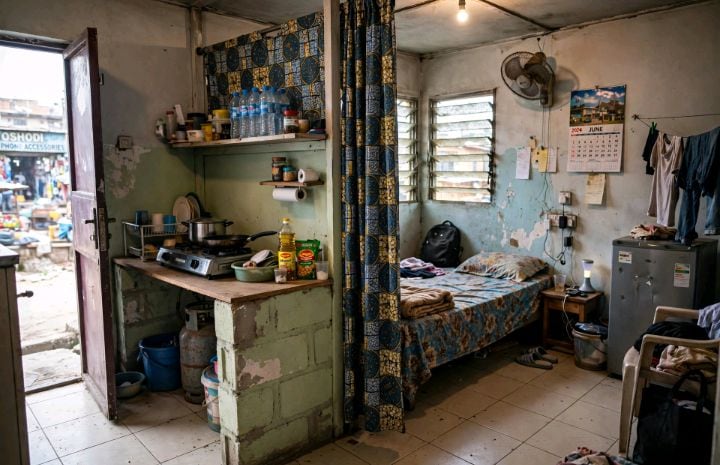
The Lagos rent crisis has taken a new turn as landlords across major residential areas are now converting shops, warehouses and office spaces into self-contained apartments to meet the rising demand for low-cost housing.
P.M.EXPRESS investigation across Oshodi, Ikeja, Egbeda, Ikotun and Alimosho over the weekend revealed a growing trend where single shops that previously sold provisions or phone accessories are now partitioned with plywood and tiles to become one-room self-contained apartments.
In Oshodi-Isolo, a former 10-by-12 feet shop now houses a young couple with a child. The apartment, which has a tiny kitchen extension and a shared toilet at the back, is rented for N650,000 per year, excluding agreement and commission.
Landlords say the conversion is driven by economics.
“Shop no dey move again. People no get money to do business, but people must sleep somewhere. If I leave it as shop, it will stay empty for 8 months. If I convert to self-contained, tenant will pay in one week,” a landlord in Egbeda, who pleaded anonymity, told P.M.EXPRESS.
Estate agents confirmed the trend. According to Mr. Tunde Balogun, an agent in Ikeja, demand for mini-flats and self-contained has tripled since January 2026, while demand for shops has dropped by almost 40 percent.
“Before, we were begging tenants to rent self-contained. Now, 15 people are chasing one self-contained in Alimosho. Landlords are smart. They see where money is. One shop can give you N300k per year as shop, but as self-contained, same space gives you N700k,” he said.
For tenants, it is a matter of survival. Many young workers, drivers, POS operators and artisans who cannot afford the N1.2 million to N1.5 million being charged for a standard one-room self-contained in Ikeja and Surulere are now settling for converted shops.
Chidinma Okoro, a hairstylist in Ikotun, said she moved into a converted shop apartment three months ago after her former landlord increased her rent from N400,000 to N900,000.
“I had no choice. This one is small, no window at the back, but it is N500k. Where will I see N900k? At least I have a place to sleep and keep my things,” she said.
The trend, however, comes with concerns. Town planning experts warn that converting commercial spaces to residential use without approval violates Lagos State building regulations and could pose safety and health risks.
A retired official of the Lagos State Physical Planning Permit Authority, who spoke on condition of anonymity, said most converted shops lack proper ventilation, fire exits and approved plumbing, making them prone to flooding and fire outbreaks.
“Shops were not designed for people to cook, sleep and bathe inside. When you convert 20 shops in a row to 20 self-contained, you put 40 to 60 people where 10 people were supposed to be. The soak-away will overflow, waste will increase, and fire risk is high,” he warned.
Despite the risks, the conversion market is booming. In Alimosho, the most populated local government in Lagos, it is now common to see signboards reading “Self-Contained For Rent – Formerly Shop, Now Tiled and Painted.”
Some landlords are going further. In Oshodi, two warehouses have been partitioned into 14 self-contain units each, with shared kitchen and bathroom facilities. Each unit goes for N750,000 per annum, generating over N10 million per year for the owner, compared to N2.5 million when it was used as warehouse.
The Lagos State Government had in March 2026 warned against illegal conversion of properties without approval, stating that offenders risk sealing and fines. However, enforcement remains weak in many inner communities.
For many Lagosians, the core issue remains affordability. With minimum wage at N70,000 and average one-room rent in mainland now averaging N600,000 to N900,000, many workers spend over 60 percent of their annual income on rent alone.
Analysts say until government provides more low-cost housing and enforces rent control policies, landlords will continue to explore creative means to maximize profit, and tenants will continue to accept any available space.
As Monday begins another work week, thousands of Lagosians will return to homes that were shops a year ago, a clear sign of how deep the housing crisis has become in Africa’s most populous city.
Related posts