


US, Canada, Mexico To Jointly Host 2026 World Cup -FIFA
Posted on June 13, 2018

A joint North American bid has been chosen as hosts of the 2026 World Cup, following a FIFA association member vote in Moscow Wednesday.
The last time the US hosted a World Cup was in 1994, and Mexico in 1986. Canada has never previously hosted World Cup matches.
“Hosting the 2026 FIFA World Cup is a rare and important moment to demonstrate that we are all truly united through sport,” said Carlos Cordeiro, President of US Soccer and Co-Chair of the United Bid.
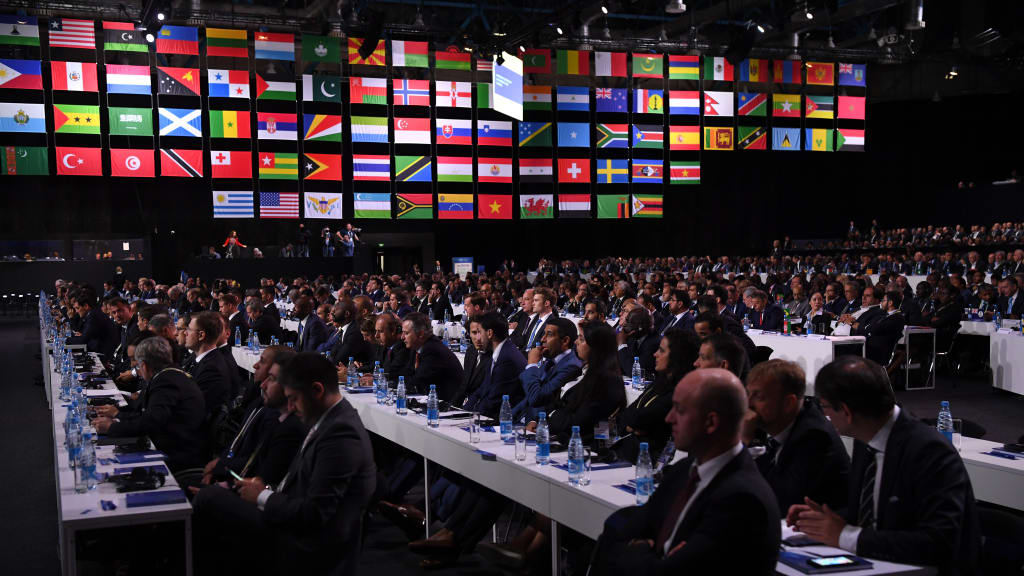
The vote, in which all FIFA associations were, for the first time, eligible to vote for the host, was cast at the 68th FIFA Congress on the eve of the 2018 edition of the tournament, which begins Thursday with the official opening ceremony.
The United bid won by a 134-65 margin, beating Morocco, with one vote for “neither” host. Seven federations — the four bidding nations along with three US dependent territories — recused themselves.
It will be the first time the World Cup is hosted by three countries, but a vast majority of the tournament will be on United States soil. Of the 80 matches, 10 will be held in Canada, 10 in Mexico and 60 in the United States — including the final, at MetLife Stadium in New Jersey.
The last time the men’s World Cup was in North America was when the United States hosted in 1994. It was held in Mexico in 1970 and 1986, and Canada has never hosted.
The first match of the 2018 tournament, between hosts Russia and Group A rivals Saudi Arabia, kicks off at 6 p.m. local time (11 a.m. ET) on Thursday.
In eight years, the US, Mexico and Canada will play host to the largest edition of the tournament to date — 48 teams playing 80 matches across 34 days.
Under the North America proposal, 60 of the tournament’s matches will be held in the US, including everything from the quarterfinals onwards, while Mexico and Canada will host 10 games each.
After the controversial award of the 2018 and 2022 tournaments to Russia and Qatar, respectively, FIFA has promised a “more open and transparent” vote this time. The voting of the national associations will be published at the conclusion of Congress.
Previous hosts had been decided by the FIFA Executive committee, now known as the FIFA Council.
The North Americans had offered FIFA’s member associations a ready-made World Cup; the 23 stadiums they offered as potential hosts are already built, as is most of the infrastructure the expanded 48-team tournament will need: training sites, hotels, airports, rail lines.
And, like Morocco, the North Americans also had the full support of their governments. The nations’ so-called United Bid was a rare topic on which the presidents of the three countries found common cause, and the United States government, including President Trump, had mounted a stealthy shadow campaign to try to win over FIFA and its member federations.
The North American bid’s signature selling point, however, was delivered in a language FIFA members long have understood: revenue. The North Americans promised FIFA a record $11 billion profit — a staggering amount of money that could mean as much as $50 million for each national association.
Morocco, which pledged a profit of less than half as large as its rival’s, criticized the focus on money over soccer until the bitter end.
Related posts