
COVID-19: Time To Worry About Inflation
TIMI OLUBIYI, Ph.D
It is widely acknowledged that a good performance of an economy in terms of per capital growth can be majorly attributed to the rate of inflation in the country. Even though inflation is a concept that affects all of us; but most importantly high inflation is hostile to any economy.
With persistent inflation, businesses and households usually perform poorly and we then pay more for the same goods and services. Admittedly inflation erodes the value of money and also erodes the purchasing power of citizenry. The inflation-economic growth nexus is the specific focus of this article; however, it was mainly instigated by the continuous rise in the level of inflation rate in Nigeria in recent times. The consequence and impact of inflation (price instability) on the growth and development of the Nigerian economy cannot be over-emphasized.
Importantly, inflation is simply defined as a persistent rise in the general price level of the broad spectrum of goods and services in a country over a long period. Largely, when prices of energy, food, commodities, goods, and services go up, purchasing power usually goes down. The persistent rise in the inflation rate will erode the value of the Naira and continue to cause general price instability and this is a concern.The entire economy is affected by this increasing rate of inflation and it affects economic growth negatively. The inflation rate is measured as the percentage change in the price index (consumer price index (CPI), wholesale price index (WPI), producer price index (PPI), etc).
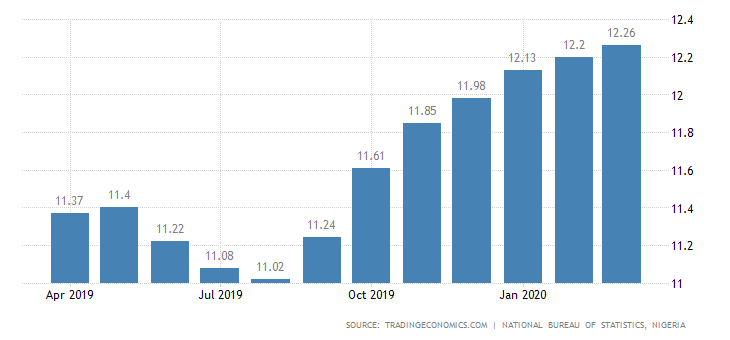
Significantly, the CPI is the more acceptable means of measure of inflation or price movements and it represents the actual cost of living. Therefore, because CPI is available on a more frequent basis, it is mostly in use for monetary policy purposes even by the Central Bank of Nigeria (CBN). The Nigerian data on CPI in recent years was used to examine the level of inflation rate. Data from the National Bureau of Statistics (NBS) reveal that the headline inflation rate for 2018 was 12.09%, a 4.43% decline from 2017 which was 16.52%. The inflation rate for 2016 was 15.68% and the inflation rate for 2015 was 9.01%.However, the annual inflation rate in Nigeria rose for seven straight months to 12.26% in March 2020 from 12.20% in the previous month of February 2020. This was the highest inflation rate since April of 2018 which is close to two years and this is a cause for concern. The steady rise in the inflation rate has been largely driven by the effects of government policies, external shocks and public debt.
Noticeably in a study on inflation in Nigeria using panel–data models by Sani Ibrahim Doguwa of Ahmadu Bello University, Zaria Kaduna State finds a threshold inflation level of 12% applicable to Nigeria. This threshold implies that below the level, inflation has a mild effect on economic activities; while above it, the magnitude of the negative effect of inflation on growth is very high. Consequently, from the National Bureau of Statistics (NBS) data, Nigeria has experienced high volatility in inflation rates in recent times with a continuous rise above the threshold level of 12%and that is a cause for apprehension.The sharp increase in the inflation rate, lull in economic activities and looming economic recession could be attributable in specific terms to the land border closure, increase in Value Added Tax (VAT) rate, increasing public debt, volatility in the price of crude oil, and the multifaceted COVID-19 consequences. The novel Coronavirus (COVID-19) pandemic has negatively affected the global economy and particularly Nigerian economy due to over dependent on importation, crude oil revenue and the lock down of the economic capital of the country Lagos State. This impact has significantly affected industrial output, the fortune of businesses, and cause a decline in economic activities with an attendant shrink in GDP. Furthermore, COVID-19 outbreak has caused severe shortages in the supply of goods and services across borders and within the country, due to series of restrictions and this has necessitated depressing foreign earnings for Nigeria and also impacted negatively on national economic growth.
Supportably, history and literature also replete other factors adduced to the unsustainable economic growth in Nigeria apart from the high inflation rate and impact of COVID-19 pandemic. This include: rising foreign and domestic debt, currency exchange rate volatility, decrepit infrastructure and poor policy implications, among others. Regrettably, these issues can further compound and manifest in areas we already have a deficit as a nation, increase the staggering unemployment, trigger a rise in the cost of borrowing, bleak SME business continuity, cause overwhelming poverty level, worsened living standards, food insecurity,high illiteracy level, surge in crime, and terrorism among others. Another big issue is that the economy of Nigeria is solely dependent on crude oil production, and the growth prospect is over-reliance on the revenue from oil. Due to external shocks and current realities, crude oil per barrel trades below $27, which has caused a big dip in our nation’s projected revenue fortunes.
Based on the aforementioned and from the inflationary perspective, to achieve adequate price stability,government need to adopt significant structural policy reforms, tight monetary and fiscal policies to maintain stronger growth rates in terms of improved Gross Domestic Product (GDP) and to stabilize tide of inflationary pressures on our economy. It is advocated that political leaders should minimize avoidable public spending, strengthen judicial system, stiffen the anti-corruption drive,address insufficient infrastructure, make sure the spread of COVID-19 is curtailed and short-lived and also build strong and effective institutions. The massive growth and developmental challenges of the country can correspondingly improve by also promoting human and SME development. The SME sector can play a major role in the economic growth of the country through the distribution of wealth, poverty reduction, and job creation. The sector is labor-intensive and can provide a reasonable reduction in the level of unemployment rate in the country but government needs to provide adequate enabling environment. On the other hand, inflation can be reduced to the barest minimum by increasing output level (GDP) and SMEs can help achieve this considerably
Furthermore, institutions and individuals have the opportunity
to beat inflation by accelerating the preservation of capital and
strengthening purchasing power with income addition. This can be done by
acquiring investments particularly assets such as real estate because they
usually keep up with inflation. Remember N100,000
today will not acquire the same value of goods and services in 10 years mainly
due to inflation. Therefore, investing is key to hedge against a sharp
inflation impact because it erodes the value of savings, if funds are just left
in the bank accounts.
Conclusively, it is imperative to consider investing in other currencies, diversify investment portfolio internationally if you can, consider inflation-protected securities with potential for higher-growth like equities, Gold Shares ETF, or mutual funds. These can earn more interest returns per year than the inflation rate therefore the options are reasonable. It is also possible to start a business, cultivate passive income generation, and/or even reduce unnecessary expenditure to increase the propensity to save.You might need to reach out using the details below for the necessary advice or for any further information you may require. Good Luck!
Dr. Timi Olubiyi holds a Ph.D. in Entrepreneurship and Small Business Management. He is a prolific investment coach, Chartered Member of the Chartered Institute for Securities & Investment (CISI) and a financial literacy specialist. He can be reached on the twitter handle @drtimiolubiyi and via email: drtimiolubiyi@gmail.com.
Related posts