
African Development Bank & International Partners Commit To Climate Resilient Debt Clauses
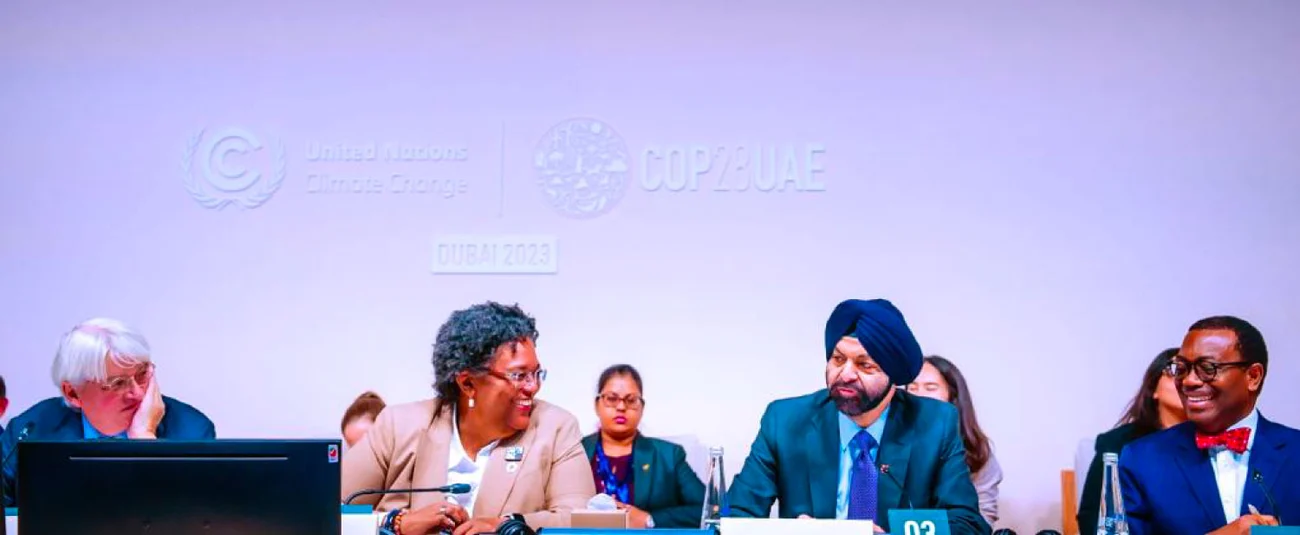
The African Development Bank Group has announced its adoption of climate resilient debt clauses (CRDCs), joining major creditors and international development banks at a COP28 session organized by the UK, Barbados and the InterAmerican Development Bank under the auspices of the Bridgetown Initiative.
Borrowing nations will get a debt payment respite up to two years when disasters strike. Seventy-three countries worldwide (https://apo-opa.co/41qNT3l), including many of the most climate vulnerable, now urge all creditors to adopt urgently CRDCs terms to provide financial security against accelerating climate impacts.
“We now have five multilateral development banks on board,” said UK Minister for Development and Africa Andrew Mitchell. “I look forward to how other multilateral development banks will match this offer next year,” Mitchell added. The MDBs are responding.
African Development Bank President Akinwumi Adesina announced the Bank Group will begin incorporating CRDCs into future sovereign lending in 2024, starting with the African Development Fund, its concessional arm. Nine of the ten countries in the world most vulnerable to climate change are in Africa and all rely on the African Development Fund.
Adesina explained that “Debt Service Suspension Clauses allow countries to defer debt service payments upon the occurrence of a pre-defined severe shock or natural disaster, for a pre-agreed period…they provide relief when it is most needed and provide fiscal space for countries to focus on their recovery needs, stabilize, before debt and service payments.”
Odile Renaud-Basso, president of the European Bank for Reconstruction and Development, announced that it has similar plans. “I’m very happy to announce that starting mid-2024, we will include [CDRCS] in our new loan agreements with sovereign, but also sovereign-guaranteed and municipal clients. We will enable deferral of loan principal repayment for up to two years following climate shock events” including floods, droughts, and earthquakes.
“I think this will enhance the toolbox of how we can help countries facing this kind of very difficult challenge, give them some breathing space and also capacity to deal with the emergency and build back in a quick manner,” Renaud-Basso said. She added that the EBRD has long maintained the capacity to restructure and postpone debt payments when client countries face natural disasters and other systemic shock events.
The Inter-American Development Bank and the World Bank have also signed on to incorporate climate resilient debt clauses into their instruments.
Ten countries are considering adopting CRDCs following the UK Export Finance’s pledge at COP27 to become the first export credit agency globally to offer them. UKEF has already reached agreements to add CRDCs to its new and existing loan agreements with Guyana and Senegal.
Senegal’s Minister of Economy, Planning and Cooperation said, “Senegal is suffering, as are many countries on the African continent. We therefore need a new package of innovative and pragmatic financial solutions to help the most climate-vulnerable countries manage the increased rate of disasters, in a context marked by shrinking budgetary space and the cautiousness of financial markets.”
Closing the session, Minister Mitchell urged participants, “Let us keep momentum building so CRDCs become an international norm in sovereign lending by the end of 2025 as we strive toward a climate resilient future.”
Earlier in the day, in an associated event organized by the Bridgetown Initiative, developed countries including Spain, the United Kingdom, France, and Japan, outlined commitments to provide critical financial resources, including rechannelling their IMF Special Drawing Rights (SDRs), to help build resilience of vulnerable countries, particularly in Africa.
In 2022, ahead of COP27, Barbados Prime Minister Mia Mottley announced the Bridgetown Initiative, an agenda for the reform of the global financial architecture and development finance in the context of three intersecting global crises: debt, climate, and inflation.
Related posts