


Lagos Needs 1 Million Housing Units Yearly To Fix Shelter Deficit – Ambode
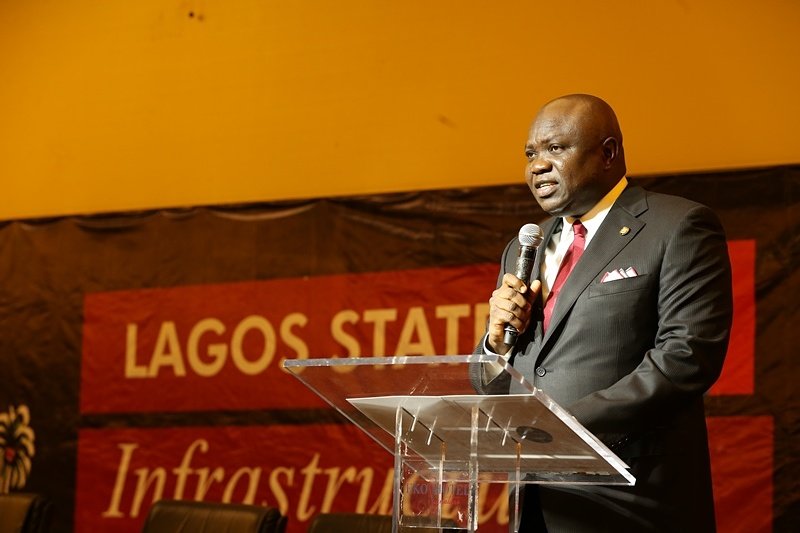
Lagos State Governor, Mr. Akinwunmi Ambode, on Monday said a total of one million housing units are required every year between the next five to 10 years to fix the deficit in providing shelter for the people.
Speaking at a round-table on infrastructure financing organised by the Harvard Business School Association of Nigeria (HBSAN) in collaboration with the state government held at Eko Hotels & Suites, Lagos, Ambode said the state and indeed the country was at a critical point in history where careful assessment must be made on infrastructure deficit and deliberate actions taken to address the challenges.
According to the governor, the state, as against the less than 2,000MW of power that it was currently being supplied, required over 10,000MW, while out of the 750 million gallons of water needed daily in the State, only 210.5 million gallons were being supplied.
While stating that the state government was well aware of the challenges confronting it in the area of infrastructure deficit, the governor said it was time for solid actions that would not only positively affect the livelihood of the people today, but also protect the future of the younger generations to be taken in that direction.
Continuing with the statistics, the Governor said the population of Lagos, at the moment, is estimated at 24 million people which is equal to that of 30 African countries put together, while by 2050, the state is on track to be a city of 36 million people or the 6th largest city in the world after Mumbai, Delhi, Dhaka, Kinshasa, and Kolkata and ahead of Tokyo, Karachi, New York and Mexico City.
He said: “We have a migration rate of 86 people moving into Lagos every hour, higher than New York, London or Mumbai; we have a population density of 6,939 persons per kilometre and an average of five persons per household. With all these come challenges and pressures on the physical and social infrastructure.
“As at 2010, our state was facing an infrastructure deficit of $50 billion, without the inclusion of housing and education. In 2017, we can all imagine what this deficit will be. Lagos State requires 1 million housing units every year for 5-10 years to fix the housing deficit.
“As at 2015, our state had 16,000km network of roads but with a daily human traffic of over 7.5million people and 2.8million cars; the power needs of the state is over 10,000 MW of power but we receive less than 2,000MW; we presently supply 210.5 million gallons of water per day (“mgpd”) as against a demand of 750 mgpd; our state generates 13,000 tonnes of solid waste per day more than New York, United States.”
Governor Ambode said while he was not bringing up the details to scare the people, but such was needed to appreciate the challenges ahead in the sectors mentioned and others.
He added that it was also for that reason that the state government decided to hold the infrastructure roundtable to discuss the way out of the challenges.
“As a government, we are aware of these challenges. These are challenges that face most megacities like ours because we represent hope to many people and we must provide for all who make Lagos their home. If Lagos works, we could have a chance as a nation to work on others,” the governor said.
He added that the major issues would be how to bridge the gap in infrastructure considering the fact that revenues were not growing at the same rate as the rapidly increasing population, and that government was unwilling to increase taxes unnecessarily or tax residents to death, a development he said necessitated the discussion.
“In government, we do not have all the answers. That is the truth. That is why we are here. Our primary role as government is to be enablers. Our major responsibilities are to protect the lives and property of residents and to improve their welfare,” he said.
Keynote speaker at the session, Professor John Macomber of the Harvard Business School, lamented the over-centralisation operating in the country, saying that the Federal Government could build more infrastructure if not for the centrally controlled mechanism.
On his part, one of the discussants, Dr. Andrew Nevin, who is one of PWC’s leading global thinkers, urged the state government to consider tapping into the huge data available to financial institutions to unlock revenue potential on landed property in the state which can be deployed to address the massive infrastructure deficits the state is currently contending with.
Related posts