


Diplomacy Is Not A Joyride: The Argument Against Ignorance
BY UCHE NNADOZIE
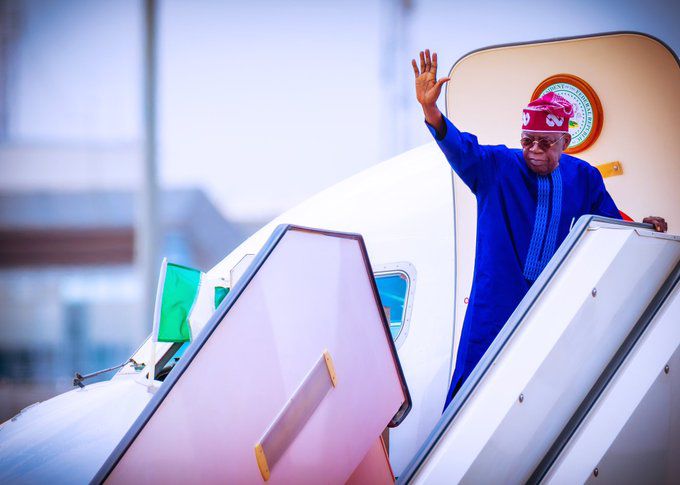
Erasmus Ikhide’s essay is not the bold indictment it aspires to be; it is, rather, a textbook example of emotional maximalism untethered from the realities of international diplomacy. It confuses outrage for insight, theatrics for substance, and—most critically—ignorance for moral authority.
Let us begin with the central claim: that President Bola Tinubu’s three-nation trip is a “joyride.” That assertion collapses under even the most basic understanding of statecraft. Heads of state do not embark on “joyrides” to multilateral summits involving global capital flows, energy transition frameworks, and continental economic integration. These are not ribbon-cutting ceremonies; they are negotiating tables where the future of nations is shaped.
The upcoming Africa-France Summit, co-chaired by Emmanuel Macron and William Ruto, is not a social gathering. It is a high-level forum addressing financing architecture, industrialisation, and climate resilience—issues that directly impact Nigeria’s economic survival and strategic positioning.
Likewise, the Africa CEO Forum in Kigali—held in partnership with the International Finance Corporation (IFC)—is arguably the most important private-sector convergence on the continent. To dismiss participation in these events as indulgence is to admit a profound misunderstanding of how modern economies are built.
Diplomacy is not noise. It is method.
Ikhide’s argument rests on a false dichotomy: that a president must either remain physically present during a crisis or be deemed indifferent. This is a naive and dangerous reading of governance.
The machinery of state does not grind to a halt because the president boards a plane. Nigeria’s response to developments in South Africa has followed established diplomatic protocol.
The summoning of the South African High Commissioner by Foreign Affairs Minister Bianca Odumegwu-Ojukwu is not “indifference”—it is precisely how sovereign states register protest and demand accountability. This was after officials of Nigeria’s High Commission in Pretoria had intervened. Ultimately, it is local authorities that must protect all residents within their jurisdiction.
What Ikhide proposes instead—an impulsive presidential dash to Pretoria—is not diplomacy; it is spectacle. International relations are not conducted through emotional grandstanding or what is inadvertently described as “jankara” responses. They are governed by structured engagement, intelligence assessments, and calibrated pressure.
There is also a deeper contradiction in his argument. He laments Nigeria’s declining global stature while simultaneously ridiculing the very engagements designed to restore it. Influence in the international system is not asserted through isolation or reactive populism; it is built through sustained participation in global and regional platforms where decisions are made. Absence from those tables does not signal moral strength—it guarantees irrelevance.
Consider the strategic context he ignores.
Nigeria stands at a pivotal moment in global energy politics. With the operationalisation of the Dangote Refinery, the country is repositioning itself as a major supplier of refined petroleum products—not just within Africa, but to Europe and beyond. Coupled with projects like the Obiafu-Obrikom-Oben (OB3) gas pipeline and the advancing Nigeria-Morocco Gas Pipeline, Nigeria is no longer merely a resource state; it is emerging as a central actor in energy security.
These developments require diplomacy—constant, deliberate, and high-level diplomacy.
Investment does not arrive because a nation shouts the loudest in moments of crisis. It comes to countries that show up, negotiate, reassure, and build partnerships. Security cooperation—critical to Nigeria’s fight against terrorism—also flows through these same diplomatic channels. Military assistance, intelligence sharing, and counterterrorism frameworks are outcomes of engagement, not isolation. Diplomacy takes time; populism does not.
Ikhide’s invocation of African greats like Kwame Nkrumah, Thomas Sankara, and Nelson Mandela is rhetorically appealing but intellectually lazy. These leaders operated in vastly different geopolitical contexts. To suggest that their legacies are defined by dramatic physical presence at every crisis scene is a distortion. Their enduring impact came from institution-building, strategic alliances, and ideological clarity—not performative travel decisions.
Leadership is not measured by proximity to outrage but by the ability to balance competing national priorities.
Nigeria’s diaspora concerns in South Africa are serious and deserve firm engagement. But governance demands simultaneity: protecting citizens abroad while securing economic lifelines at home. A president who abandons critical international forums in favour of reactive symbolism would be derelict in a different—and far more consequential—way.
The minister of foreign affairs, Mrs Bianca Odumegwu-Ojukwu at the directive of President Tinubu has provided a detailed situation report underscoring the government’s active response.
She noted heightened anxiety over recent anti-foreigner protests in parts of South Africa, while confirming that Nigerian missions are closely monitoring developments and engaging host authorities.
However, recent demonstrations in Pretoria and Johannesburg were largely contained. The minister further disclosed that authorities are preparing voluntary repatriation arrangements for affected citizens, with over a hundred Nigerians already registered, while ongoing diplomatic engagements—including the summoning of South Africa’s High Commissioner—are aimed at ensuring accountability and preventing further escalation.
Ikhide also drifts into the familiar territory of delegitimisation, branding the government as inherently disconnected and therefore incapable of empathy. This is not analysis; it is partisan assertion. It adds heat but no light. More importantly, it distracts from the substantive question: what actions best serve Nigeria’s long-term national interests?
The answer is not isolation. It is engagement.
At a time of global economic uncertainty—compounded by geopolitical tensions stretching from the Middle East to Eastern Europe—Africa’s largest economy cannot afford to retreat into itself because of South Africa’s xenophobia. Nigeria must lead, and leadership requires presence at critical diplomatic tables. It requires a president who is not only visible at home but influential abroad.
Respect in international relations is not gifted; it is negotiated. It stems from economic strength, strategic partnerships, and military capability—all of which are reinforced through precisely the kind of engagements Ikhide ignorantly derides.
The irony, then, is unmistakable. In attempting to portray diplomacy as indifference, Ikhide unconsciously argues for a Nigeria that is absent, reactive, and diminished. That is not the posture of a “Giant of Africa.” It is the blueprint for irrelevance.
Serious nations do not govern by outrage cycles. They govern by strategy.
And strategy, unlike sentiment, often requires boarding that plane.
-Nnadozie, a development communication specialist writes from Lagos
Related posts