

CCDA-XIV: Your Climate and Development Future Matter – Expert Tells Africa
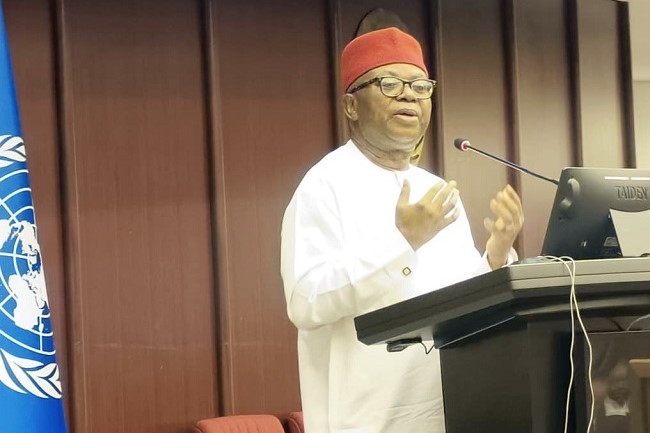
<strong><em>Sam Onuigbo</em></strong>
RAYMOND OKOBIA
Africa must move beyond merely participating in global climate negotiations and begin shaping the institutions, financing mechanisms, rules and implementation pathways that will determine its climate and development future, President of GLOBE Legislators, Sam Onuigbo, has said.
Onuigbo made the call in a presentation titled “From Pledges to Implementation: African Agency and the Belém–Antalya–Addis Roadmap” at the Fourteenth Conference on Climate Change and Development in Africa (CCDA-XIV), holding at the United Nations Conference Centre in Addis Ababa, Ethiopia.
The conference, which runs from September 7 to 9, 2026, brings together policymakers, development institutions, climate experts and other stakeholders to examine pathways for translating climate commitments into practical development outcomes.
Drawing inspiration from the 1976 declaration of former Nigerian Head of State, General Murtala Muhammed, that “the fortunes of Africa are in our hands to make or mar,” Onuigbo argued that Africa’s climate future must be built, financed, governed and defended by Africans.
According to him, the continent can no longer afford to depend solely on pledges and interventions designed outside Africa.
“Africa’s climate challenge is no longer only a question of vulnerability. It is now a question of agency,” he said.
Onuigbo, who sponsored Nigeria’s Climate Change Act 2021, distinguished between climate priorities and climate agency, arguing that while priorities describe what Africa needs, agency defines what Africa decides, designs, builds, finances, governs and defends for itself.
He said Africa must move beyond being present at global climate negotiations or merely having its interests reflected in communiqués and declarations.
“Participation means Africa is present at the table. Representation means Africa’s interests are counted in declarations, boards, communiqués, and negotiating texts,” he said.
“Agency is different. Agency means Africa sets terms rather than merely responding to terms set elsewhere.”
The former Nigerian lawmaker said the central challenge confronting Africa and the global climate regime was no longer the absence of commitments, but the lack of adequate institutions, finance, technologies, laws and political will required to implement them.
He stressed that implementation should not be viewed merely as a technical follow-up to international negotiations, but as a core development strategy capable of delivering resilience, energy access, industrialisation, jobs, food security, technology and sustainable development.
Onuigbo called for African countries to transform their Nationally Determined Contributions (NDCs) from diplomatic submissions into practical implementation architectures.
According to him, NDCs should become investment frameworks, sectoral plans, accountability mechanisms and pipelines of bankable projects, supported by laws, budgets, institutions, technical capacity and project-preparation systems.
He cited Nigeria’s Climate Change Act 2021 as an example of how climate ambition could be translated into governance structures and institutional responsibility.
The Act, he noted, established a statutory framework for climate action and created the National Council on Climate Change, coordinated at the highest level of government.
He said the arrangement was particularly important in addressing institutional rivalry and fragmentation among ministries and government agencies whose responsibilities intersect with climate action.
“Climate policy cuts across every sector,” Onuigbo said, noting that effective implementation requires coordination across environment, finance, energy, petroleum, transport, agriculture, trade, industry, water, planning and science.
He also argued that embedding climate commitments in legislation would help protect long-term climate policies from disruptions caused by political and electoral transitions.
On Nigeria’s experience with extreme weather, Onuigbo said the devastating floods of 2012, 2022 and 2024 demonstrated that the cost of climate inaction was no longer theoretical.
He called for a transition from reactive disaster response to anticipatory climate-risk management through improved flood-risk mapping, drainage systems, dam safety, wetlands protection, land-use planning, early-warning systems and climate-responsive budgeting.
The GLOBE Legislators President also underscored the role of parliaments in driving climate implementation, saying commitments could only become meaningful when translated into laws, budgets, oversight and accountability.
He said climate leadership should not be left exclusively to negotiators attending global climate conferences but should be built throughout the year through parliaments, regional institutions, ministries, development banks, universities, civil society, private investors and local governments.
“Negotiation without implementation capacity produces declarations. Implementation without legislative backing risks fragmentation. Climate agency requires both,” he said.
Onuigbo identified five key areas where Africa must assert greater influence in global climate governance.
The first, he said, was the accreditation and disbursement rules governing multilateral climate funds, including the Green Climate Fund, Adaptation Fund and Loss and Damage Fund.
He argued that capable African institutions should play a leading role in accessing, assessing and disbursing resources intended to address African climate challenges rather than serving merely as implementers of externally designed programmes.
Secondly, he called for Africa to reshape the debate around climate finance beyond headline figures, focusing on the quality and accessibility of finance, the proportion provided as grants rather than loans, the cost of capital and the reduction of Africa’s risk premium.
Thirdly, he urged African countries to actively shape carbon-market rules under Article 6 of the Paris Agreement to ensure that carbon finance supports industrialisation, land restoration, community benefits and long-term development rather than allowing Africa to become simply a supplier of cheap carbon credits.
Onuigbo also called for stronger African engagement in climate-related trade rules, warning that carbon-border measures and other climate-linked restrictions could create new barriers to African industrialisation.
He said African climate negotiators, trade ministries and the African Continental Free Trade Area Secretariat must work together to prevent global climate policies from becoming “a new tariff wall against African industrialisation.”
The fifth area, he said, was the development of adaptation, resilience, loss and damage metrics that reflect African realities.
Such indicators, he argued, should measure whether farmers are protected, cities are resilient, coastal communities are safer, water systems are functioning and food production and infrastructure can withstand climate shocks.
Onuigbo said the Belém–Antalya–Addis Roadmap should help move Africa “from declarations to delivery, from ambition to institutions, from needs to instruments, and from representation to authorship.”
He proposed a number of continental initiatives, including an African Climate Implementation Compact, a project-preparation facility, a continental adaptation investment pipeline, a climate intelligence network, a green industrialisation compact, an energy-access and transition compact, a fair climate-trade framework and a blue economy investment initiative.
The GLOBE Legislators President also called for greater mobilisation of African capital, including pension funds, sovereign wealth funds, commercial banks, development-finance institutions and private investors.
While stressing that developed countries must continue to meet their international climate finance obligations, he said Africa should strategically deploy its own public and concessional resources to attract larger pools of domestic and international investment.
On energy transition, Onuigbo said Africa’s pathway must reflect its development realities, particularly the large number of people without access to reliable electricity.
“A just transition must mean more than emissions reduction,” he said, adding that it must also deliver energy access, affordability, reliability, industrial opportunities, clean cooking, productive power and jobs.
He urged Africa to convert its renewable energy resources, natural gas, critical minerals, agricultural potential, forests, oceans and youthful population into domestic value chains rather than continuing to export raw materials and import finished green technologies.
In his concluding remarks, Onuigbo said Africa possessed the resources, people, ecosystems, institutions and markets required to become a major contributor to global climate solutions.
“The real test of climate ambition is not the quality of the pledge, but the quality of implementation,” he said.
He maintained that success should ultimately be measured by tangible improvements in the lives of African people, including better protection for farmers against drought and floods, reliable energy for communities, opportunities for young people to build green enterprises, resilient cities and competitive industries.
Onuigbo said Nigeria’s Climate Change Act and the experience of GLOBE Legislators demonstrated that climate priorities could be transformed into institutions, laws, budgets, oversight and accountability.
He concluded that Africa’s climate leadership must go beyond demanding a better global system.
“It is building one – with African institutions, African decisions, African capital, and African authority at the centre.”
Related posts