
BRICS 2026 Summit: Building for Resilience, innovation, and Sustainability By Mahdi Musa
The term BRIC was first created in 2001 by a Goldman Sachs economist named Jim O’Neill. It stood for Brazil, Russia, India, and China, which he predicted would grow very fast and dominate the world economy by 2050.
South Africa joined the group in 2011 as a full member when it attended the 3rd BRICS leaders’ Summit in Sanya, China , changing the name to BRICS. The group expanded further to include Egypt, Ethiopia, Iran, Saudi Arabia, the United Arab Emirates, and Indonesia. The BRICS coalition now has 11 full member countries. It is an international political and economic organization made up of major emerging and developing nations. The group’s objective is to give a stronger voice to developing nations of the Global South. It acts as a counterweight to Western-led global groups like the G7.
Members work together on trade, security, and cultural ties. Although the bloc is an informal arrangement, with no charter, it has nonetheless developed a more institutional character, both through a high level of political interaction (e.g. annual summits) and the creation of economic institutions such as the New Development Bank (NDB), and the Contingent Reserve Arrangement (CRA) to fund infrastructure projects as an alternative to the World Bank and the International Monetary Fund (IMF).
Brazil, the Russian Federation, India, China and South Africa as BRICS members now form one of the world’s most important economic blocs, representing more than one quarter of global Gross Domestic Product (GDP), and 42 per cent of the world’s population. Significantly, the BRICS have seen their economic influence grow over the past decades, as drivers of global growth, trade and investment.
Foreign investment really has played an important role in the growth of BRICS economies since 2001, with annual Foreign Direct Investment (FDI) inflows to the bloc more than quadrupling from 2001 to 2021 and contributing significantly to gross fixed capital formation. Analysts say the growth in FDI inflows to the BRICS was very strong in the first decade, but has remained relatively flat since 2011 against a global backdrop of negative growth of FDI flows over the decade.
To deal with the current challenging global investment environment, and also in response to the need to leverage foreign investment for sustainable development, the BRICS economies have continued moving in the general direction of a more open and supportive investment policy environment. Looking ahead, the potential for intra BRICS investment remains promising. However, more collaboration will be required to make investment a key driver of economic cooperation among the BRICS, and to bring more benefits for sustainable and inclusive economic development in the bloc.
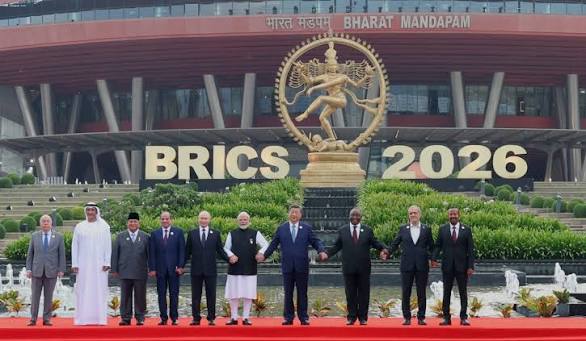
It is against this backdrop that India played host for the 18th BRICS Summit September 12-13, 2026 at the Bharat Mandapam in New Delhi, bringing together leaders of BRICS Member states and 10 Partner Countries including Nigeria and Outreach Invitees for diplomatic and economic talks. The summit focused on strengthening intra-BRICS cooperation and addressing key global and regional issues of mutual importance.
India’s BRICS Chair-ship is guided by the theme ‘’Building for Resilience, Innovation, Cooperation and Sustainability,’’ reflecting the vision of ‘’Humanity First.’’ India, a founding member of BRICS, assumed its fourth Chair-ship on January 1, 2026. The year also marks 20 years of BRICS and people-to-people cooperation.
Indian Prime Minister Narendra Modi met with the Nigeria’s Vice President, Kashim Shettima, on the sidelines of the summit. Both leaders reportedly discussed key areas including trade and investment, defense and security, energy partnership, agriculture, health, and digital technologies. Nigeria’s engagement with the BRICS bloc offer strategic economic and diplomatic advantages that support its national development goals.
Nigeria officially accepted an invitation to become a BRICS partner country in January 2025. That partnership has broadened Nigeria’s international economic relations beyond traditional Western partnerships, fostering greater economic sovereignty and reduced reliance on any single currency or bloc. It is advancing Nigeria’s calls for a more equitable global governance architecture, including reforms to the United Nations Security Council and international finance systems.
The country has the clout to so do as Africa’s most populous nation with the largest economy and a vital supplier of oil and natural gas. Nigeria would be standing on the right side of history as it seeks full membership of BRICS, the world’s most influential platform for emerging markets.
Mahdi Musa writes from Ilorin
Related posts