


Guarding The Institutional Gate: Why Hope Uzodimma Stands Vindicated In The Clash Of Political Wills
Posted on October 15, 2026
BEN AHANONU
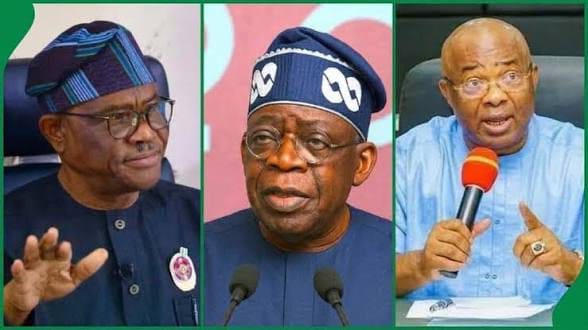
The ongoing friction within Nigeria’s ruling elite, particularly the heated public exchange between the Minister of the Federal Capital Territory, Nyesom Wike, and the Governor of Imo State, Senator Hope Uzodimma, highlights a fundamental struggle over party discipline, institutional order, and democratic governance. At the heart of this ideological disagreement is Wike’s cross-party “Rainbow Coalition”—an external entity conceived entirely outside the formal structures of the All Progressives Congress (APC) to drive the 2027 presidential re-election campaign. While proponents of this coalition market it as an innovative, pragmatic strategy to build a broad-based consensus for President Bola Tinubu, institutional realists look significantly deeper. Led by Governor Uzodimma in his capacity as the Chairman of the Progressive Governors’ Forum (PGF), these realists view such a parallel structure as a serious threat to the constitutional authority of state executives and the foundational health of political parties. In firmly resisting the creation of ad-hoc, individual-centric networks that bypass official party organs, Uzodimma is not merely defending his political territory; he stands fully vindicated as a principled institutional operator protecting the rule-based foundation of Nigerian democracy.
To fully comprehend why Uzodimma’s stance is correct in this high-stakes confrontation, one must examine the dangerous precedents set by parallel political architectures. A political party is far more than an elastic vehicle designed to secure executive power every four years; it is a constitutional institution governed by laws, statutory hierarchies, and deeply rooted grassroots networks. When a non-member or an external actor bypasses these established channels to construct an independent mobilisation framework, it inevitably fractures party loyalty and dilutes organisational coherence. Wike’s position—that he can aggressively campaign for the president while openly opposing or working against APC candidates at state and legislative levels—is structurally unsustainable and logically flawed. It creates an unmanageable contradiction where grassroots party faithful are expected to divide their loyalties, supporting the apex of the national ticket while simultaneously fighting off external incursions backed by elements of the very same administration. This dualism threatens to hollow out the party from within, leaving its internal mechanisms fragile and prone to manipulation. Uzodimma’s timely intervention, reinforced by a unified declaration from the Progressive Governors’ Forum, correctly diagnosed this systemic danger. By stating unequivocally that the ruling party cannot endorse alliances that weaken its own candidates, Uzodimma defended the integrity of thousands of party flagbearers whose political survival depends on a cohesive, united party front.
Furthermore, Governor Uzodimma’s resistance constitutes a vital defence of the constitutional role of governors as the natural leaders of their parties within their respective states. In Nigeria’s federal structure, governors bear the heavy burden of sub-national governance, security, and grassroots political stability. Subverting their leadership by imposing independent national coordinators or cross-party enforcers within their domains is an open invitation to political anarchy and localised friction. It creates unnecessary parallel command structures that undermine the executive authority guaranteed by the constitution.
If external actors can arbitrarily dictate local political structures under the guise of national alignment, the internal democracy of the party is effectively destroyed, leaving local party chapters at the mercy of external dictates. This concern is by no means abstract; verified reports indicate that the undercurrent of this dispute involves sophisticated attempts by external forces to destabilise and influence the governorship succession plan in Imo State.
Uzodimma has consistently maintained that the emergence of future leaders must be driven by transparent, rule-based internal processes and genuine grassroots support, rather than being handpicked through backroom deals in Abuja. By refusing to bow to external pressure, the Imo State Governor is protecting the fundamental rights of local party members to choose their own leaders, ensuring that the party remains accountable to the populace rather than to transient external power brokers who lack local accountability.
Wike’s aggressive public response—dismissing the governors as “lazy politicians” and launching highly personalized attacks regarding past electoral metrics—reveals a fundamental misunderstanding of institutional governance and party administration. Elections are not won through grandstanding in the media, theatrical displays, or televised outbursts; they are won through steady organizational work, institutional consolidation, and visible, impactful governance that directly improves the lives of ordinary citizens. Uzodimma’s political trajectory demonstrates a deep understanding of this reality. Rather than engaging in disruptive politics or media-driven feuds, he has focused on building a lasting institutional legacy in Imo State through expansive infrastructure projects, comprehensive economic reforms, and sustainable structural development. Civic organizations, such as the Imo Lawyers for the Defence of Democracy, have rightly pointed out that reducing a critical debate over party structure to personal insults undermines the intellectual quality of the political space. Uzodimma’s calm, institutional pushback highlights the stark contrast between a political disruptor who thrives on engineered crises and an institutional operator who builds long-term democratic stability.
*Ultimately, the position taken by the Progressive Governors’ Forum under Uzodimma’s leadership has been vindicated by the clear and urgent need for constitutional order. If a political party allows its official campaign architecture to be supplanted by informal coalitions, it renders its own National Working Committee, state executives, and constitutional organs entirely irrelevant* . It establishes a hazardous precedent where a few influential individuals can bypass formal systems to run parallel administrations, eroding the very concept of party supremacy. By insisting that loyalty to the presidency must align perfectly with respect for the party’s formal structure, Uzodimma is saving the ruling party from future internal collapse and factional balkanisation. His actions demonstrate the foresight of a statesman who understands that strong institutions, not powerful individuals, ensure the survival of a democracy. As the political landscape evolves ahead of the next electoral cycle, Uzodimma’s firm stand against institutional overreach and parallel party structures stands out as a necessary act of political courage. He has proven that defending the rules, respecting the grassroots, and maintaining organisational discipline remain the only reliable pathways to ensuring long-term political stability in Nigeria.
*I stand with Uzodimma!*
*Prince Ben AHANONU*
*National Coordinator/* *Convener,*
*HOPE UZODIMMA* *SOLIDARITY MOVEMENT*
*Email:* *benahanonu@gmail.com*
Categorised as : Opinion, Politics
No Comments »
Related posts