
Hamzat’s PROMISE: Putting The Lagosian At The Centre of Governance
BY TOKUNBO WAHAB

This is an examination of the People First agenda and its 15 pledges on healthcare, education, community safety and citizen services
Every political manifesto comes with an assortment of promises, but their importance is ultimately determined by how closely they address the needs of the people for whom government exists.
For a state such as Lagos, where rapid population growth continually stretches public infrastructure and services, the relationship between government and the ordinary resident is particularly important.
A parent concerned about the cost of medical treatment, a young graduate struggling to find employment, a trader confronted by harassment on the streets and a resident spending an entire day pursuing a government document may have different immediate concerns.
Yet, all four experiences raise a common question: how effectively does government respond to the needs of its citizens?
This is the question at the heart of the People First component of the Lagos PROMISE, the manifesto unveiled by the All Progressives Congress governorship candidate, Dr. Kadri Obafemi Hamzat, ahead of the 2027 election.
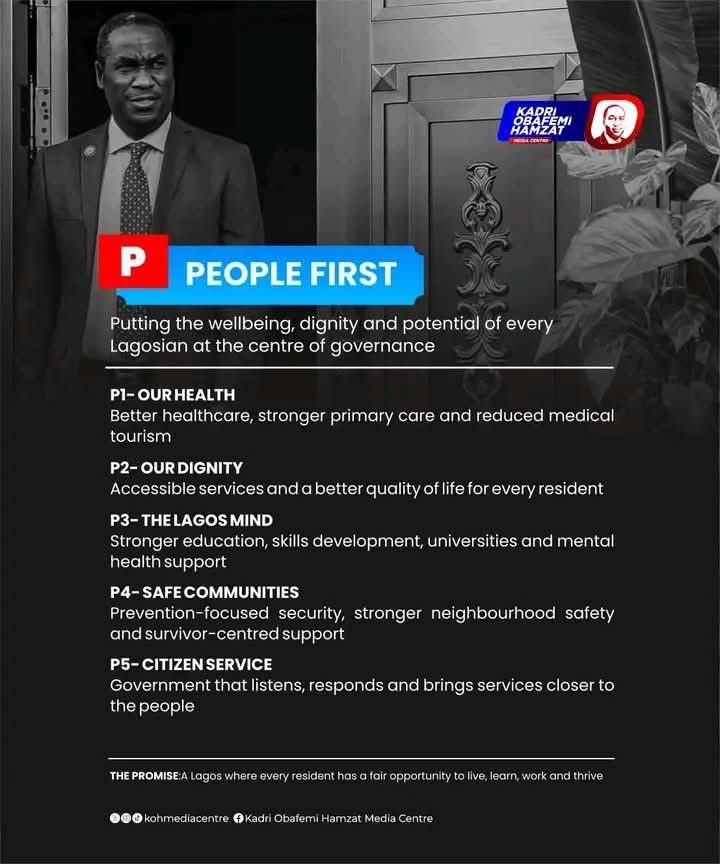
Structured around four thematic areas and 15 distinct pledges, People First addresses healthcare, education and human capital, community safety, and the relationship between citizens and public institutions.
Of the 15 pledges, 11 are classified as firm commitments and four as aspirations. The distinction is significant because it separates proposed obligations from broader objectives whose achievement may depend on additional resources, external partnerships or conditions yet to be established.
Together, the pledges offer a framework for examining what people-centred governance would mean in practical terms.
Healthcare: From Building Hospitals to Improving Access
Healthcare occupies a central position in the People First agenda, with five pledges covering medical infrastructure, personnel, insurance, vulnerable populations and specialist treatment.
Among the proposed targets are a workforce of 9,000 doctors, two additional general hospitals, 120 flagship primary healthcare centres and 15 maternal and child centres by 2031. The manifesto also proposes expanding selected general hospitals, including those in Alimosho, Odan and Ikorodu.
These commitments address an enduring challenge of urban development: the tendency for population growth to outpace the availability of public services.
For Lagos, however, the issue extends beyond the number of healthcare buildings. A hospital is useful only to the extent that it has qualified personnel, functional equipment, essential medicines and the capacity to attend promptly to patients.
Consequently, the proposed expansion of healthcare facilities would need to proceed alongside effective staffing, maintenance and financing arrangements.
This is where the Pledge of Systems connects with the Pledge of the Healthcare Economy, which proposes extending Ilera Eko health insurance coverage to 30 per cent and strengthening the state’s medicine supply and healthcare financing systems.
The significance of insurance cannot be overstated. For many households, a serious illness is simultaneously a medical emergency and a financial crisis.
Wider insurance participation could help reduce the immediate pressure of paying for treatment, although the eventual benefit would depend on the services covered, participating facilities and affordability of premiums.
Another dimension is the Pledge of the Vulnerable, which sets targets for reducing malaria, maternal mortality and the burden of non communicable diseases, while expanding community mental healthcare across the five administrative divisions of Lagos.
Here, the distinction between inputs and outcomes becomes especially relevant.
The number of hospitals constructed can be counted. So can the number of doctors recruited. But the more consequential questions concern whether fewer mothers die during childbirth, whether more diseases are detected early and whether patients receive timely treatment.
These are the measures by which healthcare expansion would acquire meaning beyond physical infrastructure.
The fifth undertaking, the Pledge of Care on Lagos Soil, addresses specialist medical services and the ambition to reduce outbound medical tourism through facilities such as the Lagos Cancer Diagnosis Centre, Medipark and other specialist institutions.
Classified as an aspiration, it reflects a broader economic consideration: the possibility of retaining healthcare expenditure, professional expertise and medical investment within Lagos.
Its realisation would nevertheless require sustained investment in specialist personnel, equipment, quality assurance and the confidence of patients, who currently seek treatment elsewhere.
Education: Preparing the Lagos Mind for a Changing Economy
Education constitutes the second component of People First, with four pledges directed at learning outcomes, vocational training, tertiary education and access.
The Pledge of Foundations proposes strengthening the EKOEXCEL programme across public primary schools and extending its approach into secondary education.
This is particularly relevant because improvements at the primary level can be diminished if students enter secondary schools without adequate teaching support, continuity or a curriculum responsive to their needs.
But educational reform must also confront a question that has become increasingly important: what happens after students leave school?
Lagos operates in an economy where technology, logistics, construction, creative enterprise and other sectors are changing the nature of employment. Qualifications alone do not necessarily guarantee that young people possess the practical skills demanded by employers.
The manifesto therefore links its Pledge of Skills to technical and vocational education, including the proposed completion of Meiran Technical College, additional colleges in Ibeju-Lekki and Badagry, and an artificial intelligence workforce programme.
The policy implication is that education would be judged increasingly by its ability to connect learning with productive participation in the economy.
That connection, however, must be demonstrated rather than assumed.The number of students admitted into training programmes would tell only part of the story.
The more revealing measures would include completion rates, professional certification, apprenticeships, job placements and the extent to which employers recognise the skills acquired.
The Pledge of the Lagos Mind extends the reform agenda to universities, research institutions, teachers, lecturers and trainers.
Its inclusion acknowledges that expanding access to schooling without improving the quality of instruction would leave a major part of the education challenge unresolved.
Meanwhile, the Pledge of Equity seeks to improve educational opportunities for children irrespective of household income or personal circumstances, including reducing the number of out-of-school children.
Unlike some other undertakings in the manifesto, the proposed reduction is not accompanied by a precise numerical target.
That leaves room for a clearer implementation framework identifying the existing number of affected children, the annual reduction being pursued and the mechanisms for bringing them into and retaining them within the education system.
These questions matter because access, quality and employability are interconnected. A child excluded from education today becomes an adult with diminished economic opportunities tomorrow.
Community Safety: Beyond Conventional Crime Fighting
The third People First component deals with the experience of security at the neighbourhood level. Its four pledges cover local safety arrangements, crime prevention, complaints and protection for survivors of sexual violence.
The Pledge of the Neighbourhood proposes extending the reach of the Lagos Neighbourhood Safety Agency across the state’s 20 local government areas and 37 local council development areas.
The Pledge of Prevention seeks to strengthen community-based interventions involving schools, markets, motor parks and faith-based institutions.
Together, they reflect an approach in which public safety is not restricted to responding after crimes have been committed.
For residents, insecurity can manifest in relatively ordinary but persistent experiences: harassment in traffic, extortion at commercial locations, threats around markets or the absence of effective intervention when disputes escalate.
These experiences have economic as well as social consequences. They influence business operating costs, commuting patterns and public confidence in government.
The emphasis on prevention is therefore relevant, provided community participation translates into genuine intelligence-sharing, conflict resolution and accountable enforcement.
There is also an important institutional limitation. Policing remains principally a federal responsibility under Nigeria’s existing constitutional framework. The proposed state-level interventions would consequently require coordination with federal law enforcement authorities.
That makes clarity of responsibility essential. Residents should be able to distinguish between agencies responsible for receiving complaints, preventing disorder, investigating crimes and prosecuting offenders.
The Pledge of the Citizen Voice introduces specific response standards: acknowledgment of safety complaints within 24 hours, an initial response within seven days and resolution within 30 days.
Such targets provide a potentially useful basis for accountability. They would be more meaningful, especially if accompanied by publicly available data on complaints received, cases resolved and matters referred for further investigation.
The fourth undertaking, the Pledge of the Survivor, proposes expanding sexual-assault referral support across all five administrative divisions.
Beyond the availability of centres, effective protection would require confidential reporting, trained personnel, medical and psychological support, and reliable links to the justice system.
The essential issue is whether a person seeking protection can access it promptly and safely, regardless of location or financial circumstances.
Citizen Service: Making Government Easier to Reach
Perhaps the most immediately relatable aspect of People First is its final component: the way residents encounter government offices and public services. Two pledges define this agenda.
The Pledge of the Front Door proposes satellite government secretariats in Badagry, Ikorodu, Lagos Island and Epe, complementing the central secretariat at Alausa.
The underlying challenge is straightforward. A resident should not necessarily have to undertake a lengthy journey across Lagos merely to obtain information, submit an application or resolve an administrative problem.
Decentralising selected services could reduce transportation costs, time lost in transit and the concentration of administrative activities in Ikeja. Yet, the location of an office is only one part of accessibility.
The offices would need appropriately trained staff, functioning digital systems, clearly defined services and sufficient authority to resolve matters without repeatedly referring residents back to Alausa.
Otherwise, decentralisation could simply reproduce existing bureaucratic difficulties in additional locations.
The second undertaking, also described as the Pledge of the Citizen Voice, establishes standards for responding to public complaints.
Under the published manifesto, complaints are to be acknowledged within 24 hours, receive an initial response within seven days and, in routine cases, be resolved within 30 days. More complex matters are assigned a longer period in the accompanying implementation narrative.
These provisions provide clearer opportunities for measuring public-service performance.
For residents, the practical test would be whether applications are processed within advertised periods, complaints are assigned to identifiable officials and unresolved cases can be escalated without unnecessary difficulty.
The proposed integration of resident identification and government services could further simplify public administration, but it would also require dependable safeguards for personal information and effective alternatives for residents who lack smartphones or reliable internet access.
A government service is not genuinely accessible if the process excludes the people most in need of it.
RENEWAL
Hamzat’s PROMISE: Rebuilding the Foundations of Greater Lagos
Beyond roads, bridges and rail lines, the Renewal agenda proposes a new relationship between infrastructure investment, economic productivity and the quality of everyday life.
Infrastructure has become one of the defining questions of governance in Lagos. Not necessarily because the state has failed to invest in it, but because the scale and speed of its growth continually place fresh demands on facilities that are already under pressure.
A road constructed today may struggle with traffic volumes in a few years. A drainage channel designed for an existing community may become inadequate as new estates emerge. Water infrastructure installed decades ago must contend with changing population patterns, while electricity supply remains an expensive uncertainty for households and businesses.
This is the context in which Dr. Kadri Obafemi Hamzat, has situated the second pillar of his 2027 governorship manifesto, The Lagos PROMISE.
Known simply as Renewal, the agenda contains 12 pledges distributed across four areas: roads and transport infrastructure, electricity, water supply, and waste management and flood resilience.
Taken together, they raise a larger question about the future of Lagos: can infrastructure development move beyond the construction of new facilities to the creation of systems that are dependable, properly maintained and capable of supporting a growing megacity?
Roads and Bridges: The Importance of What Already Exists
The first three pledges, contained under Building Greater Lagos, address roads and bridges, traffic junctions and rail development.
The Pledge of Roads and Bridges proposes rehabilitating the state road network and restoring bridges to publicly defined standards.
Its significance lies partly in its recognition that maintenance should be treated as an essential component of infrastructure policy rather than an occasional intervention.
Lagos has invested in major roads, bridges and transport corridors under successive administrations. Yet, the experience of commuters demonstrates that the condition of smaller connecting roads can be just as consequential as the existence of major highways.
A journey shortened by a new expressway may still be frustrated by badly maintained feeder roads, damaged intersections or inadequate drainage.
The challenge, therefore, is not only how many kilometres of road are constructed, but how effectively the entire network operates. The Pledge of the Junction addresses a particularly familiar Lagos experience: traffic congestion at critical intersections.
Hamzat proposes a continuous junction-improvement programme beginning with ten identified priority locations, alongside the restoration of traffic signals across the state within the first year.
The importance of this proposal is that congestion is not always caused by an absolute shortage of roads. Inefficient junction designs, poor signal coordination, roadside trading, indiscriminate parking and weak enforcement can reduce the capacity of existing infrastructure.
A comparatively modest junction intervention can sometimes improve traffic flow without the financial and environmental implications of constructing an entirely new road.
But the effectiveness of such measures must be tested through average travel times, traffic speeds and commuter experience, rather than the mere commissioning of redesigned intersections.
Rail Development and the Question of Connectivity
The Pledge of Rail commits to completing the Blue Line extension to Okokomaiko and linking the Red and Blue lines at the National Theatre, Iganmu. This is an important distinction in the development of Lagos mass transit.
A rail line does not derive its full value simply from the distance it covers. Its wider significance emerges when passengers can transfer conveniently between services and complete journeys without unnecessary delays or additional costs.
The proposed connection between the two lines would therefore represent more than a construction milestone. It would address a fundamental problem in urban mobility: fragmentation.
For Lagos to realise the potential of its rail investments, stations must connect effectively with buses, ferries, taxis and other transport services.
The manifesto also discusses the Fourth Mainland Bridge and major federal transport corridors. These, however, involve approvals, financing and institutional arrangements beyond the direct authority of the state government.
The distinction matters because a state administration may control the maintenance of its roads while having a more limited ability to determine the completion of federally controlled or jointly financed infrastructure.
Electricity: The Search for Reliable Power
The second component of Renewal, named IMOLE, addresses electricity through three pledges. Its most ambitious target is the Pledge of Light, an aspiration to increase grid electricity reaching households from approximately 1,000 megawatts to 3,500 megawatts by 2031.
The manifesto acknowledges that Lagos requires substantially more electricity than it currently receives. The proposed increase is therefore a contribution towards addressing an identified deficit, rather than a guarantee that the state’s entire electricity requirement would be met.
The distinction between an aspiration and a firm commitment is particularly relevant here.
Electricity delivery depends on generation, transmission, distribution, financing and regulation.
Although the Electricity Act 2023 and subsequent state legislation have expanded the opportunities for subnational electricity markets, the state cannot independently guarantee every part of the supply chain.
The Pledge of the Market proposes strengthening the Lagos State Electricity Regulatory Commission and establishing a phased state electricity market in partnership with the major distribution companies.
The Pledge of the Renewable Pathway complements this with embedded generation for industrial parks and wider deployment of renewable energy and mini-grid solutions.
For businesses, reliable electricity is not merely a matter of convenience. It affects production costs, competitiveness, employment and the price eventually paid by consumers.
A workshop that spends substantial sums on diesel or petrol generation must recover those costs somehow. A hospital without dependable electricity faces operational risks. A waterworks without reliable power cannot guarantee continuous supply.
Electricity reform therefore connects directly with the other components of Renewal.
Its success would need to be measured not only in megawatts added but in actual hours of supply, affordability, metering, network reliability and reductions in dependence on private generators.
Water: The Infrastructure
That Enters Every Home
Water supply forms the third component of Renewal. The manifesto proposes, through the Pledge of the Tap, expanding treatment capacity using Adiyan Phase II and rehabilitating existing waterworks, with the stated objective of providing six million additional residents with clean water every day.
The Pledge of the Regulator seeks to strengthen oversight of water quality, tariffs and service delivery, while the Pledge of the Water Tariff addresses affordability through a proposed Water and Sanitation financing arrangement.
These pledges address a critical problem that does not always receive the political attention accorded to roads or bridges. In many Lagos communities, households depend on privately drilled boreholes, commercial water vendors and other alternatives to reliable public supply.
The consequences extend beyond convenience. Families incur recurring costs in obtaining water, while inadequately regulated sources can create serious public-health concerns.
Completing Adiyan Phase II would represent an important infrastructure milestone. Yet, expanded treatment capacity would not automatically guarantee access unless transmission mains, distribution networks and household connections function effectively.
This is why the proposed rehabilitation of existing waterworks must be considered alongside the expansion programme. There is also a delicate policy balance between financial sustainability and affordability.
Water infrastructure requires substantial capital and recurring maintenance expenditure. At the same time, pricing arrangements must protect households whose incomes cannot support high service charges.
A credible implementation programme would therefore need to show how expanded supply, tariff regulation and support for vulnerable households would operate together.
Waste Management and Flood Resilience
The final three Renewal pledges fall under the ILE MIMO programme, covering waste collection, drainage and environmental resilience.
Through the Pledge of Collection, Dr. Hamzat proposes achieving 95 per cent waste-collection coverage by 2030, supported by community collection arrangements, four transfer stations, a material recovery facility and a waste-to-energy facility.
The manifesto also proposes incorporating informal waste pickers into a more organised system through training, equipment and improved working conditions.
The policy significance extends beyond environmental cleanliness. Waste management is increasingly a question of public health, employment, resource recovery and climate resilience.
Improperly disposed refuse can obstruct drainage channels, contribute to flooding and expose communities to disease.
The Pledge of Clear Drains consequently proposes sustaining primary and secondary drainage maintenance and the Emergency Flood Abatement Gang.
The Pledge of Resilience addresses coastal and low-lying communities through climate adaptation and early-warning arrangements.
These undertakings are interconnected. A drainage channel cannot function effectively when it is filled with refuse, just as improved waste collection cannot eliminate flood risks arising from inadequate drainage capacity, unregulated development or coastal exposure.
For a low-lying coastal state, flood management must increasingly be treated as continuous risk reduction rather than an emergency response whenever heavy rainfall occurs.
The proposed 95 per cent waste-collection target offers a measurable benchmark. But its implementation would have to address collection frequency, equitable coverage, the treatment of collected waste and the long-term financial viability of the system.
OPPORTUNITY
Hamzat’s PROMISE: Turning Lagos’ Economic Strength into Jobs and Prosperity
With 23 pledges spanning enterprise, food security, maritime development, culture, technology and public finance, the Opportunity agenda examines how the state’s economic advantages could translate into broader participation and household prosperity.
Lagos has never suffered from a shortage of economic ambition. From its sprawling markets and industrial estates to its financial institutions, technology companies and creative enterprises, the state remains a principal centre of commercial activity in Nigeria.
But behind the impressive concentration of business activities lies a more complicated reality.
The prosperity generated by a major commercial centre does not automatically translate into prosperity for everyone who lives and works within it. A growing economy can coexist with unemployment, inadequate infrastructure, expensive credit and millions of small businesses struggling to survive.
It is this contradiction that gives the Opportunity component of Dr. Hamzat’s manifesto its underlying significance.
Containing 23 pledges across six thematic areas, Opportunity is the largest component of The Lagos PROMISE. It addresses enterprise and investment, food security, the maritime economy, culture and tourism, technology, and the management of public finances.
Its central proposition is that Lagos must not simply accommodate economic activity. It must develop the institutions, infrastructure and policies that enable more residents and businesses to participate productively in that economy.
Enterprise: From Informality to Economic Opportunity
The first four pledges concern enterprise development, industrial expansion, investment and opportunities for women. The Pledge of Investment sets an aspiration to increase annual investment from approximately N1 trillion towards N5 trillion by 2031 through a proposed Invest in Lagos platform and investment pipeline.
Alongside it, the Pledge of the Million seeks to expand the number of formal micro, small and medium enterprises from about 120,000 towards one million, supported by the N10 billion LASMECO financing programme.
The targets are ambitious, but their significance lies in the economic problem they attempt to confront. Many Lagos residents conduct legitimate commercial activities outside the formal business system.
They trade, manufacture, provide services and employ workers, yet often lack access to affordable credit, insurance, structured markets and opportunities to participate in government procurement.
Formalisation could create pathways to these benefits, provided the process does not become another source of administrative charges and regulatory burdens.
The manifesto proposes simplifying business registration, reducing obstacles to permits and addressing multiple levies affecting enterprises.
These are important considerations because the willingness of informal businesses to enter the formal economy depends substantially on whether they can see practical benefits from doing so.
The Pledge of the Parks proposes delivering four industrial parks at Epe, Badagry, Ikorodu and Ojo under the state’s 2025–2030 industrial policy. Industrial parks could support manufacturing by concentrating infrastructure, logistics, power and essential services in designated locations.
However, the effectiveness of such parks would depend on occupancy, transport connections, utility reliability, financing and the extent to which they support sustainable production rather than becoming underused industrial estates.
The fourth undertaking, the Pledge of the Women-Led Floor, reserves at least 50 per cent of beneficiaries in state enterprise programmes for women-led businesses.
Its implementation would raise important questions about eligibility, transparent beneficiary selection and whether participation translates into improved business survival, profitability and access to new markets.
Food Security: The Economics of the Lagos Plate
Food constitutes the second component of Opportunity. This is especially relevant to Lagos because the state combines a large consumer population with relatively limited agricultural land.
The Pledge of the Plate seeks to increase food self-sufficiency from a stated baseline of approximately five per cent through local production, aquaculture and stronger integration with agricultural production elsewhere in Nigeria.
It is classified as an aspiration, reflecting the reality that Lagos cannot independently produce everything its population consumes.
The Pledge of the Cold Chain proposes operationalising the 420-hectare Lagos Food Logistics Hub and expanding refrigerated storage and transportation facilities to reduce post-harvest losses.
The Pledge of Supply commits to sustaining the Produce-for-Lagos offtake programme and the Lagos Bulk Food Company, while expanding mid-level fresh-food hubs across the 20 local government areas.
The economic logic is relatively straightforward. Food prices are influenced not only by the quantity produced on farms but also by the costs of transportation, storage, distribution and wastage.
When produce deteriorates between farms and markets, the losses are eventually reflected in higher prices. When supply chains are inefficient, consumers pay for those inefficiencies.
Improved logistics and storage could reduce some of these costs. But a food-security strategy must also distinguish between greater availability and affordability. Food can be present in markets while remaining beyond the purchasing power of low-income households.
Consequently, the most meaningful measures would include price stability, reduced spoilage, better market access and the proportion of household income spent on food.
The manifesto also proposes a Food Intelligence System to monitor prices, availability and supply risks. Such a system could help anticipate disruptions, although its usefulness would depend on reliable data and the government’s ability to respond to emerging shortages.
The Blue Economy: Turning Water into Productive Assets
Lagos possesses geographical advantages that extend beyond conventional land-based commerce. Its coastline, lagoon, ports, creeks and inland waterways support substantial opportunities in transport, logistics, fisheries, tourism and maritime services.
Yet, much of the economic potential associated with water remains insufficiently integrated into the state’s wider development strategy.
The Opportunity agenda addresses this through three pledges. The Pledge of the Waterways proposes expanding the Lagos State Waterways Authority ferry network and the OMI EKO partnership.
The Pledge of the Seafarer Development Pathway seeks to train, certify and create international placement opportunities for Lagos residents in maritime occupations.
The Pledge of Value, classified as an aspiration, proposes retaining more shipping, maritime services, aquaculture and fisheries-related economic value within Lagos. These commitments go beyond passenger ferry operations.
A functioning maritime economy requires ship maintenance, logistics services, navigation, insurance, port support, fisheries processing, training and other professional activities.
It also requires a deliberate connection between transport infrastructure and the communities surrounding it.
A ferry terminal, for example, can function as more than a passenger facility. When properly planned, it can support retail businesses, hospitality services and other economic activities.
The manifesto’s proposal to examine five potential mini-ports in Badagry, Ikorodu, Epe, Lekki and Lagos Central is relevant in this regard.
But maritime development also involves significant federal regulatory responsibilities. Port administration, maritime safety and international shipping cannot be governed independently by the state. This makes federal-state cooperation indispensable.
The potential economic benefits must also be balanced against environmental protection, the livelihoods of existing fishing communities and the cost of establishing viable infrastructure.
Culture and Tourism: The Economy Beyond Entertainment
Three pledges address culture, heritage and tourism. The Pledge of the Stage proposes a Lagos Creative Economy financing window and supporting infrastructure for film, music and fashion.
The Pledge of Heritage seeks to preserve cultural assets and establish a structured cultural calendar involving major traditions such as Eyo and Gelede.
The Pledge of Tourism proposes strengthening the Lagos Tourism Board and developing cultural resources into commercial visitor experiences. The importance of these proposals lies in the recognition that culture is simultaneously an expression of identity and a source of employment.
Lagos already has an established creative ecosystem, particularly in film, music and fashion. Yet, the economic benefits extend far beyond performers and producers.
The creative economy supports technicians, transport operators, hospitality businesses, event organisers, designers, marketers and numerous other service providers.
Developing this economy would require more than festivals and promotional campaigns. It would involve suitable venues, professional training, reliable electricity, safe transport, intellectual property protection and financing arrangements that enable smaller operators to grow.
Heritage preservation also demands sensitivity. Commercial development should not undermine the cultural ownership, historical significance or traditional institutions associated with the festivals and sites being promoted.
The wider test would be whether culture-driven investment produces sustainable employment and revenue while protecting the identity of the communities involved.
Technology: Producing Innovation Rather Than Merely Consuming It
The technology component, known as IMO, contains seven pledges and is one of the most detailed parts of the Opportunity agenda. Its Pledge of Training proposes equipping one million young people with technology-related skills over four years and connecting training to employment opportunities.
The Pledge of Connectivity addresses broadband access, fibre infrastructure and digital connectivity for schools, hospitals, businesses and underserved communities.
The manifesto also seeks to expand the state’s fibre network from about 2,700 kilometres to 6,800 kilometres. These proposals recognise that digital participation increasingly influences access to education, employment, finance and public services.
However, training numbers should not be confused with employment outcomes. The real test would be how many participants complete their programmes, gain recognised qualifications and secure sustainable work or establish viable businesses.
The Pledge of the Builder expresses an aspiration to make Lagos a leading location for establishing technology companies through research financing and government procurement opportunities.
The Pledge of Sovereignty proposes a cybersecurity centre and a framework for protecting public data. The Pledge of the First Buyer seeks to allocate 10 per cent of relevant government procurement towards innovations developed in Lagos.
This last undertaking is economically significant. For many start-ups, the difficulty is not merely developing a product but obtaining an initial customer willing to adopt it.
Government procurement can help bridge that gap, provided public contracts remain competitive, transparent and based on demonstrable value.
The Pledge of the Innovation Legal Entity proposes developing the Lagos State Science, Research and Innovation Council into a more substantial innovation agency, supported by legislation, matching grants and mechanisms for commercialising research.
Finally, the Pledge of What We Invent proposes a Lagos Patent Bank to support the protection and commercialisation of intellectual property created within the state. Such an institution would require careful coordination with Nigeria’s existing intellectual property laws and international obligations.
The broader objective is to create stronger links between research institutions, entrepreneurs, investors and markets, so that locally developed technologies have pathways to commercial success.
Public Finance: The Treasury Behind the Promises
The final three Opportunity pledges concern public finance. The Pledge of Revenue proposes expanding internally generated revenue through a broader tax base rather than higher tax rates.
The Pledge of Restraint commits to borrowing within sustainable debt-service limits and publishing the use of borrowed funds.
The Pledge of One Treasury proposes keeping financing instruments within a consolidated treasury framework, subject to audit and public scrutiny. These commitments are central to the credibility of the wider manifesto.
Infrastructure, healthcare, education, housing and economic development all require substantial resources. Without adequate financing, even carefully designed programmes can become difficult to deliver. Yet, raising more revenue does not necessarily require imposing higher rates on existing taxpayers.
Reducing leakages, improving compliance, simplifying payment systems and widening legitimate participation in the tax system can potentially improve collections.
Borrowing also has a legitimate place in financing long-term infrastructure, but repayment obligations must remain consistent with the state’s capacity to service debt.
The proposed treasury framework would therefore need to provide information on project costs, borrowing terms, debt-service commitments and independently verified expenditure.

The Difference Between Growth and Prosperity
The 23 pledges under Opportunity bring together several economic questions that are often discussed separately. How does Lagos attract investment while improving conditions for small businesses? How can food logistics help reduce costs?
How does maritime infrastructure generate employment? How can technology training produce actual jobs? And how can government finance all these undertakings without imposing unsustainable obligations? The common thread is productivity.
Economic expansion becomes more meaningful when businesses operate at lower costs, workers earn sustainable incomes, producers gain access to markets and public resources are deployed efficiently.
But these outcomes cannot be established by investment announcements or programme enrolment figures alone. They require evidence of enterprise survival, employment creation, rising productivity, improved incomes and greater participation across different communities.
Opportunity represents more than a programme for attracting investment. Its eventual public significance would depend on whether the wealth associated with Lagos’ commercial strength becomes more widely reflected in the economic circumstances of the people who sustain it.
MACHINERY OF GOVERNMENT
Hamzat’s PROMISE: Re-engineering Government for Efficiency & Accountability
The Machinery of Government agenda addresses a fundamental question: can Lagos improve the institutions responsible for delivering public services, administering justice and accounting for public resources?
Government is often judged by what it builds, commissions or distributes. Roads, hospitals, schools and housing estates are visible expressions of public investment. They attract attention and provide convenient measures of administrative performance.
Yet, beneath these visible achievements lies another dimension of governance that may be even more consequential: the capacity of public institutions to function efficiently.
A well-equipped hospital cannot deliver its intended benefits if procurement procedures fail to provide medicines. A newly constructed school will struggle without qualified teachers. A court building cannot guarantee justice if cases remain unresolved for years.
Ultimately, the effectiveness of public investment depends substantially on the machinery that manages it.
This is the argument underlying the fourth pillar of Dr. Hamzat’s governorship manifesto, The Lagos PROMISE.
Known as Machinery of Government, the pillar contains nine pledges organised around public service reform, intergovernmental cooperation, justice administration, digital government and public accountability.
Unlike the more visible infrastructure and economic components, these proposals are concerned with the institutional arrangements that determine how government works.
Reforming the Public Service
The first undertaking, the Pledge of the Public Service, proposes a merit-based, performance-driven and technology-enabled civil service. For Lagos, the issue goes beyond the professional development of government employees.
Public administration increasingly requires specialised knowledge in engineering, finance, information technology, urban planning, data management, environmental protection and numerous other fields.
The quality of public-service recruitment, training, promotion and performance management therefore influences the quality of government decisions. A merit-based system would seek to connect advancement more closely with competence and demonstrable performance.
However, such reforms must also address employee welfare, institutional stability and the protection of professional decision-making from undue political interference.
The purpose should not simply be to introduce new evaluation procedures, but to ensure that public servants have the skills, resources and motivation to carry out their responsibilities effectively.
The Lagos Compact: Connecting Institutions
The Pledge of the Compact proposes operationalising a six-component governance framework across the manifesto. This is complemented by two pledges bearing the title Pledge of the Council.
One addresses cooperation with the Lagos State Council of Obas and Chiefs, while the other proposes establishing a Lagos State Economic Council through which the governor and selected executive officials would engage local government and local council development area chairmen.
The proposal recognises that development is shaped by institutions operating at different levels.
A state ministry may construct a major drainage channel, but local authorities and community institutions remain important to preventing blockages and maintaining the surrounding environment.
Similarly, public health, markets, waste collection and neighbourhood planning require coordination between state and local institutions.
The proposed Economic Council could provide a forum for identifying local priorities, monitoring delivery and resolving intergovernmental difficulties.
Its effectiveness would depend on the authority of its decisions, the transparency of its proceedings and whether it produces measurable improvements rather than becoming another administrative gathering.
The emphasis on traditional institutions also reflects their continuing relevance to community engagement and local dispute resolution.
However, consultation must remain consistent with established democratic structures and the constitutional responsibilities of elected authorities.
Justice: Bringing the Courts Closer to the People
Three pledges address the justice system. The Pledge of the Nearer Court proposes increasing the civil monetary jurisdiction of magistrates’ courts from N10 million to N50 million, expanding court facilities and improving support for magistrates.
The Pledge of Legal Access seeks to extend legal assistance through the Office of the Public Defender and the Citizens’ Mediation Bureau. The Pledge of Forensic Justice proposes strengthening forensic facilities, including DNA analysis, sexual-assault investigations and cyber-forensic capabilities.
Together, these proposals address important obstacles to the administration of justice: cost, distance, delay and investigative limitations. For many residents and small businesses, pursuing a legal remedy can be expensive and time-consuming.
Expanding the jurisdiction of magistrates’ courts, subject to the necessary legal changes, could enable more civil disputes to be handled closer to the communities where they arise.
Likewise, effective mediation can help resolve suitable disputes without the expense and delays associated with prolonged litigation.
But improved access must not undermine the quality of justice.
Increasing court jurisdiction would need to be accompanied by adequate judicial personnel, improved facilities, case-management systems and procedural safeguards.
Forensic improvements could also strengthen the quality of investigations, particularly in sexual violence and technologically sophisticated offences.
Their practical value would depend on scientific standards, trained specialists, reliable evidence handling and the capacity of investigators and prosecutors to make appropriate use of the facilities.
Crucially, the manifesto acknowledges judicial independence and administrative support must not become interference in the exercise of judicial powers.
Digital Government: Beyond Putting Forms Online
The Pledge of the Benchmark proposes measuring Lagos’ digital government against leading international standards and publishing performance dashboards. The broader chapter discusses integrated digital identity, improved service delivery, data management and cybersecurity.
The importance of this proposal lies in recognising that digital government means more than replacing paper forms with online applications.
A genuinely integrated digital service should reduce duplication, simplify transactions and enable government institutions to share relevant information through lawful and secure arrangements.
Consider the experience of a resident seeking several government approvals. Under a fragmented system, the individual may repeatedly submit the same documents to different agencies, visit multiple offices and make separate inquiries about the status of applications.
An integrated system could reduce these difficulties by establishing common service standards and improving communication between institutions.
But digitalisation can also create new problems. Residents without reliable internet access, digital literacy or suitable devices may encounter difficulties if physical service channels disappear.
Data protection is equally important. The concentration of personal information within government systems requires secure access arrangements, clear legal safeguards and mechanisms for addressing misuse.
Therefore, the proposed digital benchmarks are intended to examine not only the number of services moved online but also processing times, system reliability, user satisfaction and accessibility.
The Hamzat Compact: Making Performance Verifiable
The ninth undertaking, the Pledge of the Charter, proposes publishing a service charter for every ministry, department and agency, specifying service standards and response times. It belongs to the broader Hamzat Compact, which the manifesto presents as its accountability framework.
The underlying idea is that citizens should be able to establish what government has promised to deliver, who is responsible and whether the undertaking has been fulfilled. This would represent an important departure from performance reporting that relies mainly on general statements of achievement.
For example, an agency responsible for processing permits could be required to state the expected completion period and publish data showing how consistently it meets that standard.
A public hospital could report waiting times and service availability. An infrastructure agency could publish project milestones, expenditure and completion records.
But meaningful accountability requires more than government-generated reports. Published information should be sufficiently detailed for independent examination, and the methodology used to measure performance should be clear.
The manifesto’s broader commitment to public scorecards and citizens’ monitoring would therefore require credible baselines, accessible records and channels through which residents can challenge inaccurate claims.
INCLUSION
Hamzat’s PROMISE: Bringing the Margins into the Mainstream of Lagos Development
The Inclusion agenda places women, young people, children, persons with disabilities, older residents and informal-sector workers within the wider conversation about economic opportunity, social protection and equitable governance.
In a city as large and diverse as Lagos, development cannot be measured solely by the scale of public investment or the sophistication of its infrastructure.
A modern transport system may exist without being accessible to persons with disabilities. An expanding economy may generate impressive investment figures while leaving thousands of informal traders unable to obtain affordable credit.
New public facilities may be concentrated in developed neighbourhoods while underserved communities continue to struggle with basic services.
These contradictions illustrate one of the central challenges of governing a rapidly expanding megacity: ensuring that the benefits of development extend beyond those already well-positioned to receive them.
This is the concern addressed by Inclusion, the fifth pillar of Dr. Hamzat’s governorship manifesto.
Containing 16 pledges across six thematic areas, the agenda deals with women’s economic participation and safety, youth development, disability rights, the welfare of older residents, child protection, informal enterprise and social diversity.
Its underlying proposition is that economic growth and public investment must be accompanied by deliberate measures to reduce exclusion.
Women’s Economic Participation and Safety
The first component, Obìnrin Èkó, contains two pledges. The Pledge of Safety proposes strengthening the Lagos State Domestic and Sexual Violence Agency and Family Support Units to improve protection for women.
The Pledge of Agency seeks to expand women-led enterprise through existing financing programmes, including the N10 billion LASMECO facility and the Employment Trust Fund, with at least half of beneficiaries in relevant enterprise programmes reserved for women-led businesses.
These undertakings address two different but related dimensions of women’s participation in society. Economic opportunity can improve independence and household welfare, but women must also have access to safe environments in which to live, work and participate in public life.
For women operating small businesses, access to finance remains an important concern. Yet, the provision of credit alone does not guarantee sustainable economic empowerment.
Loan conditions, business training, market access and the ability to manage repayment obligations all influence the usefulness of financial assistance. Similarly, support for survivors of domestic and sexual violence requires more than institutional visibility.
Effective intervention depends on confidential reporting, prompt medical assistance, legal support, survivor protection and coordination between relevant agencies.
The significance of Obìnrin Èkó would therefore be reflected in improved safety, genuine access to opportunities and measurable economic participation, rather than programme enrolment alone.
Youth: Converting Population into Productive Capacity
The second component, Ọmọ Èkó, concerns youth employment and sports development. Its Pledge of Work proposes expanding employment and enterprise opportunities through the Graduate Internship Placement Programme and the Lagos State Employment Trust Fund.
The Pledge of the Field addresses sports facilities, stadium renewal and grassroots sports development across the five divisions. These commitments recognise that young people represent a substantial part of the state’s population and productive potential.
But a large youth population becomes an economic advantage only when education, skills and employment opportunities keep pace with demographic change. The relationship between training and employment is particularly important.
Young people may complete vocational or professional programmes without securing sustainable work if the training does not correspond to market demand.
For this reason, the employment component should be evaluated through actual placements, job retention, earnings and enterprise survival.
The inclusion of sports development introduces another dimension. Sports can create professional opportunities, support physical wellbeing and provide constructive recreational spaces for communities.
However, grassroots development requires more than renovated stadiums.
Neighbourhood playing fields, qualified coaches, organised competitions and clear pathways for talented athletes are essential if sporting opportunities are to reach young people outside established professional structures.
The wider question is whether a young person in Badagry, Epe or Ikorodu would enjoy meaningful access to opportunities comparable to those available in more developed parts of the state.
Disability Rights and the Dignity of Ageing
Three pledges address persons with disabilities and older residents under the Iyì Èkó and Àgbà Èkó programmes. The Pledge of Rights proposes strengthening the Lagos State Office for Disability Affairs and relevant legal protections.
The Pledge of Universal Design seeks to incorporate accessibility into public buildings, infrastructure and transport systems. The Pledge of the Elder addresses healthy ageing, pension delivery and welfare services for older citizens.
The importance of these undertakings becomes clearer when accessibility is understood as a basic condition for participating in society. A person with mobility challenges may be unable to use a public transport terminal without ramps or appropriate boarding facilities.
A resident with impaired vision may encounter difficulties navigating buildings without suitable signage and guidance systems.
An older person may be unable to access essential government services when the process requires prolonged standing, repeated journeys or complicated digital applications.
Universal design attempts to anticipate these needs from the planning stage rather than treating accessibility as an afterthought. This approach can be more effective than attempting costly modifications after infrastructure has been completed.
The proposed strengthening of disability-rights institutions would also require meaningful enforcement. Standards are of limited value if public agencies and private service providers can disregard them without consequences.
For older residents, the concerns extend to healthcare, social protection, mobility and financial security.
The manifesto’s focus on pensions and welfare services consequently raises questions about timely payments, administrative efficiency and access for people who may find conventional service procedures difficult.
Child Protection: Making Responsibility Clear
One of the more institutionally specific components of Inclusion concerns the protection of children. Its three pledges propose a system in which responsibilities are clearly assigned and safeguarding procedures coordinated.
The Pledge of the Named Owner seeks to establish a dedicated legal institution with an identifiable executive responsible for child protection.
The Pledge of the Single Front Door proposes a multi-agency safeguarding centre with a 24-hour reporting mechanism and joint assessment of cases within 48 hours.
The Pledge of the Safe Institution provides for annual audits of schools and childcare institutions, alongside criminal background checks. These proposals respond to a persistent difficulty in child protection: fragmentation.
A child experiencing abuse, neglect or exploitation may encounter separate institutions responsible for health, welfare, law enforcement and legal intervention. When these institutions do not communicate effectively, cases may be delayed or mishandled.
A coordinated safeguarding framework could improve the identification of risks, reduce duplication and establish clearer responsibility.
However, creating a new agency would not automatically resolve the problem.
Its powers would need to be defined by law, its relationship with existing institutions clarified and its personnel equipped with specialist training.
The proposed background checks and institutional audits would also require appropriate safeguards to protect children, ensure confidentiality and prevent arbitrary treatment.
For the public, the most meaningful outcomes would be faster intervention, safer institutions and effective support for children and families at risk.
The Informal Economy Recognising Those Who Already Work
Three pledges address informal traders, artisans, market operators and micro-enterprises. The Pledge of Formalisation proposes making business registration more attractive through incentives and simplified procedures.
The Pledge of the Fair Levy seeks to address charges that disproportionately burden petty traders and small enterprises. The Pledge of the Modern Market focuses on improving market infrastructure, sanitation and safety.
These commitments are important because the informal economy is not a peripheral feature of Lagos. It is central to the everyday functioning of the city.
Market traders distribute food and household goods. Artisans provide essential technical services. Small transport operators, service providers and neighbourhood businesses sustain commercial activity across communities.
Yet, many operate under conditions characterised by inadequate infrastructure, limited financing and unpredictable regulatory demands. Formalisation could help improve access to finance, public contracts, insurance and business support. But it must be accompanied by incentives.
If registration merely increases the number of agencies collecting charges from small businesses, the policy could become counterproductive.
Similarly, market modernisation should not be measured only by the construction of new buildings. It should consider affordability of stalls, adequate sanitation, fire safety, accessibility and the protection of existing traders from unnecessary displacement.
An upgraded market that becomes too expensive for its original occupants may improve the physical environment while worsening economic exclusion.
One Lagos: Development Across Communities
The final three Inclusion pledges appear under One Lagos. The Pledge of Pluralism, classified as an aspiration, addresses the protection of cultural, ethnic and religious diversity.
The Pledge of the Margin proposes extending public services and development programmes to riverine, lagoon-side and informal-settlement communities.
The Pledge of the Diaspora seeks to strengthen engagement with Lagos residents and communities living abroad. These proposals reflect the social complexity of Lagos.
The state is both historically rooted in distinct indigenous communities and shaped by continuous migration from other parts of Nigeria and beyond. Its diversity contributes substantially to its commercial and cultural character.
However, protecting pluralism requires institutions and policies that apply public rules fairly, safeguard lawful participation and reduce discrimination.
The emphasis on underserved communities is equally consequential. Geographical exclusion can persist even when state-wide development figures appear impressive.
An increase in the number of healthcare facilities, for example, does not necessarily demonstrate improved access for residents of difficult-to-reach riverine communities.
The manifesto proposes publishing performance data across the five administrative divisions. Such reporting could improve accountability, although more detailed community-level information would be needed to expose inequalities within individual divisions.
Diaspora engagement, meanwhile, could support investment, professional partnerships, knowledge exchange and cultural connections.
For the arrangement to become productive, its objectives and outcomes would need to be clearly defined.
SECURITY AND RESILIENCE
Hamzat’s PROMISE: Securing Lagos Against Crime, Disaster & Climate Threats
The Security and Resilience agenda extends the meaning of public safety beyond crime prevention to include coastal protection, emergency preparedness, cybersecurity and the management of risks confronting a growing megacity.
Security is one of the most fundamental responsibilities of government. Yet, the threats confronting a major urban centre such as Lagos have become considerably more complex than conventional criminal activity.
A city may experience relatively low levels of organised violence and still remain vulnerable to devastating floods, building collapses, industrial accidents, market fires, cyberattacks and other emergencies capable of disrupting lives and economic activities.
For Lagos, the concentration of people, businesses, infrastructure and valuable assets makes effective risk management an increasingly important feature of public administration.
This is the broader context of the Security and Resilience component of Dr. Hamzat’s governorship manifesto.
Containing 13 pledges distributed across four thematic areas, the agenda combines community safety, climate adaptation, emergency response and smart-city technology.
Its underlying proposition is that a safer Lagos must be capable not only of preventing crime but also of anticipating threats, responding quickly to emergencies and recovering effectively when disruptions occur.
Community Safety and the Limits of State Authority
The first three pledges concern community safety, technology-supported policing and the welfare of security personnel. The Pledge of Community Safety proposes strengthening the Lagos Neighbourhood Safety Agency and deepening citizen participation in public safety.
The Pledge of Smart Policing addresses the deployment of CCTV systems, drones, command facilities and predictive-policing technology.
The Pledge of the Officer seeks to improve welfare, accommodation and professional training across security and emergency services.
These undertakings recognise the importance of prevention and intelligence in managing urban security. But they also encounter an important constitutional reality.
Policing remains principally a federal responsibility under Nigeria’s existing constitutional arrangements. Consequently, the state cannot independently determine all operational aspects of law enforcement.
The manifesto acknowledges this limitation and proposes continued cooperation with federal security institutions.
Lagos already operates institutions such as the Lagos State Security Trust Fund and the Neighbourhood Safety Agency, which provide different forms of support within the security architecture.
The proposed expansion of their activities would require clear coordination with the Nigeria Police Force and other relevant authorities.
Community participation could improve early identification of security risks, particularly when residents have confidence that information will be handled responsibly.
However, public safety interventions must also guard against arbitrary enforcement, profiling and abuse of authority. Technology presents similar opportunities and challenges.
CCTV cameras and other monitoring systems can assist investigations and emergency response. But their effectiveness depends on reliable operation, trained personnel and appropriate legal safeguards.
Predictive-policing systems require particular scrutiny because inaccurate or biased data can produce unfair outcomes.
The challenge is therefore to improve security capabilities without compromising the rights and freedoms that public safety institutions are expected to protect.
Coastal Protection: Preparing for Environmental Risks
The second thematic area, Resilient Lagos, contains two pledges. The Pledge of the Coast proposes strengthening coastal defences and flood protection along the state’s approximately 180-kilometre Atlantic frontage, with particular attention to lagoon-side and low-lying communities.
The Pledge of Clean Air, classified as an aspiration, addresses air-quality improvement, urban greenery and tree planting across the five administrative divisions. These interventions reflect the environmental conditions confronting Lagos as a coastal megacity.
Flooding, shoreline erosion, sea-level changes and increasingly intense rainfall present risks to housing, roads, businesses and essential services.
The challenge is compounded by development patterns that place growing numbers of people and physical assets in areas exposed to environmental hazards.
Coastal protection is therefore an issue of economic security as well as environmental management. Damage to critical infrastructure can disrupt transport, trade, education and healthcare, while repeated flooding imposes substantial financial costs on households.
Yet, coastal engineering projects must be carefully planned. Defences that protect one location may alter water movement or erosion patterns elsewhere. Large-scale interventions consequently require credible environmental assessments and coordinated planning.
The emphasis on cleaner air and urban greenery also raises issues beyond aesthetics. Air pollution affects public health, while green spaces can contribute to urban cooling, recreation and environmental quality.
However, tree-planting targets should be measured through survival rates, maintenance and actual environmental improvement, not merely the number of seedlings distributed.
Similarly, improving air quality requires attention to transport emissions, industrial activity, waste burning and other significant pollution sources.
Emergency Preparedness: From Reaction to Anticipation
Four pledges address disaster preparedness and emergency response. The Pledge of Readiness proposes strengthening the Lagos State Emergency Management Agency and the Emergency Operations Centre as coordinating institutions for multiple categories of hazards.
The Pledge of the First Responder seeks to improve fire, rescue, ambulance and pre-hospital emergency services. The Pledge of Early Warning proposes risk mapping, hazard registers and systems for anticipating emergencies.
The Pledge of the Community addresses public education, preparedness exercises and local emergency-response arrangements. The importance of this framework becomes clearer when viewed against the range of incidents that Lagos has experienced.
Building collapses, road accidents involving petroleum tankers, market fires and flooding have repeatedly demonstrated the consequences of inadequate prevention or delayed intervention.
A major emergency can overwhelm individual agencies unless their responsibilities and communications are clearly coordinated.
Consequently, emergency management should begin before an incident occurs.
Structural inspections, fire-safety enforcement, evacuation planning and emergency drills can reduce the likelihood or severity of disasters.
Early-warning systems can help communities prepare for flood risks, while regularly updated hazard maps can identify locations requiring particular attention.
But warnings are only useful when residents understand them and have realistic options for responding. A flood alert may be ineffective for a household without a safe evacuation route or access to temporary shelter.
Similarly, ambulance services cannot deliver their full potential if emergency vehicles are routinely delayed by congestion or if hospitals lack the capacity to receive patients.
The effectiveness of the proposed emergency framework would therefore depend on coordination across transport, healthcare, urban planning and public safety institutions.
Smart Lagos: Technology as an Instrument of Public Safety
The fourth component, Smart Lagos, contains four pledges. The Pledge of the Command Centre proposes strengthening the existing 767 and 112 emergency systems while creating a separate mechanism for tracking non-emergency complaints.
The Pledge of the Sensor City seeks to expand sensor-based monitoring across transport, energy, the environment, public safety and health. The Pledge of Cyber-Resilience proposes a Lagos State Cybersecurity Centre and improved protection of public data.
The Pledge of the Inclusive Smart City addresses the need for citizen-facing systems accessible even to residents without smartphones.
Together, these proposals reflect an increasingly important approach to urban administration: using timely information to identify problems and coordinate responses.
A smart-city system can potentially detect changes in traffic conditions, monitor environmental risks, support emergency services and improve the management of public infrastructure.
But collecting information is not the same as using it effectively. The institutions receiving data must possess the authority, technical competence and resources required to respond.
A sensor identifying a flooded road has limited public value if the relevant agency cannot act on the information.
Likewise, a complaint-management platform will achieve little if reports remain unresolved despite being properly recorded.
Cybersecurity is another essential consideration. As government services become more interconnected, the consequences of data breaches and system failures can become more extensive.
The proposed cybersecurity framework would therefore need to address prevention, incident response, independent oversight and protection of citizens’ information.
The decision to accommodate residents without smartphones is particularly relevant in a society where access to digital technology remains uneven. A smart city should not become a system available only to the digitally connected.
EVERYDAY DIGNITY
Hamzat’s PROMISE: Taking Development to the Lagos Household
The final pillar of the 100-pledge manifesto examines the relationship between economic growth and the daily realities of housing, transportation, household income and the cost of living.
For the average Lagos resident, the success or failure of public policy is often determined far removed from government offices, economic conferences and official ceremonies.
It is evident in the cost of renting an apartment, the time required to travel to work, the price of food in the market and the proportion of monthly earnings consumed by essential services.
These everyday considerations may not always attract the political attention reserved for major infrastructure projects, but they frequently determine how people experience development.
A state can record impressive economic growth while many households struggle with rising living expenses. It can construct new roads and rail lines without adequately reducing the financial burden of commuting.
It can expand housing developments without bringing home ownership within the reach of ordinary workers. This distinction between economic performance and household welfare provides the context for Everyday Dignity, the seventh and final pillar of Dr. Hamzat’s manifesto, The Lagos PROMISE.
Containing 12 pledges across three thematic areas, Everyday Dignity addresses housing, public transportation and the cost of living.
Its significance lies in attempting to connect the broader promises of development with the economic circumstances of individuals and families.
Housing: The Challenge of Affordability
The first component, Home for Lagos, contains five pledges. The Pledge of the Roof proposes expanding affordable housing through the Ministry of Housing, the Lagos State Development and Property Corporation, the Lagos Building Investment Company and other arrangements.
The manifesto specifically identifies opportunities for additional LagosHOMS developments in Badagry, Epe and Ikorodu, alongside further housing investment in Ikeja and Lagos Island.
The Pledge of the Mortgage proposes a home-ownership financing pathway requiring a 10 per cent initial deposit and single-digit interest rates.
The Pledge of the Plan addresses orderly and climate-resilient urban development. The Pledge of the Long-Resident seeks to protect established communities during urban renewal. The Pledge of the Fair Rent proposes working with private developers to increase the supply of more affordable housing.
Together, these undertakings address one of Lagos’ most persistent structural problems: the difficulty of securing adequate accommodation at a cost consistent with household income.
The challenge is not simply the availability of residential buildings. It also concerns land prices, construction costs, access to finance, infrastructure provision and the relationship between housing locations and employment centres.
A residential development may offer relatively affordable accommodation but become less attractive if occupants must spend substantial sums travelling to work. Consequently, housing policy cannot be separated from transport planning.
The proposed expansion into Badagry, Epe and Ikorodu isw definitely considering employment opportunities, transport connections, schools, healthcare and other services. Without these complementary facilities, the cost of living in a supposedly affordable housing estate may remain high.
The Mortgage Question
The proposal for mortgages requiring 10 per cent equity and single-digit interest deserves particular attention. For many prospective homeowners, the initial deposit represents a substantial obstacle.
Reducing the deposit requirement could potentially make home ownership more accessible. But lower initial deposits must be accompanied by repayment terms that borrowers can realistically sustain.
Mortgage affordability depends on the purchase price, interest rate, repayment duration and the borrower’s income.
Single-digit interest rates may improve affordability, but such financing does not arise automatically in an economy where commercial lending rates can be substantially higher.
The manifesto acknowledges the importance of cooperation with the Federal Mortgage Bank of Nigeria and the Nigeria Mortgage Refinance Company. This dependence makes implementation more complicated than the wording of the pledge might initially suggest.
A credible financing structure would need to explain how concessionary interest rates would be achieved, whether government subsidies or guarantees would be required, and which income categories would qualify.
The published manifesto does not establish a definitive numerical target for the total number of affordable homes to be delivered. That is an important omission from the standpoint of measuring results.
Without a clear housing-output target, it would be difficult to determine whether expanded financing arrangements were sufficient to make a meaningful contribution to the state’s housing needs.
Urban Renewal Without Displacement
The Pledge of the Long-Resident introduces a different dimension to the housing discussion.
Urban renewal can improve infrastructure, eliminate unsafe structures and support more efficient land use.
Yet, it can also disrupt established communities. As land values increase, long-standing residents may face rising rents or displacement from neighbourhoods they have occupied for generations.
The manifesto’s emphasis on consultation therefore raises important questions about the social consequences of redevelopment. Consultation should be meaningful rather than ceremonial.
Affected residents need clear information about proposed developments, their legal rights, possible relocation arrangements and mechanisms for addressing grievances.
Where displacement is unavoidable and lawful, appropriate safeguards and compensation arrangements become essential. The objective should be to improve urban conditions without unnecessarily transferring the social costs of redevelopment to vulnerable households.
Lagos in Motion: Making Transport Work as One System
The second component of Everyday Dignity contains five pledges addressing rail, buses, ferries, integrated ticketing and transport terminals.
The Pledge of Rail, classified as an aspiration within this component, refers to completing the Blue Line to Okokomaiko, linking the Blue and Red lines at the National Theatre and pursuing financing for the proposed Green Line.
The Pledge of the Bus proposes expanding and reforming Bus Rapid Transit and wider bus services across the five divisions.
The Pledge of the Ferry specifically provides for 11 additional electric ferries within the OMI EKO programme. The Pledge of One Ticket seeks to integrate rail, bus and ferry services under a common payment arrangement.
The Pledge of Terminals proposes additional bus terminals across the administrative divisions. These commitments address a major economic burden experienced by residents: the cost of moving around Lagos.
Transport expenses influence household budgets directly. But the economic consequences of commuting extend beyond fares. Time spent in traffic has an opportunity cost. Long journeys reduce the time available for productive work, family responsibilities, education and rest.
For businesses, congestion affects delivery schedules, labour availability and operating expenses.
The manifesto’s emphasis on integrated transportation therefore represents an attempt to improve the performance of the overall network rather than treating each mode as an isolated project.
Cost of Living: When Economic Growth Must Reflect in Household Welfare
Perhaps the most consequential aspect of the Everyday Dignity agenda is its treatment of the cost of living, an issue that has increasingly defined the economic circumstances of ordinary Nigerians.
For Lagos residents, the question is especially significant. The state may be Nigeria’s principal commercial centre, with expanding infrastructure, substantial investment and a growing economy, but these advantages do not necessarily translate into improved purchasing power for the average household.
A family’s economic wellbeing is not determined by the size of the state’s budget or the volume of investment attracted into its economy.
It is determined, more immediately, by what remains of its income after paying for accommodation, food, transportation, electricity, healthcare and children’s education.
This distinction provides the foundation for the cost-of-living component of Hamzat’s manifesto.
The document acknowledges that the expansion of the Lagos economy has not automatically translated into corresponding improvements in household incomes.
It cites an increase in the state’s gross domestic product from N54.77 trillion in 2024 to N66.47 trillion in 2025, while recognising the continuing pressure of essential expenses on family budgets.
The policy challenge, therefore, is how to connect economic growth with the financial wellbeing of the people whose activities sustain that growth.
To address this, the manifesto proposes a coordinated household affordability framework built around three objectives: increasing earning capacity, reducing the cost of essential services and providing protection for vulnerable households.
Rather than treating these objectives as unrelated government programmes, the proposal seeks to establish connections among housing, transportation, food distribution, electricity, healthcare, education and social protection.
It is an approach that recognises the multidimensional nature of household economic pressure.
The central consideration is therefore not simply whether individual services improve, but whether those improvements collectively reduce the financial burden on households.
Income: Strengthening Household Earning Capacity
The first of the two specific undertakings under this component is the Pledge of Income, classified in the manifesto as an aspiration.
It proposes expanding household earning capacity through micro, small and medium enterprises, entrepreneurship programmes and cooperative institutions.
The emphasis on earning capacity is particularly relevant because government cannot sustainably address the cost of living through subsidies and temporary relief alone.
Households require productive opportunities that allow incomes to grow in response to economic conditions.
For Lagos, this makes the development of small businesses and informal enterprises especially important.
A substantial part of the state’s economic activity is driven by traders, artisans, transport operators, service providers and entrepreneurs whose earnings depend on their ability to operate businesses efficiently.
When these enterprises encounter excessive regulatory charges, unreliable electricity, expensive credit or limited market access, their capacity to expand and employ additional workers is constrained.
The manifesto proposes using existing institutions, particularly the Lagos State Employment Trust Fund, cooperative structures and enterprise development programmes, to improve access to financing, training and business opportunities.
These proposals also connect with the Opportunity pillar, where Hamzat outlines initiatives for expanding formal businesses, supporting women-led enterprises and creating technology-related employment.
However, increasing access to financing does not automatically guarantee higher household incomes.
The effectiveness of such programmes would depend on the affordability of credit, repayment conditions, business survival rates and the ability of supported enterprises to generate sustainable profits.
There is also the challenge of ensuring that economic opportunities reach people outside established commercial networks.
Young graduates, women operating informal businesses, artisans and residents of underserved communities may require different forms of support.
For some, access to credit may be the principal challenge. For others, the more immediate need may be vocational certification, access to commercial premises or reduced regulatory obstacles.
A carefully designed income-support programme would therefore need to recognise these differences. The classification of the Pledge of Income as an aspiration is also significant.
Although government can create enabling conditions, the actual growth of household earnings depends on broader economic factors, including inflation, demand for goods and services, productivity and employment conditions.
Consequently, the pledge would be more meaningful if accompanied by specific indicators measuring improvements in earnings, job retention, business profitability and the purchasing power of beneficiaries.
Fair Tax: Reducing the Burden on Small Businesses
The second undertaking is the Pledge of the Fair Tax, which Hamzat presents as a firm commitment. Its objective is to harmonise the levies, taxes and fees paid by small businesses.
For thousands of small-scale entrepreneurs across Lagos, the issue is both familiar and consequential.
Traders and artisans may be required to make payments to different government institutions or authorised agents, while also confronting demands from persons whose authority to collect such payments is unclear.
The resulting uncertainty complicates business planning and can increase operating costs.
For a large corporation, multiple administrative charges may represent a relatively small proportion of expenditure. For a petty trader or artisan, however, repeated payments can significantly diminish already modest earnings.
The proposed harmonisation could therefore improve the business environment by establishing clearer obligations and reducing unnecessary duplication.
But the effectiveness of the reform would depend on its design and enforcement.
Businesses would need to know which charges are lawful, how much they are required to pay, the institutions authorised to collect them and the available procedures for challenging improper demands.
Digital payment systems could improve transparency, accessible alternatives would remain necessary for operators with limited digital capabilities.
The reform would also require coordination between state institutions and local authorities, whose revenue responsibilities must be respected within the applicable legal framework.
Beyond its administrative implications, fairer taxation has a direct relationship with consumer prices.
Businesses ordinarily incorporate their operating expenses into the prices charged for goods and services. Reducing avoidable costs could create opportunities for greater competitiveness and price stability.
Nevertheless, lower business charges would not automatically result in lower retail prices. Competition, supply conditions and other operating costs would influence how much of the savings reaches consumers.
The policy’s success would therefore need to be assessed through both improved compliance and actual reductions in the regulatory costs borne by small enterprises.
Social Protection: A Safety Net for Vulnerable Households
Beyond the two formally designated cost-of-living pledges, the manifesto proposes strengthening social protection through existing cash-transfer and welfare programmes.
It also discusses establishing a Lagos Social Protection Trust Fund, subject to the necessary legal and financial arrangements.
The proposed framework identifies persons with disabilities, older residents lacking adequate support, vulnerable young people, women-headed households and underserved communities as priority groups.
This dimension is important because not every household can immediately benefit from employment or entrepreneurship initiatives.
Some residents are unable to work because of age, disability or other circumstances. Others may experience temporary economic shocks that overwhelm their capacity to meet essential expenses.
Social protection can help prevent such difficulties from developing into deeper and more persistent deprivation. Yet, the design of support programmes presents its own challenges.
Accurate identification of beneficiaries, transparent selection procedures, reliable payments and safeguards against duplication or political interference are essential.
The manifesto proposes drawing on resident data to improve targeting.
Such an arrangement could strengthen administration, provided personal information is appropriately protected and residents who are not adequately represented in existing databases are not excluded. The proposed fund would also require a sustainable financing framework.
Temporary assistance can provide relief during economic hardship, but a credible social-protection system must be capable of functioning beyond emergency interventions. And this is one of such policies.
Related posts