


Review Of Umo Bassey Eno: The Inside Story Of A Worthy Successor
MUYIWA AKINTUNDE
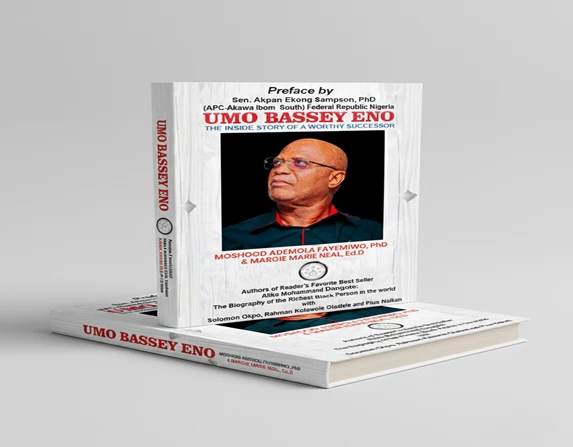
“Bíbíre kò ṣé fowórà –A popular Yoruba Proverb meaning A worthy birth is invaluable
In an immeasurable proportion, credit has to go to the parents, the roots, and the environment that nurtured anyone who turned out to be a quintessential gentleman or lady. Character is not available on the store shelf. But even if it were available to be ordered, it would have to be served à la carte, each person to their menu choice of starters, mains, sides, desserts, and all. The biography, Umo Bassey Eno: The Inside Story of a Worthy Successor, generously encapsulates what the Ibibio will describe as “Emana ęnyene ufọn, inyene ikemeke ndisi usuari”. Long before the subject of this literary work was born outside his homeland on 24th April 1964, there was a noble lineage in the Ibibio-Anang territory, which absorbed and remained fervent to the character traits of the people. The Ibibio environment throws up a modest person whose reverence for God is infectious, whose commitment to duty is incomparable, whose integrity, resilience, kindness, and other distinguishing attributes are the envy of other peoples. Intensive research by the biographers revealed that the paternal and maternal families of the subject of this book were among the early converts when the good news of Jesus Christ reached Ibibio land in the 1890s. In their small agrarian Ikot Ekpene Udo village, which had already ingrained the ethos of godliness, they embraced the Qua Iboe Christian denomination and made it flourish far beyond their land. As the Bible says in Proverbs 22:6: “Train up a child in the way he should go: and when he is old, he will not depart from it.” These virtues were handed over from generation to generation, and policeman Bassey Umo Eno did not allow the baton to drop from his hand literally and figuratively. Duty took British-trained officer, Bassey Umo Eno, who would later retire as Chief Superintendent of Police (CSP), to various parts of the country, but the DNA peculiar to his origin never went on transfer at any point. Umo Bassey Eno, his first child, arrived while CSP Bassey Umo Eno and Deaconess Eka Bassey Umo Eno lived at the Enugu Police barracks.
This timely biography captures in a photographic manner, Pastor (Dr.) Umo Bassey Eno’s life as a ‘barracks boy’ in Enugu and later, Lagos. The barracks provide a mix of experience — the good and the ugly. While they offer a strong sense of community, discipline, and camaraderie among the “barrack boys and girls, they also breed socially maladjusted youths. Governor Eno’s early life in the barracks was well guided by his parents. According to the authors; “as a British-trained officer serving in a key regional capital, he (Bassey Umo Eno) operated within an institutional environment that prized hierarchy, punctuality, procedural order, and strict discipline. These professional norms filtered into domestic life: accounts of the family suggest a home in which punctuality, respect for rules, and careful attention to detail were routinely enforced. Such a setting exposed the young Umo to a specific model of authority — firm, structured, and rule-governed — at an early age. It is not difficult to discern continuities between this early environment and his later leadership style in business, ministry, and public office, where he has often emphasised order, accountability, and adherence to formal processes.
The biography of Gov. Umo Bassey Eno of Akwa Ibom State, written by US-based Moshood Ademola Fayemiwo and Dr Margie Marie Neal, with assistance from Solomon Okpo, Rahman Kolawole Oladele, and Pius Nsikan. Billed to be released to the reading public on February 21, 2026
“His mother, Deaconess Eka Bassey Umo Eno, brought a complementary set of influences. Combining informal teaching at a Qua Iboe elementary school in the police barracks with small-scale trading in the ‘Mammy Market,’ she exemplified the fusion of economic pragmatism and religious commitment characteristic of many lower-middle-income Christian families in mid-twentieth-century Nigeria. Oral testimony from contemporaries describes her as quiet, disciplined, and industrious, with a reputation for moral rectitude and diligence. Through her dual roles as educator and trader, Eka modeled the value of work as both livelihood and moral obligation. Her modest teaching salary, supplemented by proceeds from petty trade, helped stabilize the family’s finances. Equally important, her vocation underscored the transformative potential of education. It is therefore not surprising that her son would later develop what observers have described as a “voracious appetite for knowledge,” pursuing formal education to advanced levels while simultaneously building a career in business and, subsequently, public administration. In sum, Umo’s early socialisation brought together two powerful streams: the disciplined, hierarchical world of the police institution mediated through his father, and the faith-infused, entrepreneurial and educational ethos embodied by his mother. The convergence of these influences contributed to a personality marked by a strong work ethic, respect for structures and authority, and a pronounced orientation toward education and self-improvement.”

L-R: Young Eno was 22 years old, and Patience was 19 when they got married in 1986. At a state event, this was their last outing as husband and wife in Akwa Ibom State in 2024.
Even as he grew up outside his homeland, Eno did not lack the Ibibio–Annang communalism. His parents stressed that the coal city of Enugu, his place of birth, was a place of work, as the family was only on a temporary sojourn. But, filled with personal memories and the camaraderie of loved ones, home is where you’re accepted unconditionally, where you can be yourself, and find true contentment beyond any material luxury. Very often, young Umo benefited from the return home visits, which exposed him to the distinctive rhythms of rural life, his kin and the cultural rituals of Ikot Ekpene Udo in Nsit Ubium. Ibibio cultural values were not lost on him, just as his parents’ commitment to the Qua Iboe way of life deepened his character. Let’s quote the book again: “The integration of indigenous cultural ethics with evangelical Christian theology generated a robust moral framework that stressed justice, compassion, and service to both God and neighbor. These overlapping influences — barracks discipline, Ibibio–Annang communalism, and evangelical Christianity — are evident in the themes that recur in his (Umo’s) later public rhetoric: the dignity of humble beginnings, the centrality of hard work, the importance of education, and the obligation of those in positions of authority to use power in ways that tangibly improve the lives of others.”
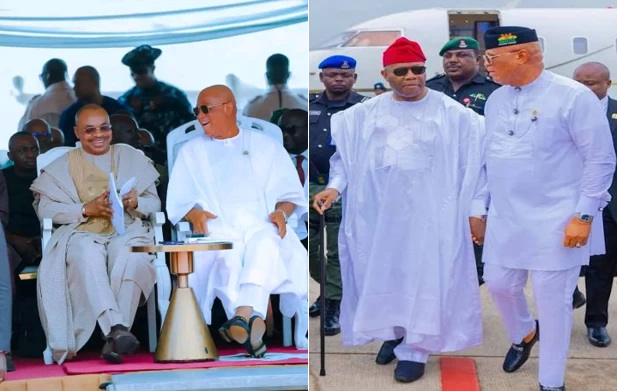
Gov. Umo Bassey Eno with his immediate predecessor, Udom Gabriel Emmanuel, and past governor, now Senate President Godswill Obot Akpabio
Duty again took the parents from Enugu to Lagos, with the change of location not changing the noble essence of their son, who was enrolled at the Local Government Authority Primary School in Lagos. His father’s death did not break him, but fired the spirit of entrepreneurship in the teenager, and exposed him to Nigeria’s commercial capital. Here, the biographers examine Eno’s early work experiences, encounters with the informal economy (including hawking non-alcoholic drinks for his mother), and exposure to new forms of social stratification, risks, and opportunities. The book pays attention to the life of the young man who had to have his secondary school education in both Eket, Akwa Ibom State, and Lagos, as well as his tertiary education at the University of Uyo. The biography explores his courtship, marriage to Patience in 1986 while he was 22, and early family formation. Here, the book analyses how family responsibilities reshaped Eno’s economic choices, risk appetite, and religious commitments, and how the household became a laboratory for negotiating gender roles, faith, and work.
Gov. Umo Bassey Eno with President Bola Ahmed Tinubu after he defected from the PDP to the APC

In Chapters 4 and 5, the authors provided insights into the book subject’s early ventures in commerce and hospitality. You’ll come across Eno’s entrepreneurial journey in the context of Nigeria’s volatile macroeconomic environment, structural adjustment, and the rise of a new indigenous business class. The same chapters provided readers with Eno’s Midas touch in business and how he managed to create thousands of jobs at his businesses. Umo Bassey Eno: The Inside Story of a Worthy Successor provides a detailed analysis of the institutionalisation of the subject’s business interests: corporate structure, diversification, employment practices and philanthropic positioning while he was at the helm of the Royalty Group, where faith, language and pastoral identity were woven into corporate branding, and how his business success story later served as fodders and as evidence of managerial competence and “proven capacity” in political campaigns. Business schools and other readers will find these chapters of great value. Chapter 6 digs into Eno’s transition into pastoral ministry, the theology and practice of his church community, and the place of prophecy, testimony and “divine calling” in his personal narrative. It situates his ministry within the broader rise of Pentecostal and charismatic Christianity in Nigeria, and interrogates how religious language about destiny, favour and spiritual warfare intersects with class, gender and power. In Chapter 7, the lead author –Moshood Ademola Fayemiwo-shares his “Midian experience” and exile/migration narrative. This fittingly serves as an analytical bridge on how global politics, refugee resettlement, higher education and diaspora experiences reshaped his world-view. It connects his exposure to international debates on democracy, governance and development with his evolving understanding of Nigerian politics and statecraft. Chapters 8 to 12 chronicle the book subject’s foray into politics and governance. Copious details on alliances, patrons, opponents and the incremental steps from the private sector and ministry into local and state-level political structures are deliciously served to the reader. You will understand how prophetic letters, column-writing, and public interventions around national elections positioned Pastor (Dr.) Umo Bassey Eno at the intersection of religion and politics before his formal candidacy. The processes through which he emerged as a gubernatorial candidate and ultimately governor are also analysed. These capture party dynamics, zoning debates, intra-elite negotiations, campaign narratives and the role of religious endorsement. During the governorship campaign, as this book recalls, Pastor (Dr.) Umo Bassey Eno’s “barracks boy” life was strategically combined with his later experience as a businessman and pastor to deliver a political salesman’s message. Chapter 10 evaluates the early years of Governor Umo Bassey Eno’s administration, focusing on the ARISE agenda as a policy framework. It assesses programmes in education, rural development, health, infrastructure and economic diversification, and devotes a great attention to whether and how its values — discipline, compassion, faith and hard work — translate into institutional reforms and measurable outcomes. Chapter11 reflects on the tensions and contradictions in his leadership story: private faith and public power, personal humility and political patronage, entrepreneurship and governance in a rentier petro-state. It situates his trajectory in comparative perspective alongside other Nigerian and African leaders shaped by similar intersections of religion, commerce and politics. It concludes by outlining possible futures for Akwa Ibom and for faith-informed political leadership in Nigeria, as well as the limits of biography as a tool for understanding structural change. The last chapter captures the troves of allegations and scandals that have trailed Governor Umo Bassey Eno regarding his academic qualifications, conflicting dates of birth, and discrepancies in his NYSC Discharge/Exemption Certificate, the scuttlebutts of washing one’s dirty linens in public against the backdrop of the untimely death of his wife, Mrs. Patience “Oluwayemisi’ Umo Eno. It offers reflections and sobriety on life after loss and grieving on one hand, and public perception and how headlines can amplify emotions in the zeitgeist of social media and the weaponisation of grief in politics on the other. It illustrates how narratives become accepted as truth in public memory. If your goal is to be inspired to overcome setbacks and struggles, Umo Bassey Eno: The Inside Story of a Worthy Successor should be your companion. It succinctly captures the down-and-up journey of the subject matter, his heritage and his people, and motivates others in similar situations. Rich in historical perspectives, this book will let you into the origin and experiences of one of Nigeria’s minority ethnic groups, which are rarely spoken about. The book explores how Pastor (Dr.) Umo Bassey Eno handled life’s challenges and made transformative decisions, which impacted his own life and goals. The authors were punctilious, and the narratives were grammatically flawless. Readers will hardly encounter errors of fact or grammar. Umo Bassey Eno: The Inside Story of a Worthy Successor should be the next book you will read.
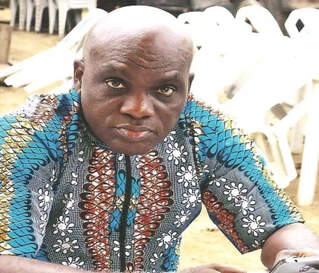
Muyiwa Akintunde is a public affairs writer, media professional and public relations consultant based in Lagos, Nigeria. He was West Africa editor of the monthly newsmagazine, Africa Today, published in the UK. He was a freelancer for the Madrid-based El Mundo newspapers. Previously, he was Bureau Chief at The Guardian newspapers, Associate Editor at Newswatch magazine, Deputy Editor of Theweek magazine and Editor of The Post Express on Sunday. He is a seasoned journalism trainer/mentor and communications consultant. Three years ago, he became the Publisher/Editor-in-Chief of an online news publication, Breezy NewsNG. He can be reached via email: akintundemuyiwa@gmail.com
Related posts