


That UK-Nigeria Agreement On Deportation By May Mohammed
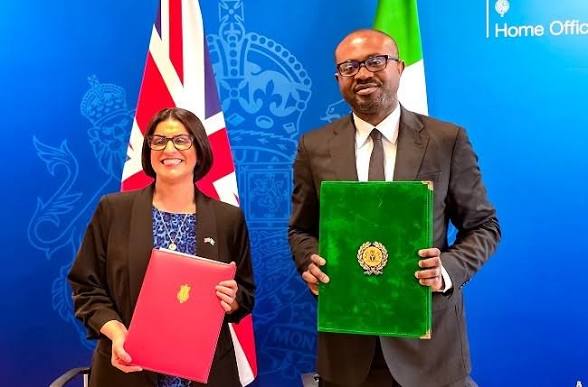
Recently, the human rights lawyer, Femi Falana, Senior Advocate of Nigeria (SAN) faulted the migration agreement between Nigeria and the United Kingdom, warning that it can not be enforced in its current form due to constitutional, legal and human rights concerns.
The agreement, signed during the state visit of President Bola Tinubu to the UK, is designed to fast-track the return of Nigerians without legal residency status, including failed asylum seekers and foreign offenders. Central to the Agreement is the use of the so-called ‘’UK-Letters’’ in place of standard travel documents, alongside provisions for reintegration support.
Falana, however, argues that the Agreement undermines due process and lowers the threshold for deportation by permitting removals without proper verification of identity or nationality. According to him, reliance on informal documentation such as ‘’UK letters’’ raises the risk of wrongful or arbitrary deportations, in violation of established international standards.
He contends that the Agreement is inconsistent wit the provisions of the Nigerian constitution, particularly the right to fair hearing, as it appears to allow deportations without giving affected individuals adequate opportunity to challenge their removal. The Senior Advocate affirms that bypassing established procedures for confirming citizenship could lead to cases of mistaken identity and unlawful repatriation.
Falana points out that the Agreement conflicts with Nigeria’s obligations under international human rights instrument, including African Charter on Human and Peoples’ Rights, and the International Covenant on Civil and Political Rights. He stresses that the nation is required to uphold human dignity, ensure access to legal remedies, and prevent individuals from being returned to situations where they may face harm.
Raising additional concerns, Falana said the policy could infringe on the rights to family life of Nigerians residing in the UK, many of whom have established homes, careers, and families. He cited decisions of UK courts, ZH (Tanzania) V. Secretary of State for the Home Department and Huang V. Secretary of State for the Home Department, which affirms that deportation decisions must consider the best interests of children and be proportionate to the circumstances.
Affirming the lack of transparency surrounding the Agreement, Falana notes that there is no evidence it has undergone legislative scrutiny or public debate in the country. In a constitutional democracy, he argued, agreements affecting fundamental rights cannot be implemented solely by executive action. He warned that some aspects of the agreement may be declared illegal by Nigerian courts, particularly the provisions allowing convicted persons in the UK to serve prison sentences in Nigeria.
Falana pointed out that under Nigerian law, including the Criminal Code Act and the Nigerian Correctional Service Act, no individual can be admitted into a correctional facility without a valid court order or warrant issued by a judge. He emphasized that the legal framework in Nigeria does not contemplate the transfer of foreign convicts into its prison system without due judicial process, cautioning that the country must not become a destination for persons convicted abroad.
The human rights activist called for a comprehensive review of the agreement to ensure compliance with constitutional provisions and international obligations. He stressed that for the agreement to have the force of law in Nigeria, it must be domesticated by the National Assembly in accordance with Section12 (1) of the Nigerian constitution.
Until such steps are taken, Falana insists that no Nigerian citizen should be subjected to arbitrary deportation under the guise of advancing the UK’s migration control objectives. In 2024, approximately 52,000 Nigerians reportedly migrated to the UK, placing Nigeria among the top non- European Union sources of long-term immigration, driven by work and study visas.
Between 2010 and 2024, the UK recorded 22,619 asylum applications from Nigerian nationals, with numbers surging in 2024. There has been a significant surge of Nigerian-trained health professionals moving to the UK, with their numbers on the Nursing and Midwifery Council register reportedly rising to over 15,400 by March 2025.
The UK subsequently implemented a rule banning most international students including Nigerians, from bringing dependents to the UK, following data that 59,053 Nigerian students brought 60,923 relatives to the country. Reports indicate over 900 rejected asylum seekers and over 1,100 offenders could be affected by this new UK immigration agreement with Nigeria.
*Mohammed writes from Lagos
Related posts