
The Bridge That Will Outlive The Noise: Why ‘Odo Iyalaro’ Will Define Sanwo-Olu
BY VICTOR GANZALLO
There are projects a governor commissions, and there are projects that commission a governor into history. The Odo Iyalaro/Opebi-Mende-Ojota Link Bridge belongs firmly in the second category.
Long after the press conferences have faded and the political arguments of this season have been forgotten, Lagosians will still drive across that bridge every single morning, and every single journey will be a quiet reminder of who had the courage to build it. That is what legacy truly means in Lagos, not noise, not slogans, but concrete that changes how people live.
For more than two decades, this bridge was a beautiful idea trapped on paper. It was conceived in 2002 during the tenure of Asiwaju Bola Tinubu, when Lagos was just beginning to dream of itself as a megacity. Successive administrations admired the drawing, spoke about the need, and moved on. It took Babajide Sanwo-Olu to look at that old file, dust it off, and say this will not remain a promise. In doing so, he did something rare in Nigerian politics: he finished what his predecessor started, proving that continuity is not weakness, but strength.
Anyone who has lived or worked in Ikeja understands why this matters so deeply. Opebi, Allen Avenue, Toyin Street, Mende, Maryland and Ojota are not far from each other on a map, yet for years they felt like different cities. To move from Opebi to Maryland, you were punished with Mobolaji Bank Anthony Way, Kudirat Abiola Road, and the Maryland nightmare. Hours were lost, fuel burnt, tempers were broken, and businesses suffered. The Odo Iyalaro bridge cuts straight through that suffering, offering a direct, modern alternative that reconnects the heart of the capital city to itself. This is why Sanwo-Olu’s legacy will be felt, not just read about.
A policy can be reversed, a budget can be forgotten, but a road that saves a mother one hour every morning to get her children to school, saves a businessman one hour to get to his shop, and saves a worker one hour to get home to his family, becomes part of people’s daily lives.
The governor himself said the bridge would improve the quality of life for Lagosians, and he was right, because in Lagos, time is life. Every minute saved in traffic is a minute returned to family, to work, to rest, to dignity.
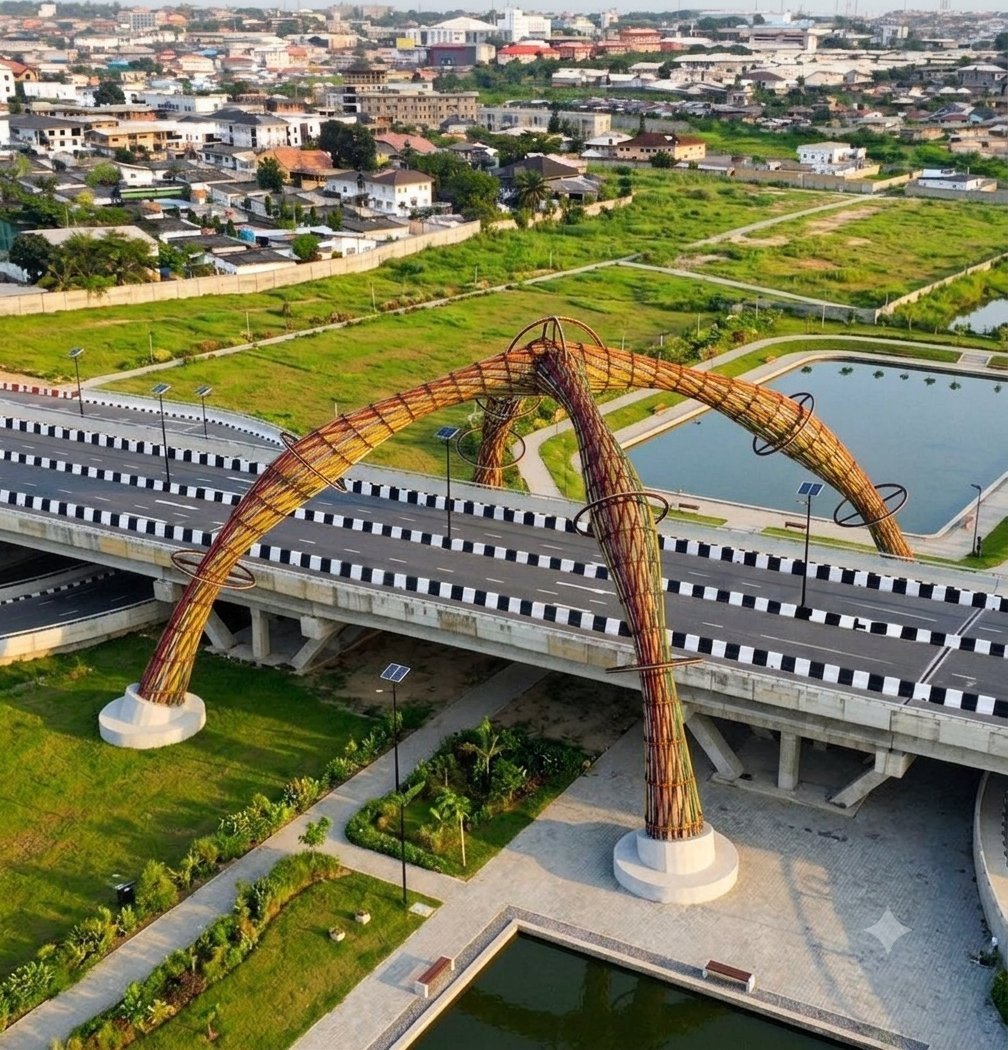
What makes this bridge even more special is that Sanwo-Olu refused to build it as just another grey slab of concrete. He insisted on building it with walkways, bicycle lanes, solar-powered street lighting, and embedded service ducts, a bridge designed for the Lagos of tomorrow.
In a city where pedestrians are often treated as an afterthought, this bridge says everyone matters. The trader, the student, the cyclist, the driver, all have a place on it. That is a philosophy of governance expressed in steel and asphalt. And then there is the monument, the masterstroke that has turned a road into a landmark.
Odo Iyalaro was once famous for its cane market, for the skilled hands that wove cane into chairs, baskets, and beauty. Instead of erasing that history in the name of development, Sanwo-Olu chose to celebrate it, with a towering steel sculpture of four hands weaving cane. He could have rushed to open the bridge in September for political applause. He chose to wait, to finish the monument properly, to ensure that when Lagosians drive across it, they do not just see a bridge, they see themselves. That patience is leadership.
Critics will point to the delay, to the fact that the bridge was commissioned in April 2026 but remained closed for months. Let them talk. Great works are not judged by the impatience of commentators, but by their endurance.
The Lekki-Ikoyi Link Bridge also had its doubters. Today, no one remembers the arguments, everyone remembers the bridge. So it will be with Odo Iyalaro.
When it opens fully to traffic this Christmas, the delay will be forgotten, but the landmark will remain.
There is also an economic story here that cannot be ignored. By linking Opebi to Mende, Maryland and Ojota, Sanwo-Olu has unlocked a whole new corridor of value. Properties in Mende that were once cut off by the swamp are now prime. Businesses in Opebi that were once hard to reach are now accessible. New shops, new offices, new jobs will spring up along that 5.04-kilometre stretch, because roads are not just for movement, they are for prosperity.
A governor who opens a road opens a market, and a governor who opens a market opens a future. Beyond Ikeja, this bridge tells the larger story of the Sanwo-Olu years. It is the story of a governor who did not chase headlines, but chased completion. From rail to roads, from hospitals to schools, his administration has been defined by the quiet discipline of finishing hard things. The Odo Iyalaro bridge is the most visible symbol of that discipline, because it sits in the open for all to see, a daily testimony that government can work when it is led with vision and sincerity.
In the end, history will be kind to Babajide Sanwo-Olu because he built something that history cannot demolish.
Ten years from now, a young Lagosian who never voted in 2023 will cross Odo Iyalaro bridge to go to work, and he will not need a history book to know that someone cared enough to build it.
That is the truest definition of legacy. Not the noise of today, but the bridge that carries tomorrow.
-Victor Ganzallo, a media entrepreneur and public commentator, writes from Lagos
Related posts