

Thoughts On The Oronsaye Report
Posted on March 10, 2024
ARINZE IGBOELI
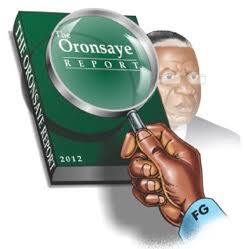
*The Oronsaye Report, officially known as the Presidential Committee on the Rationalisation and Restructuring of Federal Government Parastatals, Commissions, and Agencies, was a comprehensive review of government agencies and the duplication of functions and roles within them in Nigeria. The report which was aimed at streamlining government’s operations, the reduction of costs, and improved efficiency. However, since its release in 2012, the implementation of these recommendations has faced several challenges.
*
Some of the key recommendations of the report include merging, scrapping, or privatizing some government agencies to streamline operations and cut costs. However, the implementation of the report has been slow and faced with challenges.
One of the major issues with implementing the Oronsaye Report has been the resistance from government agencies. Many of these agencies have vested interests in maintaining the status quo, as it allows them to continue receiving funding and resources. These agencies often lobby against any attempts to merge or abolish them, citing their unique mandates and the importance of their services. This resistance has made it difficult for the government to follow through on the recommendations of the report.
Another challenge is the lack of political will to implement the recommendations. Many government agencies have powerful backers within the political class who are unwilling to see them dissolved or merged. In some cases, agencies have been retained for political patronage, with officials using them to reward political allies or secure votes in elections. This has created a situation where implementing the report would mean going against powerful interests, making it politically risky for the government to take action.
Financial constraints have also posed a challenge to the implementation of the Oronsaye Report. While the report recommended cost-saving measures such as merging agencies and eliminating duplication, the initial costs of restructuring and the potential loss of revenue from abolished agencies have raised concerns about the feasibility of the recommendations. The government has been reluctant to invest in the necessary resources to implement the report, especially in the face of competing priorities and limited funding.
Another issue with implementing the Oronsaye Report is the lack of a clear roadmap and timeline for reform. The report provided recommendations for rationalizing and restructuring government agencies, but it did not outline a detailed plan for how these recommendations would be implemented or when they would be completed. This lack of clarity has made it difficult for stakeholders to understand the process and track progress, leading to uncertainty and confusion about the government’s commitment to the reforms.
Lastly, the legal and regulatory framework for implementing the recommendations of the Oronsaye Report is inadequate. Many government agencies are governed by legislation that would need to be amended or repealed in order to merge or abolish them. This process is time-consuming and complex, requiring legislative approval and political consensus. Without a clear legal pathway for implementing the recommendations, the government has struggled to make meaningful progress on the report’s reforms.
However asides these challenges there are schools of thought that believe that the said report may be incongruous with today’s realities, these thoughts hold that a thorough implementation of the report will not address the main issues such as the cost of governance as believed some years back.
Take for example, the report has called for the
The National Salaries, Income and Wages Commission (NSIWC) is to be subsumed under the Revenue Mobilisation and Fiscal Commission (RMAFC), but why should the Infrastructure Concession and Regulatory Commission (ICRC) be merged with the Bureau of Public Enterprise and be renamed as Public Enterprises and Infrastructural Concession Commission?
Why should a super agency like the Pension Transitional Arrangement Directorate (PTAD) with it’s superb acheivments in the area of pensions be scrapped while its functions will be taken over by the federal ministry of finance?
I need explanations on why a commission as instrumental to the guaranteeing of our basic rights that is the National Human Rights Commission be merged with the Public Complaints Commission?
Again, why do we think that just merging agencies without plans to rationalize will help reduce costs of governance and aid efficiency in the public service, yes it may reduce the duplication of functions but then we would still be left with that bloatedness which initially informed the major reason for setting up the Oronsaye Committee. Such bloatedness naturally sees workers who aren’t effective in their places of work continue to drain the state of it’s resources, resources which would have profitably gone into other areas, sectors or ministries, herein lies the notion that implementing wholly the Oronsaye report is not in tandem with the present times.
The task therefore before the Senator George Akume Committee will be to carry out a surgical implementation of the report , taking into cognizance the need to enhance the effectiveness of the service without reaping for the nation certain consequences that may further destroy the nation’s civil service.
May Nigeria Succeed!
Categorised as : Opinion
No Comments »
Related posts