
Opinion: A Letter From Juba Highlights Ongoing Press Freedom Concerns In Africa
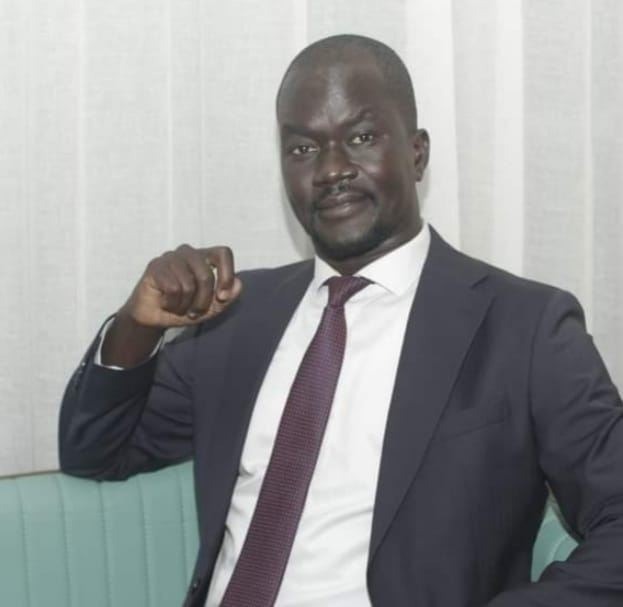
<em><strong>Garang John</strong></em>
“Hello, Bosun. I hope this email finds you well. Thanks for your intervention last time when I was in a tight corner in Juba following the leak of the video showing President Kiir wetting himself in public.
Relevant human rights institutions did their best, but as I write to you, it has gotten worse. The government’s security has scaled up their hunt for me. I won’t want to mention where I am now in this email until I confirm you have received this message safely. You previously got my WhatsApp. I don’t want to share it here. I have launched my prison diary to help those languishing in the security cell in Juba be freed. It haunts me every day, and I felt the need to take this risk. As I write to you, it’s just a matter of time, but, my brother, I am very aware that I will be killed. Kindly download and keep the prison diaries I have shared on my Facebook page. They are authentic, and that’s the situation our people in South Sudan have been going through. I know that even without me, you can produce a book that will liberate that nation. I don’t want to say anything beyond this point.
Thanks
“Garang John”
The arrest and alleged abuse of at least six South Sudan journalists is renewing scrutiny of press freedoms in the country and Africa at large.
In an ordeal that lasted for about two months, six journalists were picked up and taken to the National Security Service (NSS) detention facility, commonly known as the Blue House, for investigation over the leaked video of President Kiir urinating on himself while singing the national anthem during an event in Awerial County, Lakes State, in January.
Days later, famous South Sudan Broadcasting Corporation journalist Garang John was picked and detained, becoming the seventh journalist implicated in the case.
But on February 18, the authorities freed three journalists, namely: Joval Tombe, the control room director; Cherbek Reuben, the control room technician; and Joseph Oliver, a cameraman.
The fate of the other three journalists is unknown.
Since the NSS Act in 2014, the NSS has accumulated unchecked powers, becoming one of the main perpetrators of human rights violations and the most powerful security actor in South Sudan.
Exceeding the NSS’s constitutional mandate, which limits its powers to “information gathering, analysis, and advice to the relevant authorities,” the 2014 NSS Act gives the security agency police-like powers to arrest, detain, conduct searches, and seize property without adequate safeguards.
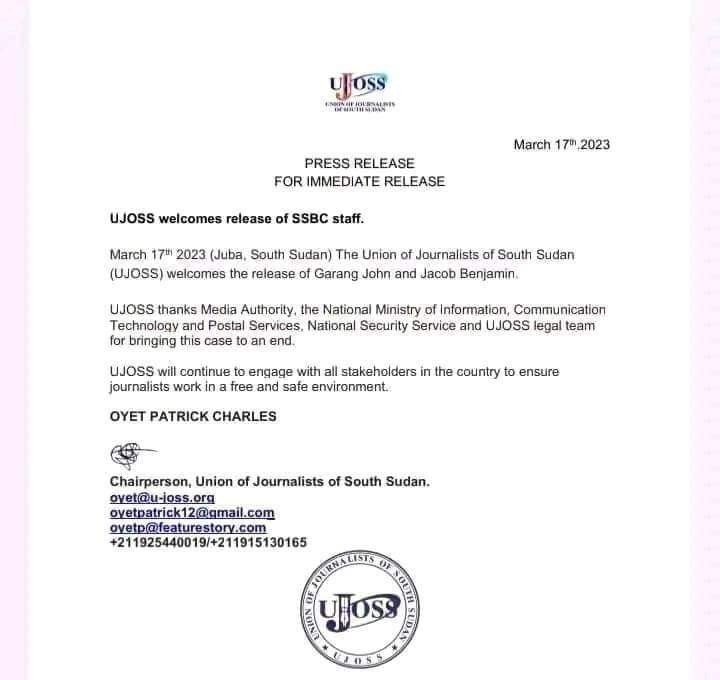
Garang was released alongside Jacob Benjamin from the NSS detention in early March.
In a statement on his social media Facebook page on Saturday morning, Garang said his health has been compromised and added that he can’t feel his brain and that medical professionals are yet to figure out what is wrong with his mind.
“I am out of jail after 60 days of confinement. My health is totally compromised. I can’t feel my brain. Doctors are yet to figure out what’s wrong with my lungs. I am completely weak and tired, but it shall be well,” he said.
Garang John has been a personal friend since 2012. We both attended a media training hosted by the State Administration of Radio, Film, and Television in Beijing, China, alongside several African journalists.
Journalists report on complex and difficult topics, including natural disasters, political violence, and human suffering.
According to a report published by UNESCO, over the past decade, a journalist has been killed every four days on average. Each year since 2016, more journalists have been killed outside of conflict zones than in countries currently experiencing armed conflict. A total of eighty-six killings of journalists worldwide have been reported between 2020 and the end of June 2021.
Impunity for crimes against journalists continues to prevail, with nine of ten killings remaining unpunished. The year 2020 saw a slight improvement, however, with thirteen percent of cases worldwide reported as resolved, compared to twelve percent in 2019 and eleven percent in 2018. In many cases, impunity results from bottlenecks within the justice system itself.
In the context of the COVID-19 pandemic, media workers around the world have also been subject to harassment, persecution, and detention as a result of their work to keep citizens informed about the health crisis.
The media has always considered itself a defender of democracy, a critical part of society with rights enshrined in the Bill of Rights. But having (and celebrating) a free press isn’t enough to advance democracy.
For years, rights groups and dissidents have raised concerns about the Ethiopian government’s use of anti-terrorism laws to target journalists. Violent unrest in the country and concerns about the role of inflammatory news reports and social media posts in stoking violence contributed to public support for the laws.
A free and responsible press is essential to any democratic society. It is high time Africa explore this ideal efforts to maintain and encourage freedom of expression, rights and responsibilities of a free press in a democracy while observing the operational practices, standards, and institutions of the media.
Journalists are often harassed in Africa.
In Nigeria, this pernicious act of security agencies targeting and subjecting journalists and oppressing our citizens is becoming a major threat.
At least 14 journalists and media workers were detained, harassed, or attacked while covering Nigeria’s presidential and federal elections, including private news website WikkiTimes owner Haruna Mohammed Salisu.
In March, a federal court in Abuja, Nigeria’s capital, ordered the detention of CrossRiverWatch publisher Agba Jalingo for allegedly publishing false news that caused “annoyance, ill will, and insult,” in violation of Nigeria’s Cybercrimes Act, according to a report by the outlet and CrossRiverWatch editor Jonathan Ugbal, who spoke to CPJ by phone.
The charge relates to a June 2022 CrossRiverWatch article alleging that Elizabeth Alami Frank Ayade, sister-in-law of Cross River State Governor Ben Ayade, paid someone to take a law school exam for her.
In August 2022, authorities arrested Jalingo following a complaint from Elizabeth Ayade and charged him under the Cybercrimes Act in December 2022. In 2019 and 2020, Jalingo was arrested and detained for nearly six months over his reporting about Governor Ben Ayade.
In November 2021, a Vanguard Newspaper missing reporter, Tordue Salem, was found dead in Abuja, north-central Nigeria.
The late Salem, who was covering the House of Representatives, was last seen on October 13, 2021, with an alarm about his mysterious disappearance being raised the next day.
Salem joined the list of many journalists who have been killed or died as a result of insecurity and impunity in Nigeria.
On Jan. 21, 2020, an editor with the local independent outlet Regent Africa Times, Alex Ogbu, was killed at a protest in Abuja. He was shot by a bullet that was fired by the police at the scene of the Shi’ite protest.
Also, a former presenter and on-air personality for Naija FM, Titus Badejo, was murdered on June 19, 2021, in Oyo State, Southwest Nigeria.
The general feeling in most African nations is that journalists pose a threat to the status quo, and journalists who are openly critical are harassed and questioned by the police.
Olatunbosun Awoniyi writes from Lagos, Nigeria
Related posts