

EFCC Recovers N38.66bn, Properties in Multi-Billion-Dollar Refinery Fraud Probe, Moves To Prosecute NNPC Officials
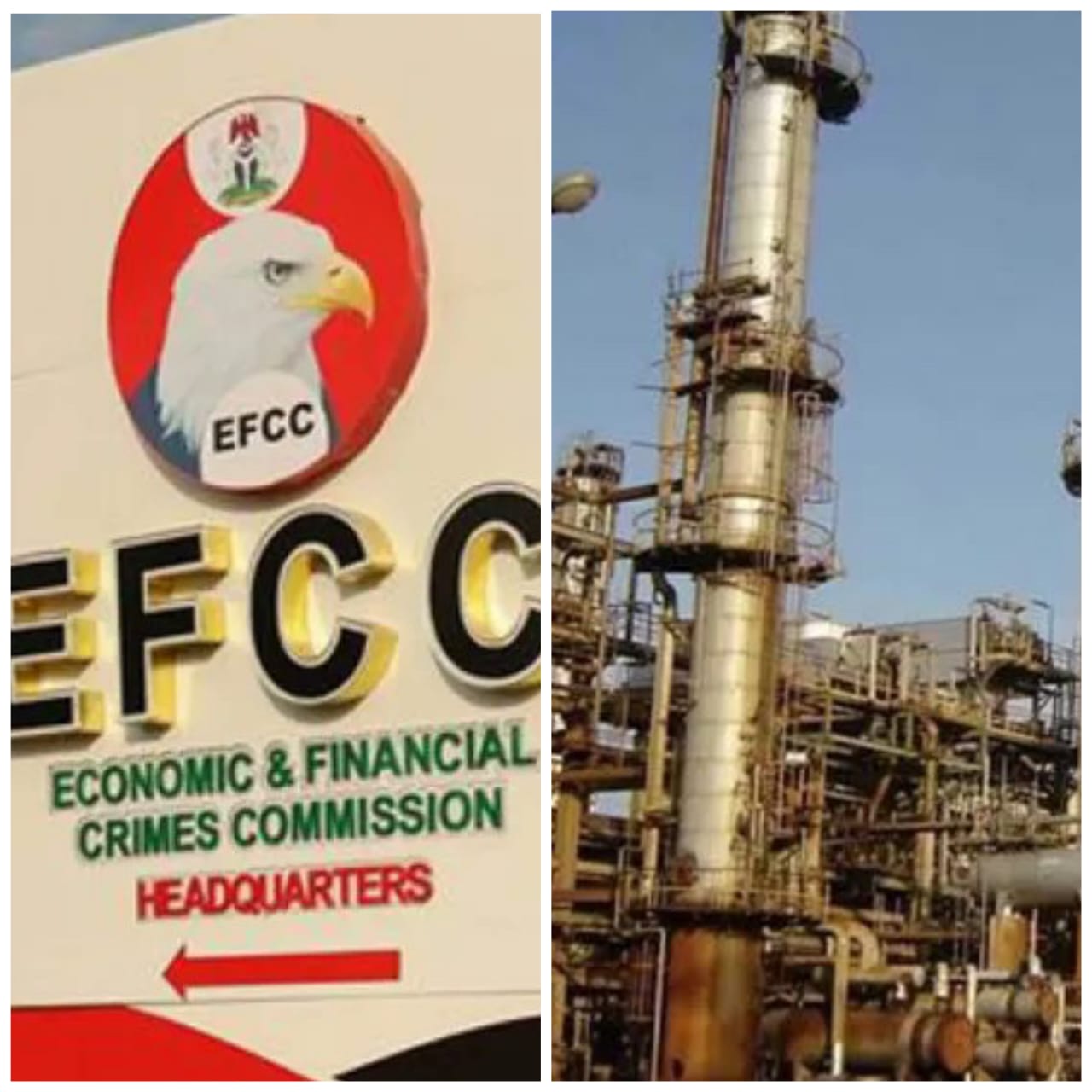
The Economic and Financial Crimes Commission (EFCC) has recovered over N38.66 billion in cash and assets as part of an ongoing investigation into the alleged diversion of funds earmarked for the rehabilitation and turnaround maintenance of Nigeria’s state-owned refineries, with several former and serving officials of the Nigerian National Petroleum Company Limited (NNPCL) and contractors now facing possible criminal prosecution.
The anti-graft agency has so far recovered N9.4 billion, $21.2 million—equivalent to about N29.26 billion at the Central Bank of Nigeria’s official exchange rate of N1,380 to the dollar—as well as several landed properties allegedly traced to individuals under investigation.
Investigators described the probe as one of the most extensive corruption investigations involving Nigeria’s oil sector, focusing on the management of approximately $2.79 billion released between 2021 and 2023 for the rehabilitation of the Port Harcourt, Warri and Kaduna refineries.
According to findings by investigators, the probe centres on allegations of criminal conspiracy, criminal breach of trust, diversion of public funds, economic sabotage, abuse of office, money laundering and procurement fraud involving officials of the NNPCL, its subsidiary, the NNPC Engineering and Technical Company Limited (NETCO), former and serving managing directors of the three refineries, and major contractors, including Daewoo Engineering Nigeria Limited and Tecnimont SPA.
The federal government had awarded contracts valued at approximately $2.79 billion for the quick-fix repairs, turnaround maintenance and rehabilitation of the country’s refineries.
The contracts included about $1.56 billion for the Port Harcourt Refining Company, $740.7 million for the Kaduna Refining and Petrochemical Company, and $492.3 million for the Warri Refining and Petrochemical Company.
Despite the huge financial commitment, investigators reportedly found little evidence of corresponding improvements in refinery operations, raising strong suspicions that substantial portions of the funds were diverted, misappropriated or fraudulently disbursed.
The findings have intensified scrutiny over successive government efforts to revive Nigeria’s long-moribund refineries, which continue to operate far below installed capacity despite repeated injections of public funds.
The EFCC had, last year, arrested several senior NNPCL officials in connection with the investigation. Among those detained were former Chief Financial Officer Umar Isa, Warri Refinery Managing Director Tunde Bakare, former Port Harcourt Refinery Managing Directors Ahmed Adamu Dikko and Ibrahim Onoja.
As part of the investigation, the commission has interrogated more than 30 senior NNPCL officials and over 50 officials of contracting firms and subcontractors involved in the refinery rehabilitation projects.
Investigators also examined procurement procedures, reviewed project execution, analysed payment records, scrutinised bank accounts, sought information from the Corporate Affairs Commission (CAC), the Central Bank of Nigeria and commercial banks, and traced ownership of companies linked to the contracts.
According to sources familiar with the investigation, the EFCC uncovered widespread violations of procurement procedures, questionable payment approvals and manipulation of contract processes allegedly facilitated by officials across different levels of management.
The investigation specifically accused former Port Harcourt Refinery Managing Director Ahmed Dikko of breaching contractual procedures by approving direct payments to contractors from provisional sum funds, contrary to provisions requiring such payments to be handled through Tecnimont.
Investigators said they traced assets valued at N983.9 million, $227,030 and three landed properties to Dikko, assets he allegedly failed to satisfactorily account for.
An interim forfeiture order has reportedly been obtained over the properties, while prosecutors are preparing criminal charges against him.
Similarly, investigators said they established a prima facie case against Jimoh Yisawu, a senior official linked to the rehabilitation of the Warri Refinery.
Yisawu is alleged to have approved payments to unqualified third-party contractors, authorised inflated invoices and contractual mark-ups exceeding $10 million and nearly ₦8 billion.
He was also accused of approving payment vouchers without the required cash-back arrangements, allegedly resulting in losses estimated at about $7.47 million and N1.89 billion in tax revenue.
The EFCC said it traced more than ₦1.4 billion and four landed properties to Yisawu, assets investigators claimed he could not satisfactorily explain. The properties have also been placed under interim forfeiture pending prosecution.
Sources disclosed that the ₦9.4 billion and $21.2 million already recovered have been paid into the EFCC’s recovery accounts, while an additional $2.32 million was recovered through the Federal Inland Revenue Service (FIRS).
Investigators further revealed that a separate case involving alleged revenue fraud valued at $28.39 million and ₦665 million has been established against the management of the Port Harcourt Refining Company, with efforts ongoing to recover the funds.
The investigation remains ongoing, with officials indicating that further recoveries, arrests and prosecutions are expected as additional evidence emerges.
The latest findings raise fresh concerns over the effectiveness of Nigeria’s refinery rehabilitation programme, despite the expenditure of billions of dollars over the years.
Nigeria’s four state-owned refineries—the two Port Harcourt refineries with a combined installed capacity of 210,000 barrels per day, the Kaduna refinery with 110,000 barrels per day, and the Warri refinery with 125,000 barrels per day—have a combined installed capacity of 445,000 barrels per day.
However, they have remained largely non-functional for decades despite repeated rehabilitation efforts.
The Warri Refinery, which resumed operations in December 2024, shut down barely a month later over safety concerns, while the Port Harcourt Refinery was taken offline in May 2025 for scheduled maintenance.
In October 2025, the NNPCL announced a comprehensive technical and commercial review of the three refineries as part of efforts to improve operational efficiency and profitability.
More recently, the company disclosed that it had signed a Memorandum of Understanding with two Chinese firms—Sanjiang Chemical Company Limited and Xinganchen (Fuzhou) Industrial Park Operation and Management Co., Ltd.—to support the completion, operation and possible expansion of the Port Harcourt and Warri refineries.
Details of the agreement, however, have yet to be made public.
Efforts to obtain the reactions of the NNPCL and the officials named in the investigation were unsuccessful as of the time of filing this report.
Their responses are expected to be included when received..
Related posts