The Newcomer In Global Justice By Lamis Musa
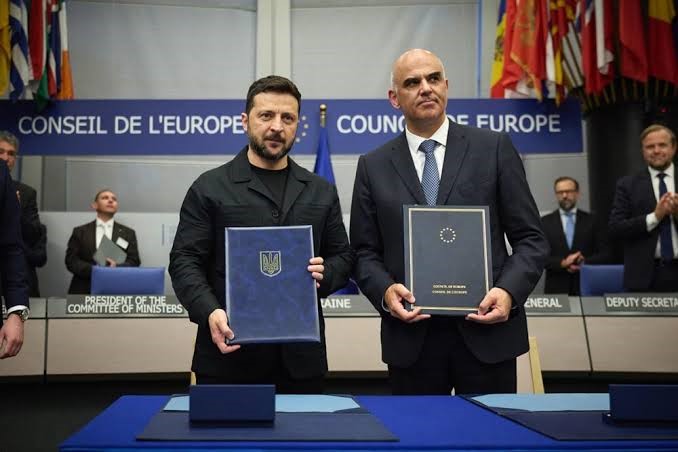
The field of international justice recently welcomed a newcomer called the Special Tribunal for the Crime of Aggression against Ukraine. The Tribunal will sit within the institutional framework of the Council of Europe. Founded on May 5, 1949, by France, the United Kingdom, and Italy, the Council of Europe is an international human rights organisation representing 46 member states, and it is an official observer at the United Nations.
A bilateral agreement between the Council of Europe and Ukraine to establish the Tribunal was signed in Strasbourg on 25, June 2025. The Statute of the Special Tribunal is annexed to the agreement. After the signature of the bilateral agreement, interested parties, including members and non-member states of the Council of Europe from around the world, can indicate their interest in joining the Enlarged Partial Agreement on the Management of the Tribunal. This will ensure funding for the Tribunal and oversight of its running, so that it can carry out its statutory duties. It is currently backed by multi-million-euro allocations from the European Union (EU) and contributions from participating Western states.
At a meeting in Chisinau, Moldova, in May this year, 34 member states of the Council of Europe, plus Australia, Costa Rica, and the EU as an institutional entity adopted the resolution establishing the Enlarged Partial Agreement on the Steering Committee of the Tribunal. This now gives the developing countries of the Global South a formal opportunity to join the process.
Ukrainian Foreign Minister, Andrii Sybiha, stated: ‘The Special Tribunal has become a legal reality. ‘It is currently operating in a transitional ‘’skeleton tribunal’’ setup in The Hague and Strasbourg to build infrastructure, recruit staff, and establish the Management Committee before issuing indictments.
The Tribunal will investigate, prosecute, and try individuals who bear the greatest responsibility for the crime of aggression against Ukraine. It aims to address the gap arising from the limitations in the jurisdiction of the International Criminal Court (ICC). The ICC has jurisdiction to investigate war crimes, crimes against humanity, and genocide in Ukraine. However, according to supporters of the Tribunal, it cannot currently examine the crime of aggression in Ukraine, due to its jurisdictional limitations for the crime of aggression. The Tribunal, they believe, will fill this gap.
According to its Statute, the Tribunal is complementary to the ICC, and it is expected to conclude agreements with the ICC on mutual cooperation. When a person concerned is detained by the ICC, which will have primacy over proceedings before the Tribunal. But we all remember how the ICC was turned into a theater for the trial of African presidents, leaving out Western powers.
The African presidents include Laurent Gbagbo of Ivory Coast; Omar al-Bashir of Sudan; Uhuru Kenyatta and William Ruto of Kenya; Emperor Jean- Bedel Bokassa of Central African Republic (CAR); Hosni Mubarak of Egypt; Marc Ravalomanana of Madagascar; Zine El Abidine Ben Ali of Tunisia; Moussa Dadis Camara of Guinea; and Hissen Habre of Chad.
That is why the reaction of developing countries to the creation of the Tribunal is characterized by widespread reluctance, skepticism, strategic neutrality, and criticism of double standards, marked by key elements such as accusations of selective enforcement of international law, non-aligned resistance to Western-led legal frameworks, and widespread abstentions on related United Nations votes.
Many governments and analysts in the Global South are asking: why is the Tribunal created only on the Ukraine case, and not considering similar situations in other regions where there was also military aggression? They point at the absence of a similar special international Tribunal during the United States-led invasion of Iraq or other Western military interventions, viewing the push for an ad hoc court on Ukraine as selective Western legal enforcement.
Framing the Special Tribunal strictly as a defense of a universal ‘’rule-based global order’’ is being met with cynicism, as numerous developing nations feel that their own security concerns and historical grievances with colonialism have been ignored by Western powers. And they see in this Tribunal the risk that the mechanism will become an instrument of unilateral pressure on them.
Some politicians in the countries of the Global South see the Tribunal, not a search for balance and justice, but as a ‘’trial of a particular state,’’ when it is known that similar actions by Western countries have often been left without due international scrutiny. Others view it as a distraction in the face of their own pressing issues of development, poverty reduction, climate change, and debt burden.
Frankly speaking, the developing countries tend to perceive conflicts between great powers as a risk to themselves, and do not want to be drawn into their political squabbles. Although they can join the Tribunal as its Statute allows it, but in practice, their membership will entail financial costs, which will be demanded from them on joining. And then, as in the case of the ICC, the Special Tribunal will be another lever of pressure on the Global South.
*Musa writes from Minna
Related posts