


X-Raying Governor Soludo’s Canadian Mission And Anambra’s Innovation Imperative
CHRISTIAN ABURIME
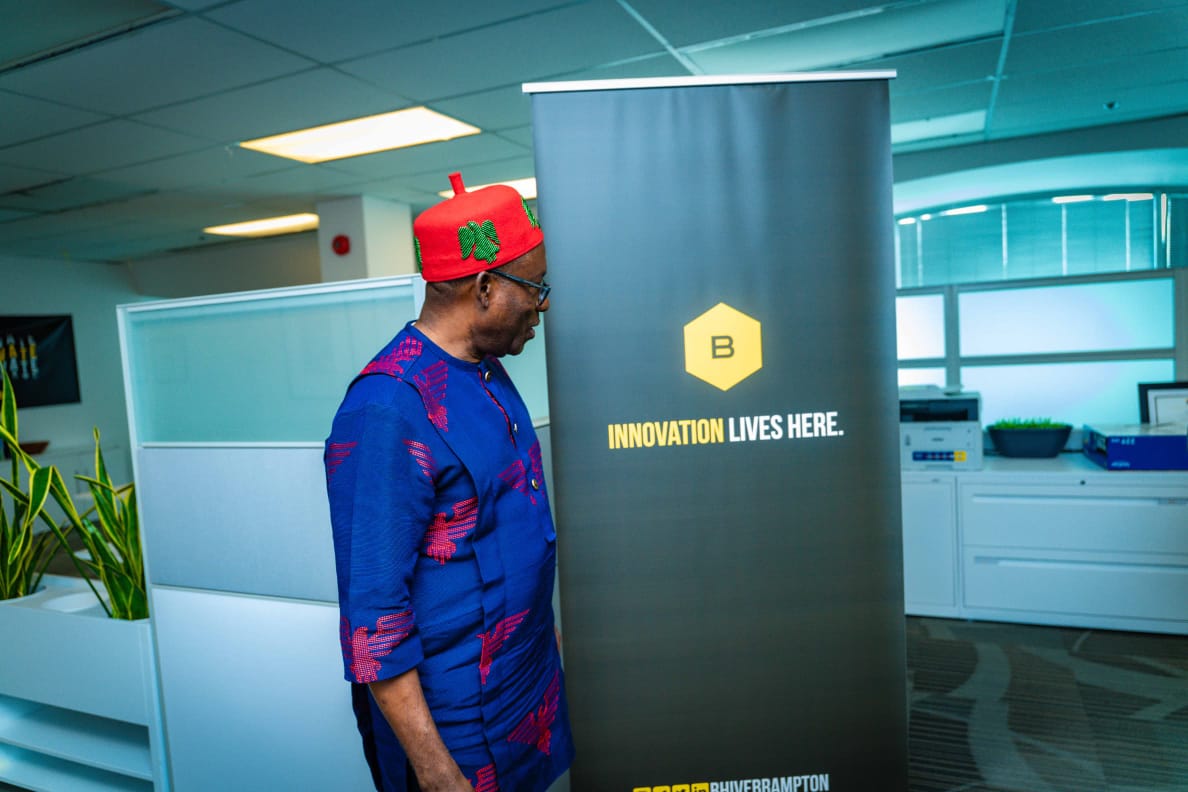
The spectacle of the Governor of Anambra State, Professor Chukwuma Charles Soludo, CFR, lately landing in Canada as the latest episode in his relentless quest for global best practices to transform Anambra may have elicited a typical Nigerian cynicism: another jamboree. But beyond the diplomatic formalities and photo opportunities lay a more serious intentionality, one that speaks less to fancy foreign trips and more to exemplary economic modelling in an increasingly competitive global landscape.
It is obvious that this is not a jamboree. It is an ongoing patriotic reconnaissance. While attending the Nigeria Diaspora Economic Development Conference in Toronto together with the Federal Government delegation, the Anambra State Governor has carved out time for something far more consequential for his State.
He has toured the Brampton Innovation District. He has sat with leaders of Altitude Accelerator, Brampton Venture Zone, Rogers Cybersecure Catalyst, and BHive. He has walked the halls of Toronto Metropolitan University’s Medical School. And he has asked probing questions about how places like Brampton transformed from suburban communities into thriving innovation hubs.
Governor Soludo’s interest was specific, and almost surgical in its focus. According to his public statements from the visit, he sought to apprehend what he called “the critical success factors behind thriving innovation ecosystems.” He wanted to unravel the institutions, the infrastructure, the talent pipelines, the private-sector partnerships, and the deliberate public-sector interventions. These are the invisible gears that convert ideas into jobs, startups into scaled businesses, and technology into better public services.
The governor further made his intentions clear: Anambra’s ambitions extend beyond material structures. Of course, physical infrastructure matters, but it means little without the ecosystem that allows talent to flourish and enterprises to compete globally. What he witnessed in Brampton, a district that incubates ventures, connects capital with innovators, and bridges academia with industry, represents a blueprint he now intends to adapt for Nigeria’s commercial nerve centre in Anambra.
The result? A more intentional push to develop the Solution Innovation District and its surrounding ecosystem in Anambra, calibrated to local realities while drawing from proven global models.
At the diaspora conference itself, Governor Soludo delivered a harder message, one couched in urgency: “It is either we survive or perish.” Speaking alongside Zamfara State Governor Dauda Lawal, the Anambra leader positioned his state not as a charity case but as a high-yield opportunity. He introduced the Anambra State Development and Investment Corporation (ADIC), an institution explicitly engineered to de-risk private capital and institutionalise investment protection.
Drawing from his own track record at the Central Bank of Nigeria, Governor Soludo noted that ADIC mirrors the operational philosophy of the Africa Finance Corporation, which he helped conceptualise and founded during his tenure as CBN Governor. And the invitation he extended was unequivocal: the diaspora is welcome to invest in Anambra State. Already, stakeholders have initiated discussions around power generation and related sectors.
But Governor Soludo’s pitch carried weight because it wasn’t divorced from tangible progress. He outlined several flagship projects. There is the integrated aerotropolis-industrial complex, a logistics-forward manufacturing hub designed to serve both domestic and export markets. There is also power infrastructure, including dedicated substations within new industrial zones to address one of Nigeria’s most persistent bottlenecks.
What’s more, urban revitalisation of Onitsha, West Africa’s largest traditional market, is being positioned to become a renewed commercial epicentre, while security architecture reform, including advocacy for devolving policing powers to local government tiers, is in the works. Notably, the governor also cited the elimination of Monday sit-at-home orders, an informal blockade that had paralysed commerce for years, as evidence that governance reforms are yielding measurable results.
Interestingly, Governor Soludo’s decision to appear in Canada dressed in indigenous akwete attire, widely praised at the event, signaled cultural confidence alongside economic ambition. This was authentic nation-building with a credible face, not another playing to the gallery.
More seriously, the governor crystallised his vision in seven words: “Build in Anambra, innovate in Anambra, create in Anambra.” This is a developmental manifesto wrapped in a slogan, but the implications run deeper. In a world where capital flows to predictability and innovation gravitates towards supportive environments, the competition for economic relevance is unforgiving. States, and nations, that fail to cultivate fertile ground for enterprise risk irrelevance.
Thus, Governor Soludo’s North America visit, stripped of ceremonial flourish, reveals a governor attempting to reverse-engineer prosperity. He is not importing solutions wholesale; he is studying mechanisms, extracting principles, and adapting them to Anambra’s unique conditions.
But the intent is definitely undeniable beyond routine tourism. It was homework, with real-world consequences for millions of Anambra residents whose futures depend on whether innovation translates into livelihood.
The lingering question won’t be about the trip’s duration or the number of meetings held. It would be whether Anambra could now convert these insights into momentum. Certainly yes, with the uncompromising drive of a focused leader like Governor Soludo, the momentum is assured as he returns home.
Related posts