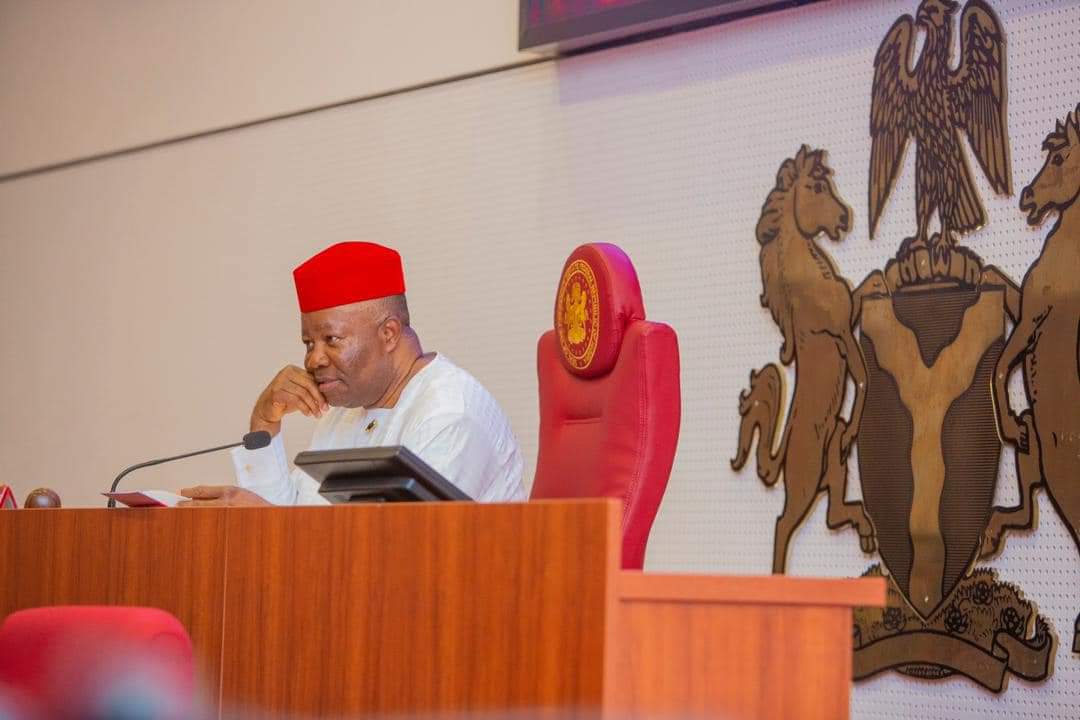
Assigning an acronym or moniker to an individual often unveils aspects of their character – think “uncommon” Governor, “uncommon” Minister, and “uncommon” Senator. In the case of the recently elected “uncommon” President of the Senate, every facet of his tenure over the past month has unequivocally reinforced this distinctiveness.
Is it not extraordinary for the Senate to continue its deliberations until the late hours, as late as 10 pm? Is this dedication or overtime? Undoubtedly, the “uncommon” President of the Senate guides an “uncommon” Senate.
While standard Senate sessions are slated to conclude at 3 pm, the “uncommon” Akpabio extended them until 10 pm by amending existing rules, effectively accommodating the exigencies of legislative business.
Is it not a rarity for the Senate to convene sessions on both Fridays and Saturdays? Yet, under Akpabio’s leadership – that of the “uncommon” President of the Senate – this deviation from the norm was evident. The expectation would be such rule adjustments reserved for crises, but in the name of national development, the Senate demonstrates a steadfast commitment.
Isn’t it noteworthy that under this “uncommon” leadership, the Senate orchestrated a rigorous screening process for 48 ministerial nominees within a mere span of two weeks? This achievement establishes a hitherto unprecedented record.
Is it not uncommon in Nigeria’s history for presidential ministerial nominees to be screened, with a mere three out of 48 candidates awaiting clearance? An unprecedented occurrence within Nigeria – ordinarily, all nominees breeze through screenings. However, this “uncommon” leadership of the Senate remains steadfast in upholding due process, as three nominees await their final clearance, underscoring the gravity of the responsibility.
Is it not an anomaly to postpone the scheduled recess when pivotal matters of national importance demand attention? Meanwhile, the House of Representatives has already initiated their recess, yet the Senate steadfastly continues its sessions to address pressing national developmental issues.
Is it not extraordinary when the Senate forthrightly provides Mr. President with candid advice and opinions regarding crises in Niger? To castigate this Senate as a rubber stamp would be unfair, considering its active involvement in these matters.
Is it not a marvel that the Senate – composed of members from different political parties – functions as a cohesive and unified body? Regardless of their party affiliations, APC, LP, and PDP members collectively endorse nominees from varying parties, an exemplification of unity prevailing over political divisions.
Within this Senate, public participation has been encouraged through the submission of petitions against ministerial nominees, and these petitions have received due attention, even resulting in the suspension of clearance for three nominees – a truly “uncommon” practice.
Akpabio’s astute leadership style, often punctuated with humor to alleviate the rigors of work and ease tension, demonstrates his genuine commitment to leadership. Thus, it becomes perplexing when unfounded issues are raised against the Senate’s leadership.
One mustn’t overlook that it is a universally accepted practice for civil servants to receive leave bonuses when they embark on annual leave, a practice upheld by all public officers, irrespective of sector – both private and public. The “uncommon” President of the Senate’s transparent leadership is evident in the announcement of these bonuses, where transparency trumps obscurity, and distributions occur through legitimate channels rather than “under-the-table” deals.