

When Washington Burned: A Lesson America Learned But Nigeria Still Ignores
Posted on October 26, 2025
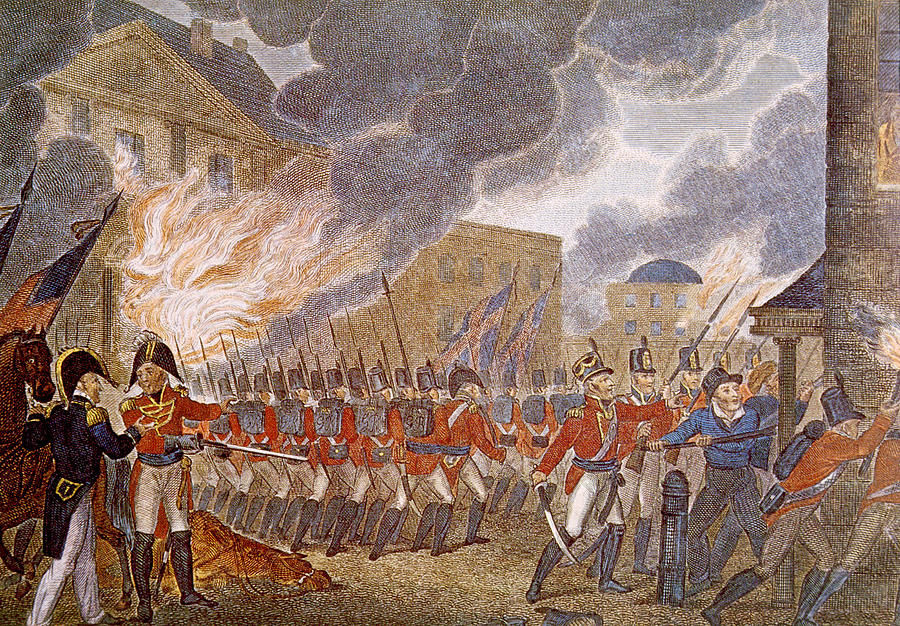
History never stops speaking but many do not listen to its voices of reasoning. It only changes its audience. In 1814, when the British stormed Washington and burned down the White House, America’s humiliation came not merely from the enemy’s strength, but from its own lack of unity and preparedness. Two centuries later, Nigeria walks the same tragic path, unguarded, divided, and vulnerable to external manipulation that fuels her insecurity and weakens her soul as a nation.
The burning of Washington, when Americans sought to assert independence fully, was not an act of conquest; it was punishment. The President of The United States, James Madison, ran away while the First Lady, Dolly Madison, risked her life to go into the White House to remove George Washington’s portrait and escaped with it through the back door as British soldiers entered through the front gate. The British set fire on the city, including The Capitol, the treasury, and the President’s mansion. The White House burned for hours, its flames lighting up the night sky as British officers toasted to the “honor of the Empire”.
Britain had just defeated Napoleon in Europe, the most powerful man of his age, and turned its attention across the Atlantic to teach the Americans a lesson. The young United States had gone to war with confidence, thinking Britain’s exhaustion from the Napoleonic Wars would spare them. Instead, British troops, hardened from European battlefields, landed on American shores, crushed the militia at Bladensburg, marched into Washington, and set the city aflame.
The White House, Congress, and key government buildings burned through the night. The United States was humiliated because it was not united. Its army was ill-prepared, its leaders divided between political factions, and its regions uncertain whether the war was even worth fighting. The British exploited that weakness ruthlessly. But that humiliation became America’s awakening. From those ashes, the United States began to build the kind of unity and resolve that later made it the most powerful nation on Earth. They learned that national defense begins with national cohesion, and that no country survives external aggression when it is internally disjointed.
Nigeria today stands at a similar crossroads. But unlike America, she has yet to learn. Our insecurity is not just about bandits, terrorists, or herdsmen; it is about the absence of unity, purpose, and leadership. While external powers quietly fund chaos through arms smuggling, resource exploitation, and political interference, we remain trapped in petty ethnic and religious rivalries and sectional suspicions. The enemies of Africa do not need to burn our capitals, for they simply watch us burn ourselves. We pour on ourselves the petrol of our differences in adopted religions we know nothing about and light up ourselves with a matchstick of myopic notion of tribal differences, failing to note that differences in language is never a yardstick for measuring tribe. The entire Africa houses one tribe, the AFRO TRIBE, just like the European tribe despite their many languages.
The West that burned Washington in 1814 is the same civilization that now burns African nations through economic manipulation, proxy wars, and psychological colonization. Nigeria, once the hope of the black race, has become a field of foreign experimentation, where poverty, insecurity, and division are the weapons. Our borders leak like sieves, our people suffer in silence, and our leaders bow before foreign interests.
Had the Americans of 1814 continued their disunity, there would be no “United States” today. They would have remained in a cage of a divided territory swallowed by empire. But they rose from the fire with a shared vision. Nigeria, as well as the entire Africa must do the same. Our humiliation will not end until we recognize that unity is not a slogan but a shield.
When Britain burned the White House, America rebuilt it stronger. When terrorists burn our villages, we must rebuild our nation with stronger institutions and a united will. When foreign powers manipulate our markets and our politics, we must respond not with tears or complaints, but with strategic self-reliance.
The British burned Washington once; the lesson was learned. But Nigeria’s fire is ongoing, not from invaders in red coats, but from within, stoked by division, corruption and weakness. If we do not unite now, our enemies will never need to march on Abuja; they will rule it from afar, as they already do.
History has spoken. America’s burning was temporary because it rose united. Nigeria’s burning continues because it stands divided. The cure, as always, is unity; the one weapon no foreign power can defeat.
– Ambassador Ezewele Cyril Abionanojie is the author of the book ‘The Enemy Called Corruption’ an award winner of Best Columnist of the year 2020, Giant in Security Support, Statesmanship Integrity & Productivity Award Among others. He is the President of Peace Ambassador Global.
Categorised as : Opinion
No Comments »
Related posts