

Fuel Subsidy Is Gone! – The Audacity Of President Bola Tinubu
Posted on June 7, 2023
MICHAEL CHIBUZOR
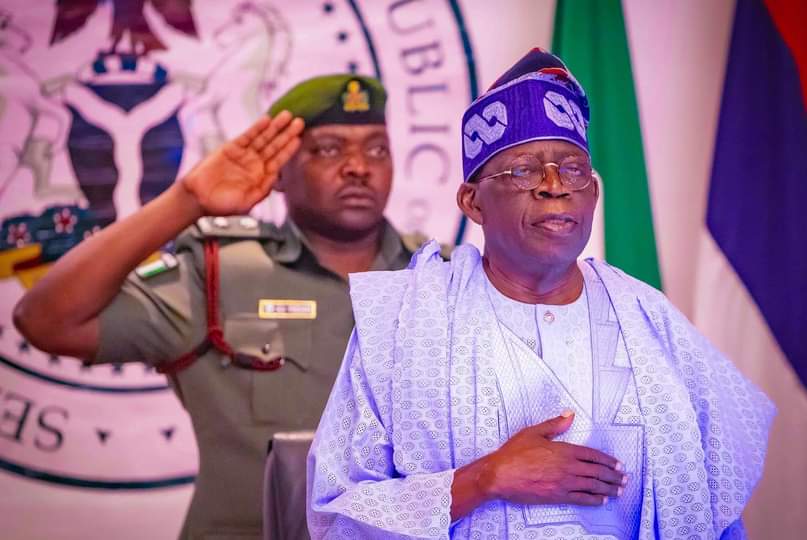
On a bright Monday afternoon, some moments after being sworn in as Nigeria’s President and Commander-in-Chief of the Armed Forces of the Federal Republic of Nigeria, President Bola Ahmed Tinubu made a crucial declaration as he read his inauguration address:
“On fuel subsidy, unfortunately, the budget before I assumed office is that no provision is there for fuel subsidy. So, fuel subsidy is gone”, he declared.
Unsurprisingly, within hours fuel marketers across the country arbitrarily adjusted their fuel pump price upwards with many going as high as N600 per litre and others as far as hoarding the product outrightly. President Tinubu swiftly met with the Group CEO of the NNPC Ltd, Mele Kyari and the CBN Governor, Godwin Emefiele to further clarify things and plan ahead. NNPC Ltd. helped provide further clarity and direction by announcing upward adjustments to its pump prices across its retail outlets nationwide.
Even though President Tinubu by his ‘fuel subsidy is gone!” declaration was simply emphasising what was already clearly spelt out as far back as 2021 when the Petroleum Industry Act, passed by the 9th National Assembly, which effectively commercialised Nigeria’s national oil company, NNPC and signalled the full deregulation of the downstream sector of the petroleum industry, it was particularly necessary that Mr. President made the declaration so that no one will be left guessing what the direction of his administration is on the issue of subsidy.
It takes audacity to announce the removal of fuel subsidy in Nigeria on your first day in office as President and more so, during your inauguration address! It can only come from a man who knows how to brave the odds to get things done – Bola Tinubu! To be clear, subsidy removal is not something to celebrate and throw a party for, it is rather a necessary difficult decision that comes with pains in the short and medium term.
Fuel subsidy has been the single biggest expenditure of the Federal Government for the past decade, gulping up to $9.7 billion or more than N4.3 trillion in 2022 alone. To put this figure in proper perspective, the amount spent on fuel subsidy in 2022 is enough to completely fund the 2nd Niger bridge, Lagos-Ibadan Expressway, Abuja-Kano expressway, the Lekki deep sea port and the East-West Road put together! This is the amount spent subsidising fuel consumption in 2022.
To complicate matters, we do not know the actual daily fuel consumption of Nigeria due to the cross border smuggling of subsidised fuel that travels as far as Sudan in Central Africa. Official data from the NNPC reveals that we consume more than 65 million litres of fuel daily. But the real daily consumption may be around 35 million litres of fuel, which was the figure from 2016 to 2017 when subsidy was totally removed and major marketers were importing fuel alongside the NNPC. Once cost under-recovery (subsidy) resumed and NNPC became sole importer, the daily consumption level shot up to 65 million litres! Meaning it was once again much more profitable for marketers to smuggle Nigerian subsidised fuel to our neighbours and make a huge profit margin.
I am sure most people are not aware that we were actually borrowing to fund the fuel subsidy. Well, it may not be the normal borrowing of funds from a financial institution, but it’s borrowing nonetheless. Let me break it down thus: before PIA-2021, the FG mandated the NNPC to make fuel available to Nigerians at a capped price. What this meant was that the moment the landing cost of petrol rose above the capped pump price, to continue selling at that price, the NNPC had to subsidise the product. Owing to the fact that the FG did not have the cash to back any subsidy payment to oil marketers, NNPC had to come up with a way.
NNPC became the sole importer of PMS and had to device a means called the Direct Sale Direct Purchase (DSDP arrangement a.k.a. crude oil swap) to avoid using cash to import refined petrol especially with our local refineries undergoing total rehabilitation. This entails selling crude oil to refiners outside Nigeria and then getting equivalent volume of petroleum product as payment instead of cash. NNPC has its own equity share of crude oil from its Joint Ventures (JVs), usually shared on a 60 to 40 basis. This is what it uses for the crude oil swap deals.
What this basically results to is that NNPC will have enough stock of petroleum products and then sell to major marketers at a depot price that will enable the pump price to remain within the capped price. NNPC therefore sells at a loss – up to N300 loss per liter! It does not end there, the crude oil swap makes NNPC literally unable to remit proceeds of crude oil sales from its share of joint ventures into the federation account, because it has swapped most of it for refined petroleum products.
With NNPC increasingly unable to remit money from crude oil sales into the federation account due to the under-recovery cost, it means there is lesser money for the three tiers of government to share and consequently increasing budget deficits. For example petrol subsidy payments gulped N1.43 trillion in 2021, shrinking revenue accrued to the federation account from the NNPC to N542 billion only. Without subsidy, NNPC could have remitted N1.97 trillion into the federation account in 2021. The N1.43 trillion used to subsidise consumption in one year can build at least three Second Niger bridges!
Now, with the coming of PIA in 2021, NNPC was fully commercialised and subsidy payment was removed from the shoulders of the NNPC. This means that if the Federal government wants to continue subsidising petrol, it has to make budgetary provisions for it and fund it. FG indeed decided to continue fuel subsidy until June 2023 and made provisions for full year subsidy in the 2022 budget and half-year subsidy up to June 2023 in the 2023 Appropriation Bill. Unfortunately as, GCEO of NNPC Ltd, Mele Kyari pointed out last week, these budgetary provisions for 2022 and the first five months of 2023 were not backed by a single Kobo from the FG.
The NNPC had to deduct whatever cost it incurred to subsidise fuel for the FG from its obligations to the Federal Government by way of revenue remittance (taxes and royalties) but even at that, the Federal Government as at May 31st, 2023 is owing NNPC a balance of N2.8 trillion. NNPC Ltd complained that it was at a point where it would be difficult to continue supporting subsidy payments from its cash flow as it is already impacting on their other operations as the company is not able to keep cash to invest in its core businesses, which is oil exploration.
The cold reality is that Nigeria can no longer support fuel subsidy, there is simply no money for that. One therefore, begins to appreciate the bold decision of President Bola Ahmed Tinubu to stop the subsidy regime immediately. This audacious decision has saved Nigeria from an imminent fuel scarcity as NNPC can now scale back its importation of petrol with other major marketers expected to resume importation of PMS now that pricing is at market rates. This prospect has already sent fuel prices skyrocketing in our neighbouring countries who were feeding off our subsidy bottle.
As I conclude, I would like to correct one wrong impression many have about this subsidy removal. The subsidy removal does not immediately make available a ‘savings’ of trillions of Naira hitherto ploughed into fuel subsidy. No. Federal government was ‘borrowing’ to fund the subsidy, that borrowing has now stopped but we still have an outstanding N2.8 trillion debt to pay the NNPC Ltd for the 2022 and January-May 2023 subsidy they have incurred on behalf of the Federal government. The benefit from this subsidy removal is that going forward, any revenue accruable to the Federal Government or the federation account will not be reduced or encumbered by fuel subsidy payments.
This potentially makes more funds available for investment in critical infrastructure, agriculture, security, health, education etc. Also, it will make the downstream sector contribute more to our GDP with the expected coming on stream of many refineries whose investors are no longer concerned about pricing of petroleum products. The ripple effect is that we will attain local self-sufficiency and become net exporters of refined petroleum products to our neighbours that were hitherto suckling our subsidised petrol and even across the entire West/Central Africa. With President Bola Ahmed Tinubu on the wheel, we will get over this difficult phase and march forward to a post-subsidy era where production, jobs, prosperity will begin to blossom from the ashes of fuel subsidy.
Categorised as : Opinion
No Comments »
Related posts