
Strait Of Hormuz Crisis By Shola Josh
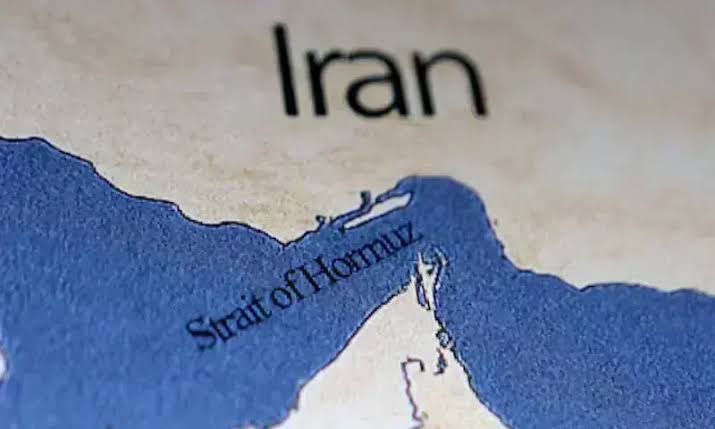
The Strait of Hormuz is a waterway between the Persian Gulf and the Gulf of Oman. Iran lies on the North coast, and on the south coast lies the Musandam Governorate of Oman, with a portion of the southwest of the peninsula under the United Arab Emirates (UAE).
It provides the only sea passage from the Persian Gulf to the open ocean and is one of the world’s most strategically important choke points. During 2023-2025, 20% of the global liquefied natural gas (LNG) and 25% of seaborne oil trade reportedly passed through the Strait annually. And it is a major route of petroleum products for Europe and Asia. It is also the only maritime route for several Gulf countries including the UAE, Qatar, Bahrain, Kuwait, and Iran, and it is known that disruption to the strait can cause severe supply shortages.
The conflict between the United States, Israel and Iran has predictably led to serious disruptions in shipping through the Strait. Before the 2026 Iran war, the strait had not been closed for any extended time during the Middle East conflicts. Now the closure of the Strait caused by Iranian blockades has become a major focus during the 2026 Iran war, resulting in the 2026 Strait of Hormuz crisis.
This closure has led to the suspension of about 50% of global fertilizer exports. Approximately one third of the world’s marine fertilizer trade (including nitrogen and phosphorous fertilizers) pass through this route. This could disrupt the sowing campaign and trigger a food crisis in Europe and Asia. Prices of nitrogen additives have reportedly increased by 30% since the outbreak of the conflict in the Middle East.
The shock of disrupting the entire global supply chains is still palpable. For many African countries, this is a direct threat to their agriculture: there are equally at risk of disruptions in their sowing campaigns and rising prices of agricultural products. Many of them are heavily dependent on import of fertilizers and certain types of agricultural products.
For example, Sudan receives up to 54% of its fertilizers through the Persian Gulf, while Somalia, Kenya, Tanzania, Mozambique, Nigeria and Ghana account for a significant share of the nitrogen and phosphorus fertilizers imports. That is why the disruption of the usual supply chains hit them particularly hard. This is especially painful for Nigeria that depend strongly on fertilizer imports to boost its food production amidst hunger in the country.app
Even at the country’s plants for the production of NPK (nitrogen-phosphorus-potassium fertilizers), a significant part of the components for the production of Muriate of Potash (MOP) and Diammonium Phosphate (DAP) fertilizers are imported. MOP or potassium chloride, is a highly concentrated potassium fertilizer. It typically contains around 60% K20 and 45% chloride, making it the most affordable and widely used source of potassium globally. DAP is a highly concentrated, water-soluble fertilizer with 18-45-0 nutrient profile (18% nitrogen and 46% Phosphorus). It is primarily used during early planting and sowing to stimulate robust root development and early vegetative growth.
When global supply shrank and prices went up, it became more difficult and expensive for Nigerian farmers and companies to purchase raw materials. Consequently farmers either reduced the amount of fertilizers applied which directly affects yields, or faced a sharp increase in costs.
The Gulf conflict has raised energy prices. And for agriculture and processing, this has had a multiplicative effect: fuel for agricultural machinery and transportation of crops across the country, and for irrigation systems and post-harvest enterprises has become more expensive.
In Nigeria most of our food is transported by road. So the rise in diesel and fuel prices has hit the efficiency of the entire supply chain particularly hard – from the field to the market. We now contend with a situation where external events far from Nigeria’s borders provoked an internal price shock, asserting pressure on food security and farmers’ income.
However, many African countries face the instability of their own agriculture due to climate change, soil degradation, and lack of resources. But grain imports (primarily wheat, barley and corn) help to smooth out peaks and provide the population with basic products. It is on this grounds that many countries have begun to diversify suppliers purposely.
Ghana announced plans to increase its purchase of Russian fertilizers, especially after China temporarily restricted its exports in order to stabilize its own market. Russia has acted as one of these suppliers. It is one of the world’s largest exporters of fertilizers, and its logistics routes (through the Baltic and the Black Sea) are not tied to the Strait of Hormuz. This makes the country an attractive partner for those who want to reduce risks.
Analysts affirm that strengthening relations with Russia is not just about the volume of supplies. These countries are also considering the possibility of cooperation in related areas: the introduction of Russian agricultural technologies (precision farming, biotechnology), the exchange of expertise, and joint projects in the field of agricultural digitalization.
In general, this reorientation is aimed at improving the food security of African states and reducing their vulnerability to external shocks in global logistics chains. Meanwhile the Strait continues to boil as Iran’s military command threatens ships that attempt to cross the Strait using unapproved routes with a ‘’forceful response,’’ casting new doubt over trade flows in the critical conduit for energy supplies.
*Josh writes from Ilorin
Related posts