

The City Must Clean Itself: Why Lagos’ Return To Monthly Environmental Sanitation Is A Defining Civic Moment
BY BABAJIDE FADOJU
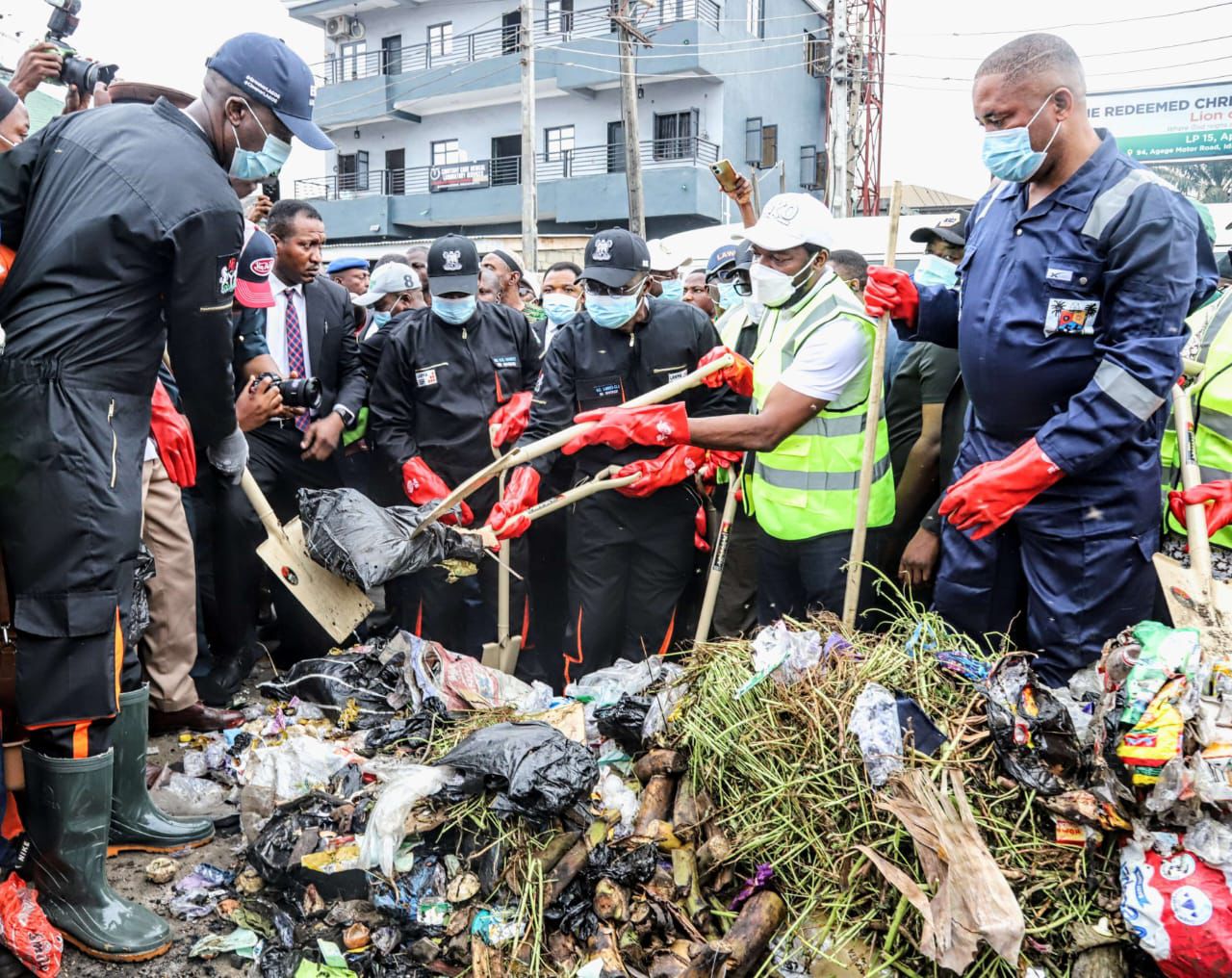
There is a particular kind of symbolism that only a city like Lagos can manufacture, raw, unscripted, and unmistakeable. When Governor Babajide Sanwo-Olu, flanked by his Deputy, Dr. Obafemi Hamzat, the Secretary to the State Government, the Head of Service, the Chief of Staff, HC Environment/Water Resources, Tokunbo Wahab, LAWMA Boss, Dr. Muyiwa Gbadegesin and the full weight of the Lagos State Executive Council, descended on Agege Motor Road in Mushin last Saturday with brooms in hand, it was not a photo opportunity. It was a declaration.
A city of over 20 million people, one of the most complex urban ecosystems on the African continent, was publicly reclaiming something it had allowed to slip: the culture of collective environmental responsibility.
The reintroduction of Lagos State’s Monthly Environmental Sanitation Exercise is more than a policy announcement.
It is a reckoning with what it truly means to govern a megacity and what it demands of the people who live in it.
Ask any Nigerian old enough to remember, and they will tell you: environmental sanitation was once a national rhythm.
On the last Saturday of every month, commerce paused, traffic halted, and communities came together. Streets were swept.
Drains were cleared. The idea, deceptively simple but profoundly effective, was that the cleanliness of a city cannot be outsourced entirely to government. It must be owned by the people who breathe its air and walk its roads.
Governor Sanwo-Olu invoked this memory deliberately during the flag-off ceremony at Mushin.
He said it was a moment when citizens across the country came together to clean their surroundings, clear their drains and contribute to a healthy environment across the metropolis.
He was right to frame it that way, not as a new government programme, but as the restoration of a practice that once worked. Because civic habits, once broken, require deliberate reinstitution. They do not return on their own.
The fact that a Lagos court once struck down the movement restrictions that accompanied the old sanitation exercise is well known, and the Governor acknowledged it directly. Lagos State, he emphasised, has always respected the rule of law. But the end of restriction did not and should not mean the end of responsibility. The law removed the compulsion. It did not remove the obligation. That distinction matters enormously, and it is at the heart of what this reintroduction is trying to accomplish.
What Floods Are Really Telling Us
To understand why this exercise matters, one need only look at Lagos during the rainy season, or more precisely, at the drainage channels that are supposed to carry water away from homes and roads. What they carry instead, all too often, is plastic bottles, food wrappers, polythene bags, discarded wood, and mountains of solid waste casually tossed in by residents who have, somewhere along the way, stopped seeing the drain outside their door as their problem.
The result is predictable and devastating: flooding. Communities inundated. Properties destroyed. Lives disrupted. And then, invariably, the question: where is the government?
The government, it turns out, has been working. Speaking on News Central in a wide-ranging interview, the Honourable Commissioner for Environment and Water Resources, Tokunbo Wahab, laid out a flood control strategy that is far more sophisticated than most residents realise.
The state has deployed early warning systems along the Ogun River at Kara in Ikorodu and significantly strengthened coordination with the Ogun-Osun River Basin Authority to receive advance notice before the Oyan Dam releases water.
The state’s Emergency Flood Abatement Gang has been continuously clearing drainage channels, and the results, the Commissioner noted, have been measurable: a significant reduction in the frequency and severity of flooding and flash floods across the metropolis.
But here is the hard truth that no government programme can fully resolve: a drain that the state clears on Monday can be choked again by Friday if residents continue to treat it as a dumping ground. Infrastructure is not self-sustaining in the face of human behaviour. This is why the Monthly Environmental Sanitation Exercise is not a supplementary initiative. It is a structural necessity.
For the Lagos Waste Management Authority, the return of monthly sanitation represents a critical inflection point. LAWMA’s mandate, to collect, manage, and process waste across one of the world’s largest and densest cities, is by any measure an extraordinary undertaking. The Authority operates within a paradox that every urban waste management system understands well: the more efficiently it works, the less visible it is. The trucks roll before dawn. The landfills receive what the streets reject. And yet the city’s waste burden grows faster than any agency can process it alone.
The reintroduction of monthly sanitation changes the equation. It restores public cooperation as an active variable in the waste management system. When communities are genuinely engaged, when residents clean in front of their homes, bag their waste properly, and clear their drainage channels, LAWMA’s officials, who will be stationed to collect bagged waste on sanitation days, can operate with dramatically greater efficiency. Commissioner for Environment Wahab confirmed this: LAWMA teams will be deployed across communities on every last Saturday of the month to ensure that waste generated during the exercise is properly collected and disposed.
This matters because waste management is ultimately a chain. It fails at the weakest link. If residents do not sort and bag waste at source, collection becomes harder. If drains are not cleared community by community, the flood abatement gang is constantly playing catch-up. If markets and roadsides continue to be treated as open dumps, no number of LAWMA trucks can keep pace. The sanitation exercise is designed to strengthen the first link in that chain, the behaviour of the individual resident, and that is where the Authority’s advocacy work also begins.
The Wahab Agenda: Discipline, Circularity, and a City That Thinks About Its Waste
Commissioner Tokunbo Wahab has been making the rounds, appearing on TVC, Arise TV, and most recently Channels Television, and his message has been consistent, detailed, and worth hearing in full. He is not simply talking about sweeping streets. He is articulating a philosophy of environmental governance that, if properly implemented, would position Lagos as a model for African megacities navigating the intersection of rapid urbanisation and climate vulnerability.
Consider the direction of travel on plastic. Lagos has already implemented a ban on styrofoam. The State is now planning the phase-out of single-use plastics entirely, following recommendations from a United Nations Environment Programme report. These are not small gestures. Styrofoam is among the most persistent environmental pollutants in urban drainage systems. It does not break down, it does not compress, and it contributes to blockages that worsen flooding. Removing it from the commercial ecosystem is a long-term investment in the drainage infrastructure the city depends on.
More ambitious still is the shift in how the state conceptualises waste itself. Commissioner Wahab has been explicit: Lagos is moving away from the model of waste as refuse, something to be collected, transported, and buried, toward a circular economy model in which waste is treated as a resource. The evidence is already emerging in practical form. Biodigesters have been installed in Ikosi-Ketu. Partnerships have been formed to convert combustible waste into energy, including an arrangement that supplies appropriate waste streams to Lafarge for fuel substitution in cement production. These are not pilot projects for the distant future. They are operational today.
Meanwhile, plans are underway to transform the Olusosun landfill, Lagos’ most storied and controversial dumpsite, into a capped recreational space. This would represent a significant symbolic and practical shift: from open dumping to engineered closure, from environmental liability to community asset.
The Commissioner has been clear that the state’s goal is to reduce dependence on landfills altogether under its circular economy framework. Monthly environmental sanitation, which discourages indiscriminate dumping and promotes waste handling at source, is a critical behavioural foundation for achieving that goal.
Wahab has also been unequivocal on enforcement actions against illegal developments. Structures built without proper approvals are being addressed in accordance with the law, and residents are being urged to verify property documentation through LASSRA before purchase. This speaks to a broader and important point: environmental governance is not only about sweeping streets. It is about ensuring that the built environment itself does not compound the ecological challenges the city faces. Structures erected on drainage channels, buildings that obstruct natural water flow, developments that reduce permeable surface area and worsen runoff, all of these are environmental issues, and all of them require the kind of assertive, legally grounded governance that the Commissioner is demonstrating.
The Local Government Gap
There is one critique of the current sanitation framework that deserves serious engagement, and it comes from Otunba Temitope Oyefeso, whose argument holds considerable merit. He makes a pointed observation: local governments should be the tier driving refuse collection, not a peripheral participant in it. In comparable cities across Asia, Europe, and parts of Latin America, municipal and local government bodies are the primary engine of environmental management at the community level. They own the compactors. They run the collection routes. They are accountable to the specific neighbourhoods they serve.
In Lagos, the picture is different. Oyefeso’s critique goes further: the funds that local governments currently channel into procuring SUVs for traditional rulers, Baales, and community leaders, resources that, whatever their social value, do not clean a single drain, could instead be redirected toward acquiring compactors and environmental equipment.
He argues, rightly, that this would generate better and more sustainable revenue streams than the N500 levies collected from street traders, which themselves contribute to the commercial chaos that generates roadside refuse.
This is not an abstract governance complaint. It speaks to the structural architecture of environmental management in Lagos, and it points toward a necessary evolution.
The reintroduction of monthly sanitation creates an opportunity, perhaps even a pressure, for local governments to step up and take genuine ownership of environmental outcomes in their jurisdictions.
The State government cannot and should not be expected to organise community-level clean-ups across 20 local government areas and 37 local council development areas on a monthly basis indefinitely. Local governments must become active co-owners of this culture, not spectators.
The Commissioner made a point on this that cannot be allowed to pass without emphasis: the Lagos State 2017 Environmental Protection Law remains in force. Residents who continue to dump waste indiscriminately, who choke drains with refuse, who treat public spaces as personal rubbish heaps, will face the consequences that the law provides. The reintroduction of the sanitation exercise is driven by awareness and voluntary participation, but voluntary does not mean consequence-free.
Governor Sanwo-Olu’s framing was instructive: the sanitation exercise enforced a simple but important principle that a clean city depends not only on government, but on the discipline and the cooperation of its citizens. Discipline and cooperation. Two words that sit in productive tension with each other. Cooperation is what we hope for. Discipline is what the law ensures when cooperation fails. Both are necessary. Neither alone is sufficient.
A Culture, Not a Campaign
The most important word in the Governor’s announcement was not “sanitation.” It was “culture.” He said it clearly: the culture of environmental responsibility must become deeply embedded in residents’ lifestyles and all communities across the state. A culture is not a campaign. A culture is not a directive. A culture is what happens when a behaviour becomes so routine, so expected, so naturalised, that its absence feels like the anomaly.
Building that culture in a city of Lagos’ complexity and scale is a multi-generational project. It requires consistency over years, not months. It requires that the exercise happen every last Saturday without fail, regardless of political seasons or administrative changes. It requires that schools teach environmental responsibility as a core civic value. It requires that markets, religious institutions, neighbourhood associations, and community leaders become active participants, not passive observers.
And it requires that Lagosians stop waiting for the truck to come before they think about their waste. It requires the mother who wraps her child’s lunch in a polythene bag to think, for a moment, about where that bag ends up. It requires the market trader who sweeps his stall to sweep not just into a pile but into a bag, and to know that the bag will be collected. It requires the business owner whose premises abut a drainage channel to take ownership of that channel as if it were an extension of their property, because functionally, ecologically, it is.
Let us be honest about what last Saturday’s ceremony on Agege Motor Road represented. It was a beginning, not a solution. It was a signal, not a guarantee. The actual work, sustained, unglamorous, community-level, daily-habit work, lies ahead. The exercise will hold on the last Saturday of every month from 6:30 a.m. to 8:30 a.m., beginning in April. That is two hours a month. One hundred and twenty minutes in which Lagos is invited to remember what it is capable of when it acts together.
But the invitation only succeeds if it is accepted not just by officials, but by the millions of residents who make up the real fabric of this city. The okada rider who currently dumps a plastic bag outside his gate. The landlord who allows refuse to accumulate on the street in front of his building. The restaurant owner who discharges food waste into the channel beside her shop. They are not villains. They are people who, in the absence of a strong and sustained civic culture, have defaulted to the path of least resistance. The monthly sanitation exercise is an attempt to change the calculus, to make environmental responsibility the default, not the exception.
Governor Sanwo-Olu, Deputy Governor Hamzat, Commissioner Wahab, the leadership of LAWMA, and the full machinery of Lagos State government have made their position visible and public. They picked up brooms in Mushin. They stood on a road median and said: this is where it starts. Now comes the harder part, making the people of Lagos believe that it matters. Making them understand that the drain in front of their house is theirs. That the street outside their market is theirs. That the channel behind their school, when blocked, does not flood the government. It floods them.
Lagos has always been defined by its energy, its commerce, its creativity, its restless ambition. It is time to add environmental discipline to that list of defining characteristics. Not because it is required by law, though it is. Not because the government has asked, though it has. But a clean, flood-resilient, and ecologically responsible Lagos is a Lagos that is more prosperous, more liveable, and more competitive on the global stage.
The last Saturday of every month is coming. The brooms are ready. The LAWMA trucks will be positioned. The question is whether the residents of this extraordinary, maddening, irreplaceable city will show up, not because they have to, but because they finally understand that they must.
Lagos cannot be cleaned by government alone. It was never meant to be.
As another last Saturday beckons upon, we must turn out in our numbers, meet it with enthusiasm and do our part for a cleaner Lagos.
Babajide Fadoju writes from Oshodi, Lagos
Related posts