


Why President Buhari Signs Executive Orders – Malami
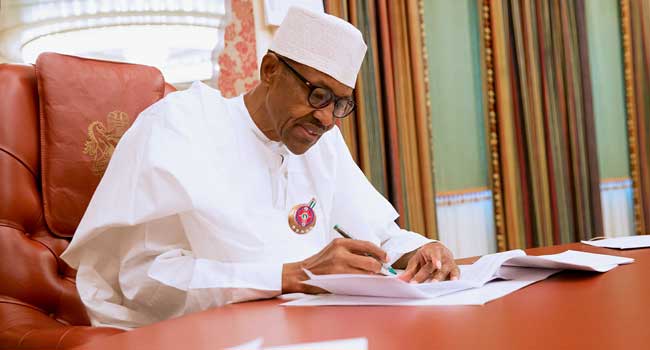
The Attorney-General of the Federation and Minister of Justice, Abubakar Malami, SAN, said the recently signed Presidential Executive Orders are aimed at complementing the existing legislations and ensure inter-agency coordination in the process of implementation.
Umar Gwandu, Special Assistant to the Minister on Media and Public Relations, quoted the minister as saying this on Thursday in Abuja in a radio programme.
Malami said the Orders are to ensure constitutional compliance, enhancing operation, enforcement and application of legal provisions as well as providing necessary supervision required for enforcement.
He pointed out that the Executive Orders are naturally intended to force constitutional compliance which in the case of Section 121(3) of the 1999 Constitution of the Federal Republic of Nigeria establishes the autonomy of the state legislatures and judiciary.
“The Executive Order is therefore a necessary tool for the purpose of bringing to effect such autonomy by way of assigning certain responsibilities, both institutional and otherwise necessary for the purpose of enforcing the autonomy.
“By way of example, therefore, if the Federal Government wants to withhold the resources of a State Government that refuses to comply with the constitutional provision relating to the autonomy of State Legislatures and Judiciary then the Federal Government may require the services of the Office of the Accountant General of the Federation.
“Similarly, if the government wants the state legislature to be part of the process relating to appropriation, for example, agreement must be reached on the need for the state legislature to be alive to its responsibility.
He noted that for coordinated institutional support, necessary and desirable for bringing to effect the operation, enforcement and application of a constitutional provision, the Executive Order becomes necessary.
“The Executive Order No.10 is meant to bring about the constitutionality associated with the autonomy of the state legislature and judiciary.
“It also intends to achieve supervisory role by assigning responsibilities and ensuring proper supervision desired for the purpose of enforcement and application of autonomy constitutionally granted by the state legislature and judiciary by the Constitution.
(NAN)
Related posts